

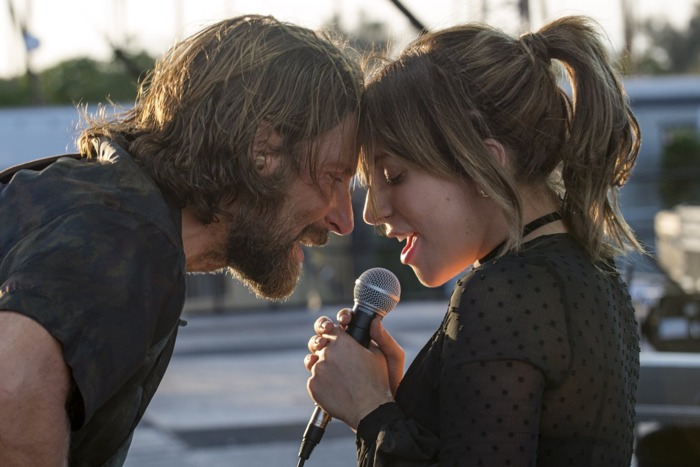
If you remember any scene from the trailer for Bradley Cooper's new A Star Is Born remake, it is almost certainly the one in which Cooper's character, declining roots-rock god Jackson Maine, calls from a car window to Lady Gaga's aspiring singer, identified only as Ally. It's a scene that's appeared in all four(!) versions of A Star Is Born: the 1937 silent film, the 1954 Judy Garland vehicle, the 1976 Streisand-Kristofferson joint, and Cooper's new bid for auteurist Oscar cred. "Hey!" Jack cries out. When Ally turns around, puzzled, the rocker smiles and says, "I just wanted to take another look at you." Cue Gaga face:

I saw A Star Is Born at a critics' screening Monday night. I thought it lived up to the hype -- corny and predictable, sure, but executed with a grace and beauty far beyond what I expected from Cooper's directorial debut. I was engrossed throughout, not least of all by the music. In the context of the film, the songs worked extremely well in their double role as convincing popular singles and vehicles to move the story along. But did they stand up on their own as pop tunes outside the theater? The next day, I eagerly dug into the soundtrack to find out.
What is the point of a movie soundtrack? It depends on the movie. In a Broadway-style musical like The Greatest Showman, the songs are part of the story, modernized showtunes designed to mark key moments in the narrative. The soundtrack for the superhero blockbuster Black Panther functioned quite differently, more like a stylish accessory reflecting the movie's themes. Perhaps the best way to understand it was as a killer Kendrick Lamar mixtape with a whole festival poster's worth of guests.
Both of those soundtracks were massive hits this year, remaining at #1 on the Billboard 200 for multiple weeks and lingering in the top 10 far longer. A Star Is Born will surely be a huge success in its own right. The movie is riding a tidal wave of hype, with Oscar buzz for both Cooper and Gaga. Its companion album is 34 tracks long, about half of them spoken interludes comprising dialogue from the film. Even if those interstitial skits don't count toward Spotify or Billboard's calculations, the tracklist is built for gargantuan streaming totals.
Conceptually, A Star Is Born's soundtrack splits the difference between the narrative-advancing The Greatest Showman model and Black Panther's thematically linked mood board approach. The songs loosely tell a story, but mainly they are supposed to be hit singles by Jackson Maine and Ally. Like Whitney Houston's The Bodyguard soundtrack, the project doubles as a new Lady Gaga album of sorts -- or at least it contains the substance of a new Gaga album within its multifarious sprawl -- and every one of those since 2011's Born This Way has debuted at #1. Plus, its appeal could extend far beyond Gaga's army of Little Monsters considering the range of genres covered within the movie.
Up front, we get a lot of Jackson Maine songs, mostly Southern rock guitar jams Cooper crafted with assistance from an actual Southern rocker, Lukas Nelson, son of Willie. In recent years Nelson's band Promise Of The Real hastoured and recorded with Neil Young, so they're well prepared for the role of Jack's backing band in A Star Is Born, accustomed to the art of collaboration with a larger-than-life character. The songs Nelson wrote with Cooper -- "Black Eyes," "Out Of Time," "Alibi" -- are stomping riff-rockers rife with twangy, electrified soloing. They effectively sell Jackson Maine as Eric Church crossed with Derek Trucks. Speaking of trucks, these tracks wouldn't sound out of place hawking F-150s in a Ford commercial.
Cooper and Nelson also teamed up on "Too Far Gone," a slow-rolling country tune that appears late in the movie as part of Jack's redemption narrative: "Please don't tell me I'm too far gone/ I can't go on if I ain't livin' in your arms." But the best of the Jackson Maine solo songs is the one penned by alt-country hero Jason Isbell, a folksy acoustic ballad called "Maybe It's Time." You may have heard part of it in the A Star Is Born trailer; it's the one with the acoustic arpeggios where Cooper sings, "Maybe it's time to let the old ways die." If the rest of the Jack material is strictly serviceable, this one beams with personality and point of view. In its quietness, it comes through loud and clear.
Gaga's material is tougher to wrap your head around. In practice, her songs as Ally are fairly straightforward genre exercises tracing the character's path from Jack's country-rock backing band to an A-list pop stardom that exists in parallel to Gaga's own life. But that's the thing: Are we to understand these primarily as Lady Gaga songs or Ally songs? Sometimes there's no substantive difference, as when she belts out "La Vie En Rose" in theatrical cabaret style or teams with Lukas Nelson on "I Don't Know What Love Is," an operatic number fit for an old Italian crooner, which would have made sense on her collaborative album with Tony Bennett. Other times, it's hard to tell if a track is intended primarily as pop or a comment on pop.
Consider the song co-written by veteran hit-maker Diane Warren, "Why Did You Do That?" It's a paint-by-numbers pop tune with slinky xylophone and violin parts, big bass drops, and an incessant chorus melody that practically stabs you in the eardrums. In the movie, Jack writes it off as vapid sellout garbage, scoffing at lyrics like "Why do you look so good in those jeans? Why you come around me with an ass like that?" Ally defends her work, but elsewhere in the movie she balks at backup dancers and other trappings of prepackaged pop stardom. And A Star Is Born takes pains to broadcast Jack's belief that the path to a long and meaningful career involves giving your audience "the truth," having "something to say." So is "Why Did You Do That?" supposed to be "bad," representing Ally's turn away from authentic expression in pursuit of cheap fame? Or is it a "good" song designed to offend a rockist's sensibilities?
https://twitter.com/gagasyuyi/status/1047167729579581440?ref_src=twsrc%5Etfw