
October 1, 1988
- STAYED AT #1:3 Weeks
In The Alternative Number Ones, I'm reviewing every single #1 single in the history of the Billboard Modern Rock Tracks/Alternative Songs, starting with the moment that the chart launched in 1988. This column is a companion piece to The Number Ones, and it's for subscribers only. Thank you to everyone who's helping to keep Stereogum afloat.
Richard Butler, longtime leader of the Psychedelic Furs, has always come off both conflicted by and slightly embarrassed of his own rock stardom. I get it. Rock stardom is a fundamentally embarrassing thing, both for artist and for fan. If you're a deep-niche rock star -- the type who rules alternative radio but who rarely makes much of a dent on the wider consciousness -- then it's probably doubly embarrassing.
All through their prime, the Psychedelic Furs seemed to be in a push-pull relationship with anything resembling mainstream fame. They worked with big-deal producers, and they went for bold pop-radio sounds, but then they would retract, and they would make a display of their retraction. To this day, the band might be most famous for recording "Pretty In Pink," the song that gave the John Hughes classic its name. The Psychedelic Furs re-recorded that song for the Pretty In Pink soundtrack, and they got a minor hit out of it, but they never got tired of saying how the movie had nothing to do with the song and how John Hughes' whole vision went against the darkness of the song itself. It definitely never occurred to these guys that Hughes made a sick-ass movie, that they were lucky to be associated with it.
But what else was Richard Butler going to do? Niche rock stardom was, and is, his lot in life. When you're born with icepick-sharp cheekbones and an amazing facsimile of David Bowie's bitchy-scratchy baritone, you really can't sell insurance or manage a tractor-parts retailer. You're doomed to a life crafting modern-rock-radio bangers and telling everyone who will listen that you like Bob Dylan better than David Bowie. That's your only viable career path. That's what money wants.
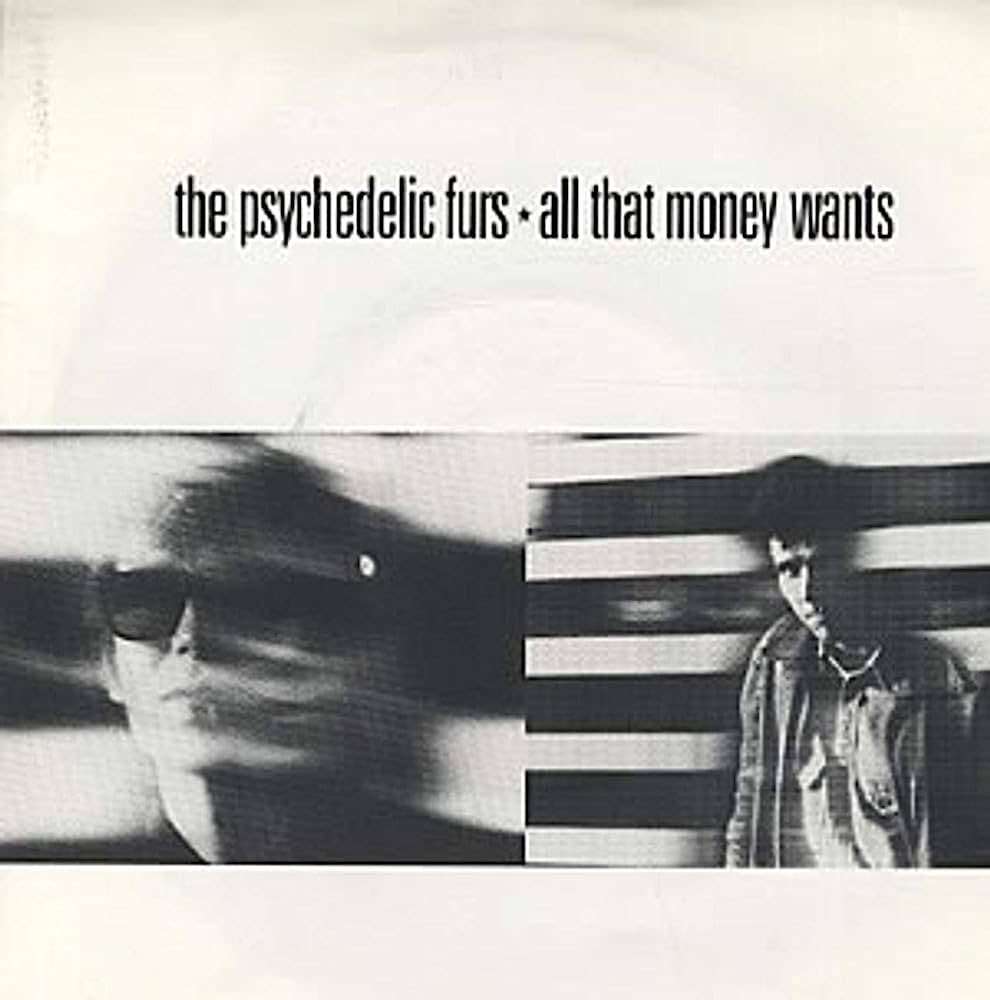
In 1988, the Psychedelic Furs had been around for the better part of a decade, and they were thinking about hanging it up. The Furs were five albums deep into their run. They'd made a handful of modest hits -- songs that might edge into the pop top 40 on either side of the Atlantic but that didn't have enough juice to go top-10. They were in an uncomfortable place, perception-wise. They'd made just enough commercial moves that critics didn't take them tremendously seriously, but they hadn't made enough commercial moves -- or perhaps hadn't made those moves at the right times, with the right enthusiasm -- to become actual crossover arena-rock stars. They'd lost about half their lineup, and they'd racked up just enough singles to warrant a greatest-hits album. "All That Money Wants" was the bonus track on that greatest-hits album, and it could've made for a hell of a farewell.
Confession time: I've never really been a Psychedelic Furs guy. Maybe they missed me. Maybe they broke up right around the time that I was becoming a dedicated alt-rock radio listener. I think they were a band for people just slightly older than me; one TA that I had in college talked about them all the time. But I could say all the same things about Echo & The Bunnymen, the Furs' peers in sonorous and archly melodramatic Doors-derived Brit-rock, and I love the fucking Bunnymen. (Echo & The Bunnymen's highest-charting Modern Rock chart hit, 1997's "Nothing Lasts Forever," peaked at #8. It's an 8. Ian McCulloch will eventually appear in this column.) Maybe the Psychedelic Furs were too icy, too remote, too unwilling to take ownership of their own rock stardom.
But when I sat down to research this column, taking in the whole of the Psychedelic Furs' history and all of that band's kinda-sorta hits, I have to concede that they have bangers, and that their catalog of bangers goes a whole lot deeper than "Love My Way" and "Pretty In Pink." One of those bangers is "All That Money Wants," the one-off single that they recorded for their first greatest-hits album. As near as I can tell, "All That Money Wants" is a disillusioned banger, a banger about the struggle of being forced to make bangers over and over until you can't stand it anymore. It still bangs.
Like every band that's appeared in this column since the dang thing started a couple of weeks ago, the Psychedelic Furs were a product of the UK's initial 1977 punk explosion. Richard Butler and his brother Tim grew up in Surrey, just outside London, and they started the Furs in 1977, when Tim was still a teenager and Richard was maybe 21. The Butlers rounded up a few friends and practiced in their living room until their mother made them stop. They went through a few different band names before settling on the Psychedelic Furs. The "Psychedelic" part was in there because the Furs' punk peers all actively disdained the way-out music of the '60s. The Butlers were into it, so their embrace of the word was a knowing zag, a way of out-punking the punks. The "Furs" part comes, naturally, from the Velvet Underground's "Venus In Furs."
It took the Psychedelic Furs a couple of years to land a record deal, but they eventually made their way to Columbia and released their debut single "We Love You" in 1979. The band's self-titled 1980 debut (big-deal producer: Steve Lillywhite) is a grandly clangorous mess, with Richard Butler declaring half-ironic Bowie-isms over his band's guitars-plus-saxophones tangle. That first album didn't sell anything, but it set them up for the critical breakthrough of 1981's Talk Talk Talk (big-deal producer: Steve Lillywhite again).
Talk Talk Talk is a pretty sick album. It manages to be scrappy and majestic at the same time, and its skronkiest moments are often its catchiest. That album had the original version of "Pretty In Pink," which wasn't much of a hit at first -- it only made it to #43 on the UK charts -- but which sounded something like early-'80s Bowie trying to make a Tom Petty song. The LP did respectable chart numbers in both the US and the UK. It also landed at #15 on that year's Village Voice Pazz & Jop Critics' Poll -- three spots up from U2's Boy. The Psychedelic Furs were primed for bigger things.
Before the Furs recorded 1982's Forever Now, they lost a couple of members and moved to the US. Todd Rundgren, that album's big-deal producer, thickened and softened the band's feverish sound, and he presented them as something ready for MTV. Forever Now had "Love My Way," the swoopingly swoony number that became the first Furs song to reach the American Hot 100, where it peaked at #42. It's still their best-loved song, by far. It took almost a decade, but Forever Now eventually went gold. Critics were no longer especially intrigued, but the Psychedelic Furs were now a commercially viable proposition.
The Furs made their next album, 1984's Mirror Moves, with Keith Forsey, who was mostly known for working with Giorgio Moroder and Donna Summer and who'd already become Billy Idol's go-to producer. A year later -- speaking of John Hughes -- Forsey would write and produce the Simple Minds' massive "Don't You (Forget About Me)." (The Simple Minds will eventually appear in this column.) Drummer Vince Ely had just left the Psychedelic Furs, and Forsey essentially stepped in and became their drummer.
You could imagine why the Furs wanted to work with a proven hitmaker. They'd moved to the US, a land that was suddenly in love with British new wave, and Forsey had the touch. Mirror Moves charted better than any previous Furs album -- #43 US, still not that great -- and gave them a second Hot 100 entry when "The Ghost In You" peaked at #59. Good song! It took a full decade, but Mirror Moves eventually went gold. Once again, though, the critics did not fall all over themselves for the Furs. (If the modern rock radio chart had existed in 1984, though, I bet the Furs would've dominated.)
The Psychedelic Furs got another visibility boost with the 1986 release of Pretty In Pink, and their re-recorded version of the title track became their biggest hit at home in the UK, where it peaked at #18. (On the Hot 100, "Pretty In Pink" made it to #41.) A year later, the Furs released Midnight To Midnight, their most nakedly commercial move yet. (Big-deal producer: Latter-day Stones buddy Chris Kimsey.) In the US, Midnight To Midnight made it to #29, which makes it the band's highest-charting LP to date over here. Lead single "Heartbreak Beat" -- really good song -- proved to be the band's biggest American chart hit, peaking at #26 on the Hot 100. But critics, from what I can tell, hated the album, and the synthetic horn-stabs really do sound pretty cheap. The Psychedelic Furs were losing their cool, and for a band like that, cool is vital.
All Of This And Nothing is the name of a song on Talk Talk Talk, but when you use that as the title of your career-spanning compilation, you're giving the whole enterprise an air of finality. The Psychedelic Furs felt that they'd been rushed into the studio to finish Midnight To Midnight and that the album wasn't really any good. By the time their comp came out, the band was down to just three members -- the Butler brothers and saxophonist Mars Williams -- at least until drummer Vince Ely returned to the fold. All Of This And Nothing does the annoying thing where it jumbles up the band's chronology, but it's an otherwise impressive career retrospective that relies as much on the deep cuts as on the quasi-hits. It's also got "All That Money Wants," a legitimate slapper that deserves to be remembered among the Furs' best.
In an awkard-ish 1988 TV interview, Richard Butler described "All That Money Wants" as "a bit of a return to the old sound of the band that we had. It’s more layered. It’s a bit more mysterious, lyrically." A couple of notes here. First: You can't describe your own lyrics as mysterious. That's so goofy. Even if they are mysterious, you can't say that. You need to give the impression that you know what those words mean, even if the rest of the world doesn't. Second: It's really not that mysterious. When an alternative rock band -- especially an alternative rock band with a conflicted relationship to commercial success -- uses a song title like "All That Money Wants," it's a pretty good bet that they think this money is a corrupting influence.
Sure enough, there's no way to read "All That Money Wants" as anything other than a lament about the empty demands of almost-fame: "Painted lies on painted lips that promise heaven tastes like this/ I don't believe that I believed in you/ All that money wants." Richard Butler also sings about a grey city sky coming down like rain to drown in him his sleep, and I don't know what that's about, but I get the basic idea. You do, too. It's not that deep.
But! That shit goes hard! The Psychedelic Furs found another big-deal producer for "All That Money Wants," and this one was a smart choice: Stephen Street, best-known at the time for working on the Smiths' final album Strangeways, Here We Come. You can definitely hear some echoes of the Smiths in "All That Money Wants." The song's sound is thick. Acoustic guitars come buzzing through the background relentlessly, sounding a bit like the ones on "Bigmouth Strikes Again." In the foreground, a big electric-guitar riff twinkles and growls. Strings flit through the mix. Drums crash and boom. There might be some accordion in there, too. The mix is vast and overwhelming. When you hold it up next to the chintzy dance-pop production of Midnight To Midnight, the Psychedelic Furs finally sound psychedelic again.
Richard Butler sounds fully reinvigorated on "All That Money Wants." As a singer, Butler never seemed particularly concerned with little things like hitting notes. Instead, he declaims, and he knows that there's so much presence in his sandpaper purr that he can get away with it. On "All That Money Wants," though, Butler comes off like he's angrily bellowing up at the clouds -- and when you're attempting to wrestle with the effect of capitalism on art, then you might as well be doing exactly that. With Butler howling over the song's wall of gothic folk-rock sound, the Psychedelic Furs suddenly sound like the self-righteous dark-pop avengers that they decided, at some mid-'80s point, not to be. It's the sound of a band setting back the clock and rediscovering its own power.
I'm sure I'd heard "All That Money Wants" before working on this column; the song has that vague memory-string tug to it. But I'm just as sure that I'd never fully appreciated the song. "All That Money Wants" isn't quite a classic. I wish it had more of a chorus than Richard Butler just yelling the title a few times. But he yells that title with emphasis, and he makes me believe whatever he's implying. When I hear that song today, I get some inkling of what the people five or seven years older than me heard in the Psychedelic Furs. I hear the power.
If the Psychedelic Furs had really decided to call it quits after "All That Money Wants," it would've been a hell of a swan song. But that's not what they did. The Furs stuck around, and they kept their status as modern-rock radio giants. We'll see them in this column again.
GRADE: 8/10
BONUS BEATS: "All That Money Wants" is a song without much real cultural footprint; we'll probably see a lot of those in the early years of this column. Once again, then, I've got to look elsewhere in the band's catalog. Since nobody probably wants to watch Armie Hammer dance in 2023, let's go with the first moment that the Psychedelic Furs really imprinted on American culture, which also happens to be the first moment that Nicolas Cage really imprinted on American culture. Here's "Love My Way" soundtracking a romantic moment between Cage and Deborah Foreman in the 1983 classic Valley Girl: