
January 28, 1989
- STAYED AT #1:2 Weeks
In The Alternative Number Ones, I'm reviewing every #1 single in the history of the Billboard Modern Rock Tracks/Alternative Songs, starting with the moment that the chart launched in 1988. This column is a companion piece to The Number Ones, and it's for subscribers only. Thank you to everyone who's helping to keep Stereogum afloat.
At their very first show, R.E.M. covered the Monkees. The gig went down in April 1980 at the deconsecrated Episcopal Church where both Michael Stipe and Peter Buck were living. R.E.M. didn't even have a band name yet, but they already had a genuine love of the hooky nonsense pop anthems of the '60s, the songs that stood at the place where garage rock and bubblegum intersected. (The Monkees song in question was "(I'm Not Your) Steppin' Stone," the same Monkees song that every punk band covered, but the point still stands.)
In their early days in Athens, R.E.M. played a lot of fun, goofy songs; it's one of the reasons that they quickly built up a following. Other Athens bands were apparently pissed that R.E.M. shows were fun, that the band played covers and aimed to make something other than confrontational art-punk. Over the next eight years, R.E.M. quietly became one of the biggest bands in America. Along the way, people stopped thinking of R.E.M. as a good-time band. Instead, they were the kings of jangly and punk-informed folk-rock, the enigmas who communicated depth through elusive lyrics and fragmented imagery. But R.E.M. never lost their love of dizzy, silly bubblegum. Every once in a while, that silliness poked its way through to the surface.
In 1986, R.E.M. included a cover of "Superman," an obscure late-'60s B-side by the Austin band the Clique, on Lifes Rich Pageant. "Superman" is pure silliness, and it undercuts the Southern-poet mystique that tons of fans had already attached to R.E.M. "Superman" was R.E.M. playing against type, and it worked for them. The song was one of R.E.M.'s biggest college-radio hits of the '80s, which means it was one of the biggest college-radio hits of the '80s. (I wish I could find a good archive of the CMJ charts, but this list, of the top CMJ singles between 1979 and 1988, has "Superman" at #18. It's the fourth R.E.M. song on the chart.)
When R.E.M. finally made the major-label leap two years later, they had the opportunity for a grand social experiment. Could they record their own ironic bubblegum song, their parody of the late-'60s hits that they loved, and turn it into an actual hit? Maybe it wasn't that deep, but R.E.M. were always a self-conscious band, and their silliest songs come off as being even more self-conscious than their most sincere ones. "The One I Love," the song that crashed the Hot 100 and became the band's first genuine crossover hit, was a nasty and ironic love song that plenty of people misheard as an actual love song. When R.E.M. went back into bubblegum-pastiche mode, they pulled off something similar.
If you've been reading the mainline Number Ones, then you already know how I feel about bubblegum pop. Long story short: I love it. I think it kicks ass. If music can artfully make some grand, moving point about life in the world, then hey, great. But I don't need it to do that. I'm just as emotionally attached to music that has no greater purpose than to facilitate fun. Once upon a time, R.E.M. lost hipster cred for their willingness to facilitate fun. The R.E.M. who became famous was light years away from that Athens party band, but I like that R.E.M. always had that streak running through them.
I don't need to devote an entire entry in this column on the history of alt-rock radio hits to defending bubblegum pop, but I'll just make one quick point here. Other than maybe the Velvet Underground, the band who left the deepest artistic imprint on R.E.M. was the Byrds. In their own early days, the Byrds weren't that far removed from the Monkees.
The Byrds were mostly folk-scene veterans, and the Monkees were literally created for TV, though at least one of them was also a folk-scene veteran. But both bands existed to capitalize on the excitement surrounding the Beatles. Both bands made catchy, jangly hits that hold up remarkably well today. Both bands were frustrated because their producers insisted on using session musicians in the studio. (For the Byrds, that only lasted as long as their first single. For the Monkees, the fight dragged out a lot longer.) Point is: The boundary between rock 'n' roll's canonized artistic giants and its goofy hook-merchants has always been paper-thin.
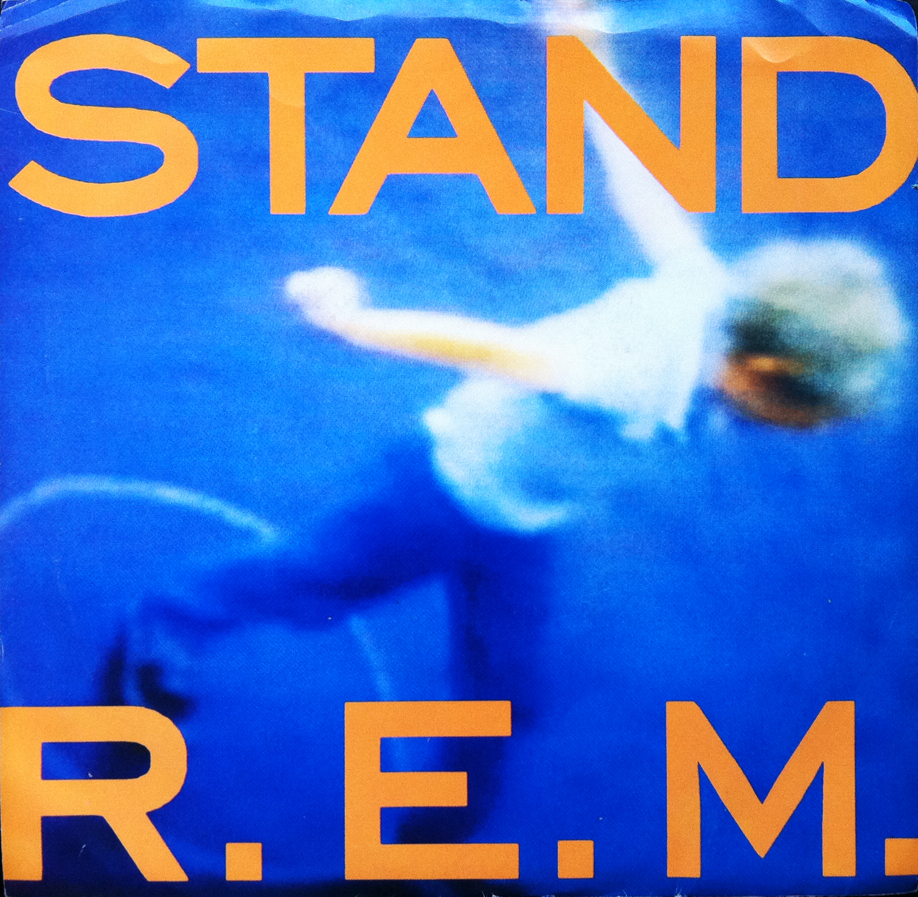
Green is the album where R.E.M. suddenly had to worry about people calling them sellouts, and maybe that's why the stern and intense "Orange Crush" was the album's first single. But "Orange Crush," like so many past R.E.M. anthems, is still catchy as hell. That song was a huge hit on both alternative and mainstream rock radio. "Stand," their follow-up, is a much lighter and sillier song than "Orange Crush," but R.E.M. had years of goodwill on their side. I can just picture the dorm-room debates over "Stand." As in: Were R.E.M. just making a stupid pop song, or were they making a comment on stupid pop songs? I'm not sure the band members themselves could give you a satisfactory answer.
Michael Stipe once said that "Stand" came out of an internal R.E.M. discussion about '60s bubblegum -- the Monkees, the Archies, the Banana Splits -- and his own attempt to come up with "the most inane lyrics that I could possibly write." I don't think he means "inane" in a disrespectful way, just like I don't think Peter Buck is being disrespectful when he says that the "Stand" riff is one of the dumbest riffs that he ever laid down. As someone who loves pop music, I wish these guys didn't have to talk about it being stupid, whether or not they mean it affectionately. But I'm glad that R.E.M. knew that every song didn't have to be some self-serious statement. Their willingness to have a little fun separated them from many of the bands who wanted so badly to be them.
Michael Stipe's "Stand" lyrics are just as difficult to parse as most of Stipe's lyrics, with the crucial distinction that Stipe sings those "Stand" lyrics as clearly as possible. "Stand in the place where you live/ Now face north/ Think about direction, wonder why you haven't before" -- that could be absurdity, or it could be Stipe barking out instructions for a very strange dance. In the video, a bunch of people do some bouncy synchronized steps on the face of a giant compass, but they never face north when Stipe tells them to.
Stipe once said that "Stand" is "about making decisions and actually living your life rather than letting it happen," elaborating with a whole story about seeing the same parking lot every day for years without actively noticing the existence of that parking lot. Sure. Fine. Whatever. When you're the enigmatic lead singer of a successful but ultra-hip rock band, then you can't say that your goofy pop hit isn't really about anything, that it's just an attempt to put together the catchiest sequence of nonsense words that you can muster. I would prefer to think that this is what "Stand" really is. I can tell you that this is what "Stand" is to me, that this is why I like it.
I also like "Stand" because it's a genuinely fun song. R.E.M. didn't have to change too much to shift into bubblegum-anthem territory. They added some pounding pianos, and Peter Buck played a slightly more direct guitar riff while Michael Stipe enunciated into the microphone more clearly. But the sounds on "Stand" still blur into each other. Buck's wah-wah guitar solo achieves the psychedelic-freakout quality of his best work. Stipe and Mike Mills’ voices still do intricate things with harmonic layers. In this case, though, R.E.M. put all those strengths in service of a straightforward garage-rock stomper. If anything, I wish they would've done that more often.
"Stand" might be the only R.E.M. song that would make sense at a middle-school dance. I don't think I ever boogied to "Stand" at a middle-school dance. I was still in third grade when the song came out, so it was probably out of rotation by the time I was old enough. Still, it's possible, and it would've worked. It would've worked especially well at the end of the song, when R.E.M. launch into a couple of key changes in quick succession, making the track that much more urgent and frenzied.
The one thing that really holds me back from "Stand" is the arch, ironic distance in Michael Stipe's voice. Maybe I'm just projecting that quality, but all those quotes from the band seem to indicate that "Stand" was a lark for them, a half-joke. I would've liked to hear Stipe throw himself into "Stand" like it was "Radio Free Europe." In 1989, though, I have to imagine that Stipe's detachment was part of the song's appeal.
"Stand" was a genuine smash for R.E.M. MTV got behind the video in a big way, and the song, like "Orange Crush" before it, went to #1 on both the Modern Rock and AOR charts. "Stand" also became R.E.M.'s second top-10 hit on the Hot 100; it peaked at #6, sharing pop-chart real estate with stuff like Roxette and Milli Vanilli. I've been reading Tony Fletcher's R.E.M. biography Perfect Circle, and he says that the band's 1989 show at Madison Square Garden, which sold out in an hour, was one of the worst experiences he had at an R.E.M. gig, mostly because the girl behind him wouldn't stop screaming about how much she loved Michael Stipe. Where I'm sitting, that's usually the measure of a good show. When kids are excited to see a band? Thats where you want to be. If everyone is respectfully and quietly appreciating the music, I want to crawl out of my skin.
https://youtube.com/watch?v=QhwdcdoSP2Y&ab_channel=PaulJohnson
After the "Stand" single, R.E.M. came out with another quasi-ironic pop song, and this one had the phrase "pop song" in its title. "Pop Song 89" is essentially a high-concept joke about meaningless pop-song lyrics and just-as-meaningless small-talk, but it's nearly as catchy as "Stand." Michael Stipe directed the song's video, where he and some buddies gyrated shirtless, in an effort to satirize the way women danced in other MTV videos. Shockingly, MTV did not get behind this one, and "Pop Song 89" did not turn out to be a big hit for the band. On the Modern Rock chart, it topped out at #16. Another Green song, the ringing and anthemic "Turn You Inside-Out," never got a proper single release, but it still reached #10 on the Modern Rock chart. (It's an 8.)
Green didn't turn into the Joshua Tree-level juggernaut that Warner Bros. presumably wanted, but the album was easily the biggest of R.E.M.'s career to that date. It eventually went double platinum, and it turned them into an arena-level band. R.E.M. spent a solid year on tour behind Green, playing cavernous venues and bringing along likeminded opening acts: Robyn Hitchcock, the Go-Betweens, the Indigo Girls, Throwing Muses, NRBQ, Pylon.
Once the long tour was all over, R.E.M. were so tired and burnt-out that they needed to take an extended break, finally ending their album-per-year streak. When the band came out with their next LP a few years later, they decided not to tour behind it, and the record still blew up into something much, much bigger than Green. We'll see R.E.M. in this column again.
GRADE: 8/10
BONUS BEATS: Here's "Weird Al" Yankovic's 1989 "Stand" parody, which is obviously called "Spam":
(The Billboard website is too buggy for me to investigate Yankovic's history on the Alternative chart, but it looks like not even "Smells Like Nirvana" made the list, so maybe alt-rock radio simply never embraced the man.)
BONUS BONUS BEATS: "Stand" famously served as the theme song for Chris Elliott's short-lived but cult-beloved 1990 sitcom Get A Life. Here's the title sequence:
BONUS BONUS BONUS BEATS: Here's the scene from a 2012 Parks & Recreation episode where Ben Wyatt uses "Stand" to sequence his DIY stop-motion animation:
(In real life, Adam Scott, the man who plays Ben Wyatt, once had an R.E.M. podcast. The highest-charting alternative hit from Letters To Cleo, the band on Scott's shirt in that scene, is 1994's "Here And Now," which peaked at #10. It's a 9.)
THE 10S: Enya's deeply soothing, blissed-out oceanic reverie "Orinoco Flow" peaked at #6 behind "Stand." From Bali to Cali, far beneath the Yellow Sea, it's a 10.