
April 1, 1989
- STAYED AT #1:5 Weeks
In The Alternative Number Ones, I'm reviewing every #1 single in the history of the Billboard Modern Rock Tracks/Alternative Songs, starting with the moment that the chart launched in 1988. This column is a companion piece to The Number Ones, and it's for subscribers only. Thank you to everyone who's helping to keep Stereogum afloat.
I've never been a musician, but when I was in sixth grade, I decided that I wanted to learn to play bass. I took a grand total of two lessons, and then my plan hit a brick wall: My parents didn't want to buy me a bass. Those two lessons, then, involved zero actual bass playing. Instead, it was me talking to my teacher, a floppy-haired guy who was either in high school or college, about how I wanted to play bass. I told him that I wanted to play like Billy Gould from Faith No More, a band who will eventually appear in this column. I probably wouldn't have been able to articulate this at the time, but I liked the idea of making an instrument sound like concrete slabs falling on your head. My teacher said Billy Gould was fine, but if I really wanted to become a bass master, I had to pay close attention to Colin Moulding from XTC.
This piece of instruction made zero sense to me. I'd heard XTC -- they were getting a lot of American alternative-rock radio burn well into the '90s -- but the bass never stood out to me. Nothing stood out to me. I didn't get their music at all. It sounded like hyperactive elves bouncing around. It sounded like music for Smurfs. XTC were the type of band who would come on the alternative-rock station and cause me to immediately lunge for the dial so I could see if something cool was playing on the hard-rock station instead. (In Baltimore, those two stations were right next to each other, which was convenient for those of us who didn't have digital radios with preset stations.)
After my would-be teacher told me that I should check for the bass on XTC records, I tried giving the band a good, hard listen the next few times they came on the radio. I had zero epiphanies. Instead, I just heard more happy goblins chanting gibberish at me. I figured that XTC must be music for sophisticated college kids, that I'd understand one day, that it would all make sense when I got older. Well, I'm older now, and I still don't fucking get it. XTC have a few songs that I genuinely like, but their maximal-pastoral psychedelic thing still makes me want to lie down and savor silence. Also, I still think Faith No More fucking rules.
But that bass teacher gave me a valuable lesson. I didn't learn much about bass or even about XTC, but this was an early run-in with a specific type of guy. I've encountered that type of guy many times since -- the type who'd utterly in awe of some random hyper-prolific artist who has carved out a singular aesthetic. I've been that type of guy, except that my XTC is, like, mid-'00s Lil Wayne mixtapes. ("Guy" is a reductive term here; it's not always men who get extremely into these hyper-niches. It's just men the vast majority of the time.) For that type, these artists broadcast at a specific frequency that hits their brains the exact right way. I'm happy for them. I'm glad they have that. But I can't join them in their appreciation for XTC's helium-tooting swingin'-hobbit sounds.
This whole preamble is a long way of saying that I just can't really fuck with XTC's first big hit on Billboard's Modern Rock chart -- or, indeed, with most of XTC's other hits. Sorry. My brain just isn't wired like that. In my personal ranking of bands that start with "X," XTC rank well below the Los Angeles X, the xx, X-Ray Spex, and the Australian X. (They're probably above X Ambassadors, though.) If you're part of that XTC cult, please don't take my feelings on "Mayor Of Simpleton" personally.
XTC's cult status caused the band plenty of problems. The group came up in the post-punk moment, but they didn't see themselves as part of it, and they didn't want anything to do with it. Instead, they drew their inspiration from '60s psychedelia -- both the ultra-pop stuff like the Monkees and the way-out experimental guys like Captain Beefheart. XTC were absorbed into new wave, and later into alternative music, mostly because they were gigantic weirdos who couldn't resist the urge to cram a bajillion ideas into every song. They didn't see themselves in those scenes, or in any other scenes.
XTC were also very bad at business. After signing a few shitty deals, they spent decades in deep debt to their record label, unable to make proper hits or to generate income on the road, since frontman Andy Partridge abruptly retired from live performance in 1982. So XTC just kept cranking out records, amassing the kind of deep discography that's great if you're in their cult and intimidating if you're not. But XTC were capable of writing sticky melodies, and that was enough to keep them from ever sliding into obscurity. I've never paid money for an XTC record, but they still probably have a dozen songs that I could sing right now. XTC weren't Guided By Voices. They were always after mass success, rather than obscurity, and their cult probably included at least a few alt-rock radio programmers.
XTC's roots go back further than the initial UK punk explosion. The members of the band grew up in council estates in Swindon, a small and deeply unhip British industrial town about 75 miles from London. (In a 1989 Spin feature, guitarist Dave Gregory says that you probably couldn't buy XTC records in Swindon stores.) Frontman Andy Partridge was a '60s kid who fell in love with flowery psychedelia and taught himself guitar. Partridge formed a band that went through a few different names, opened a local Thin Lizzy show, and eventually landed on the XTC name and a relatively stable lineup.
XTC were never a fashionable band, and Andy Partridge later said that he found the Ramones and the Sex Pistols to be "rather average." But XTC wrote fast, weird songs, and in the moment after the punk explosion, that was enough to get labels interested, especially after the tastemaking BBC DJ John Peel invited them to play a Peel Session. XTC signed with Virgin, recorded at Abbey Road, and released their debut single "Science Friction" in 1977. Partridge wrote another early single, 1978's "This Is Pop?," about not wanting to be pigeonholed as punk or new wave.
XTC's first few records were not terribly successful. But the band recorded their third album, 1979's Drums And Wires, with producer Steve Lillywhite, and they landed a top-20 UK single with "Making Plans For Nigel." That song is not as discordant as the singles that the group had been releasing, but its militant whimsy is just as grating to me. The band went back to Lillywhite for their 1980 follow-up Black Sea, and that one had "Generals And Majors," one of the handful of XTC songs that I really do like. Maybe that one is just fast and simple enough that it never loses me. (Andy Partridge wrote most of XTC's songs, and he struggled to maintain control over the band, but "Generals And Majors" is a Colin Moulding joint.)
On the back of Black Sea, XTC toured arenas in the US as an opening act for the Police. The process left Andy Partridge badly freaked out. He decided that he wanted to tour less often, and he started writing more complex and layered songs, his logic being that he wouldn't have to perform live if the band was simply unable to recreate the material onstage. 1982's English Settlement, XTC's next album, had "Senses Working Overtime," which made it to #10 in the UK -- the band's biggest chart hit ever in their homeland. While touring that album, though, Andy Partridge started having terrible panic attacks. After a full-on nervous breakdown in Los Angeles, XTC never played a proper live show again. Partridge's bandmates weren't especially thrilled about that, but I guess they never attempted the Beach Boys move of having someone else sing Partridge's parts on tour while he stayed home and devised more fantastical musical landscapes.
When they stopped touring, XTC checked out what was happening with their bank accounts, and they were not happy. They were in debt to Virgin, making no royalties, and they got into a heavy legal dispute with their manager, which caused a court to freeze the band's assets for years. For a while, some members of XTC had to run out and get part-time jobs. Because of gag orders, they couldn't talk publicly about any of this. But XTC kept making records, and those records became increasingly bugged-out and experimental. The band members also started up a side project called the Dukes Of Stratosphear, which they devoted to full-on '60s-style psych-pop. In the UK, their Dukes Of Stratosphear records regularly outsold the stuff that they made as XTC.
At a certain point, Virgin read XTC the riot act. The label needed the band to make a record that might actually achieve some form of commercial success, and they wanted XTC to record it with an American producer, with the thinking that this might force the band to make something that American audiences would find palatable. Legend has it that the label gave the band a list of possible producers, and the only name that they recognized was Todd Rundgren, another true pop weirdo. So XTC went off and spent a whole lot of money recording the dizzy and overstuffed 1986 album Skylarking with Rundgren. Within the XTC cult, general consensus has Skylarking as the band's masterpiece. I just listened to the whole thing for the first time, and yeah, no, not for me.
The Skylarking single "Grass" was not a huge hit on either side of the Atlantic, but the UK single release featured a song called "Dear God" as the B-side. It's a direct and passionate manifesto against religion, and it's easily my favorite XTC song. Some American college radio DJs got ahold of the "Grass" single and flipped for "Dear God," so Virgin added "Dear God" to the US version of Skylarking, and the song became a big American college-radio hit. That thing blew my mind when I was a kid. I couldn't believe a song like that was allowed. I wish more XTC songs hit me the way that one does.
Partly as a result of the groundswell behind "Dear God," Skylarking sold hundreds of thousands of copies, and it pulled XTC out of their commercial slump. Andy Partridge constantly butted heads with Todd Rundgren while recording Skylarking, so he wanted to make the band's follow-up with a different producer. By this point, XTC were bigger in the US than they were in the UK, so they found another American producer: Paul Fox, a session musician and XTC fan who'd never produced before. Fox brought in Mr. Mister drummer Pat Mastelotto, which is kind of funny, and he incurred the wrath of the non-Andy Partridge XTC members by giving free reign to Partridge's ideas.
XTC went into the sessions for 1989's Oranges & Lemons with the idea of making a Dukes Of Stratosphear-style psych-rock record while using up-to-date technology. This was probably a good idea. Jangly '60s music was in the zeitgeist at that moment, and XTC were on something of a roll after the success of Skylarking. While XTC recorded Oranges & Lemons, Elvis Costello was down the hall in the same LA studio, working on the similarly busy Spike. Costello would sometimes stop by XTC's sessions to hear what they were making, as would fellow celebrity types like David Byrne and River Phoenix. That must've been good for the band's collective ego.
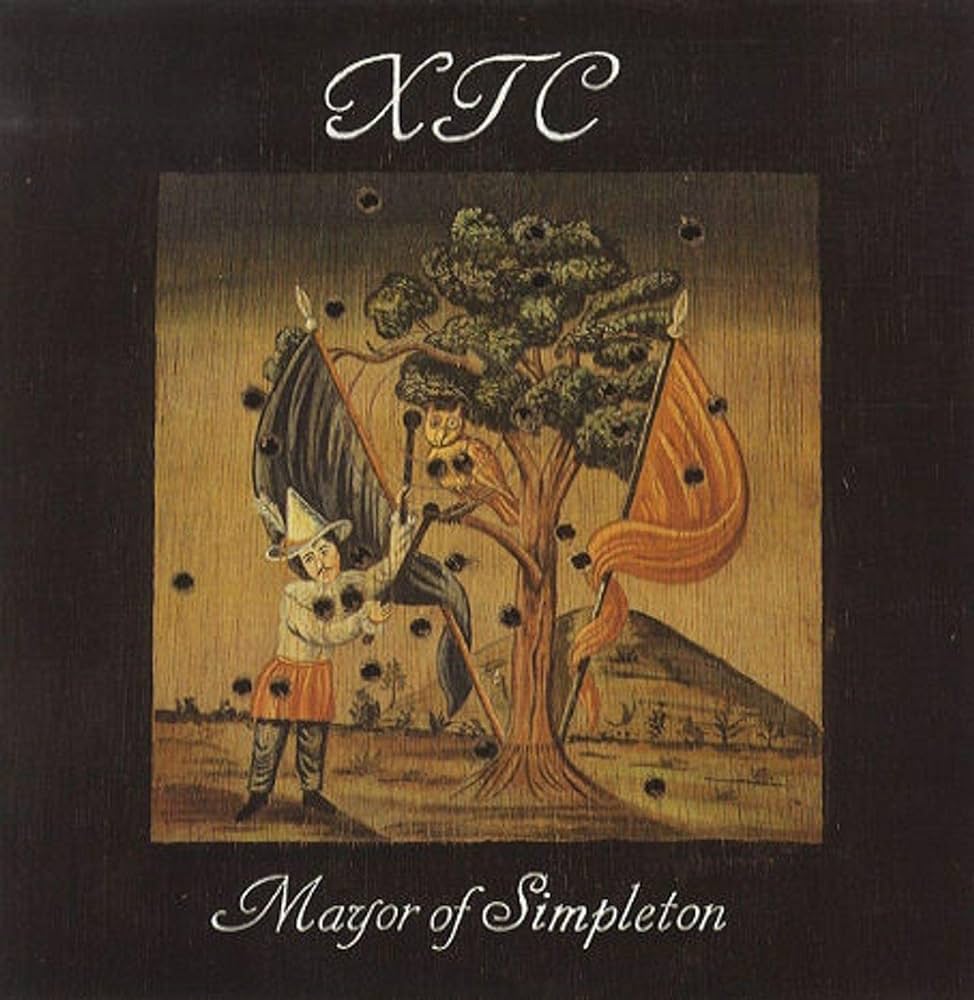
Making Oranges & Lemons, XTC blew past deadlines and budget restrictions, and Virgin considered dropping them. Eventually, they came back with a double album full of overstuffed songs. "The Mayor Of Simpleton," the album's first single, is one of its simpler and more straightforward numbers, but we're speaking relatively here. On the song, Andy Partridge's narrator professes his love while admitting that he's not all that smart -- the same basic concept as Sam Cooke's "What A Wonderful World," though Partridge claimed ignorance of that song.
Sam Cooke's "What A Wonderful World" is a perfect song, a simple and elegant pop miracle. If Andy Partridge was more plugged in with songs like that, I'd probably like XTC more. Even though "Mayor Of Simpleton" is about the same thing, its lyrics are a lot more winky and whimsical: "I can't have been there when brains were handed round/ Or get past the cover of your books profound/ And some of your friends think it's really unsound that you're even seen talking to me." Partridge even throws in a little meta line about XTC's commercial struggles: "Well, I don't know how to write a big hit song/ And all crossword puzzles, well I just shun." So: Clever lyrics about not being clever enough. You get it.
This kind of tee-hee writing exercise always leaves me cold, though Andy Partridge has said that he actually hated school and that he identifies with the narrator. Partridge originally wrote "Mayor Of Simpleton" as a kind of quasi-reggae thing, and he didn't like it. But he landed on a clear, ringing guitar riff while trying to figure out how to play Blue Öyster Cult's "(Don't Fear) The Reaper," and he was happy to find that his "Mayor Of Simpleton" lyrics worked over that riff. Partridge later said, "I was kind of blundering around with someone else's song, and made the mistake of finding the 'Mayor' riff. It was not what I was looking for, but I found something all my own." (It wouldn't have occurred to me, but the main riff from "Mayor Of Simpleton" really does sound a lot like "(Don't Fear) The Reaper.")
Like a lot of XTC songs, "Mayor Of Simpleton" walks a strange line between simple and complex. Andy Partridge complained that the Beatles' influence on XTC was overstated, but there's a whole lot of late-period Beatles in practically every XTC record, "Mayor Of Simpleton" included. The song has harmonies that cascade all over each other, and the bassline is complicated in an understated sort of way. Andy Partridge took credit for that: "Colin had to work very hard to get that bassline. It's very precise. It took me a long time to work it out, because I wanted to get into the JS Bach mode of each note being the perfect counterpoint to where the chords are and where the melody is. The bass is the third part in the puzzle." I often go out of my way to avoid people who say things like that.
Look: "Mayor Of Simpleton" doesn't suck. I know that. It's a breezy, efficient little hook-machine, and it doesn't flaunt its complexity too ostentatiously. The lyrics really are pretty clever, even if they're ostentatious in their own way. The song never bothered me the way some XTC songs did, but I never went out of my way to hear it, either. There's something about Andy Partridge's voice that just puts my teeth on edge. I don't think it's his fault, but the combination of accent and elocution has always sounded terribly mannered to me. I just can't vibe with it. When Partridge gets louder and goes for a soul-singer growl on the "I'm not proud" bit, I check all the way out. The song is fine, which is more than I can say about a lot of XTC tracks, but I just can't go beyond that.
By XTC's standards, "Mayor Of Simpleton" was a full-on hit. In the UK, the song peaked at #46 -- the band's best chart placement since "Senses Working Overtime" seven years earlier. Over here, "Mayor Of Simpleton" became the only Hot 100 hit of XTC's career, though it peaked at #72. The song even got some traction at mainstream rock radio, going top-20 on that chart. The Oranges & Lemons album sold pretty well on both sides of the Atlantic, and the band promoted it by touring around to different radio stations, playing acoustic in the studio. They even played their follow-up single "King For A Day" on Letterman -- their first time performing for a live audience in seven years. ("King For A Day" peaked at #11 on the Modern Rock chart. It's a Colin Moulding song, so Andy Partridge didn't have to sing lead.)
After that Letterman appearance, XTC never performed in front of an audience again, but they stayed together as a band for another decade-plus. For a while, America's modern-rock radio programmers stuck with them. We'll see XTC in this column again.
GRADE: 5/10
BONUS BEATS: Here's fan footage of Joe Jackson playing a solo-keyboard "Mayor Of Simpleton" cover at a 2022 show in New Orleans:
(Joe Jackson's highest-charting single on the Modern Rock chart, 1991's "Obvious Song," peaked at #2. It's a 6.)
THE 10S: New Order's wistfully body-rocking bitterness banger "Round & Round" peaked at #6 behind "Mayor Of Simpleton." It's driving me wild, it makes me act like a child, it's a 10.