
August 5, 1989
- STAYED AT #1:3 Weeks
In The Alternative Number Ones, I'm reviewing every #1 single in the history of the Billboard Modern Rock Tracks/Alternative Songs, starting with the moment that the chart launched in 1988. This column is a companion piece to The Number Ones, and it's for subscribers only. Thank you to everyone who's helping to keep Stereogum afloat.
What happened to the larger-than-life funny weirdos? The party-animal types who seemed to spring fully-formed from the bins of thrift shops in far-off galaxies? We used to have so many of those goofballs. In the '80s, we had Pee-Wee Herman, Cyndi Lauper, Morris Day, John Waters' leap into mainstream Hollywood films, the "Day-O" scene from Beetlejuice -- a whole wacky zeitgeist full of zebra stripes and Valentino mustaches. On top of all that, we had the B-52's, the deeply idiosyncratic band who made some of the most purely joyous rock 'n' roll that the world has ever seen. Most of the people who I just mentioned are still alive and active, but none of them have the cultural weight that they had near the end of the '80s. Bring those freaks back. We need them.
In 1989, the B-52's had every reason to pack up their hairspray and rayon and go home. The band had been patron saints of the '70s-into-'80s new wave explosion, but that moment was over. In 1985, guitarist Ricky Wilson, the group's musical genius, died of AIDS at the age of 32. Most of Wilson's bandmates didn't even know he was sick. Considering that the group included Ricky Wilson's best friend and his little sister, the surviving B-52's were understandably shocked and heartbroken. 1986's Bouncing Off The Satellites, the album that the band released just after Wilson's passing, was their first total commercial failure. The group took years to regroup, and if they'd called it quits, the world would've understood.
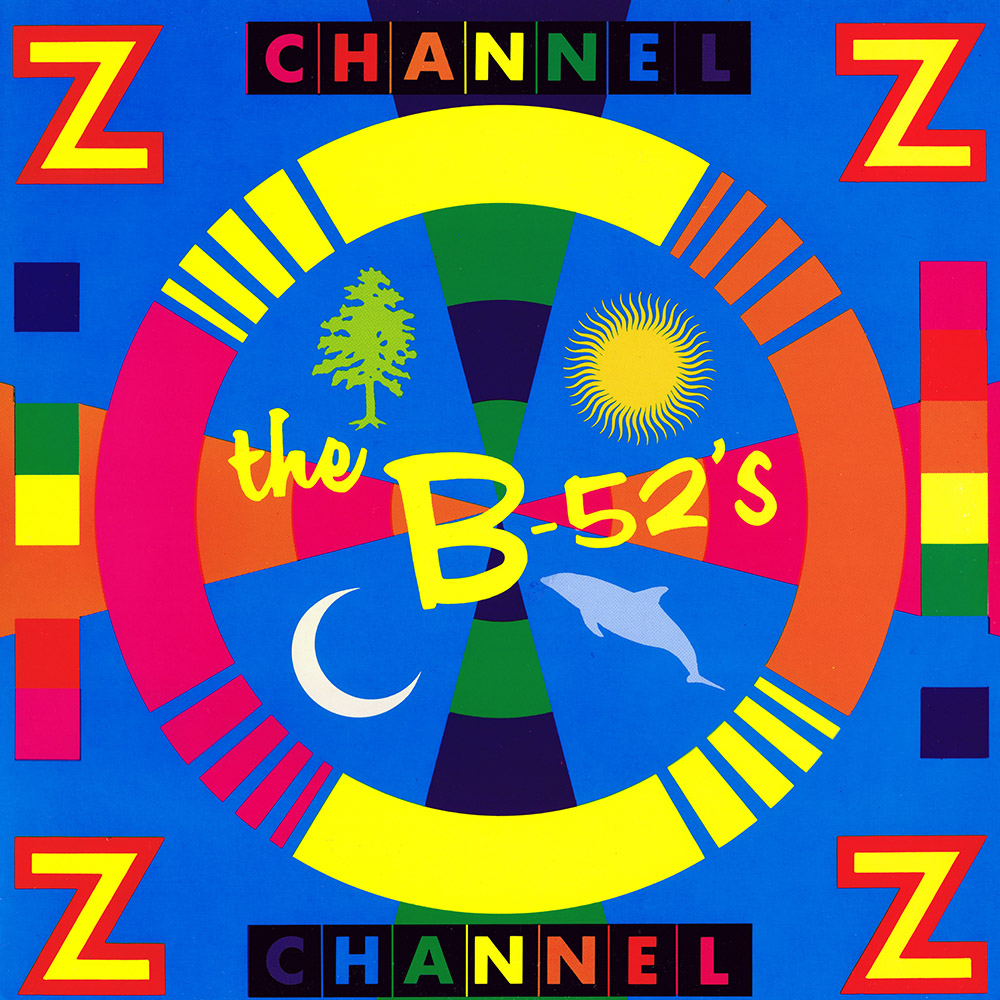
Instead, the B-52's came back with a blockbuster. Cosmic Thing, the band's 1989 album, sanded down some of their more jagged edges, but it also updated their ever-evolving party-time style with verve and vigor. The B-52's brought a sense of purpose to their fun, and even when they sang about everything that was wrong with the world, they sounded like they were having a blast. Cosmic Thing is an album loaded with hits, and it's a little strange to learn that the album's first single was the closest thing to a protest song that the B-52's had ever recorded. "Channel Z" isn't anywhere near as great as some of the B-52's singles that followed, but it still stands as a song that only a group of larger-than-life funny weirdos could've made.
The B-52's famously got their start in the Southern college town of Athens, Georgia, and they probably helped catalyze the explosion of post-punk art-kid bands that came out of that town. But by the time R.E.M. and their peers really got going, the B-52's had left Athens behind. Three of the five original B-52's -- Ricky and Cindy Wilson and original drummer Keith Strickland -- were Athens natives. Ricky Wilson and Keith Strickland were high-school best friends in the early '70s. Both were colorful local eccentrics who bonded over colorful-eccentric rockers like Captain Beefheart. They were townies who worked together at the local bus station, but they became friends with Fred Schneider, a New Jersey native who'd come to Athens to study forestry at the University Of Georgia.
Nobody on this planet has ever sounded quite like Fred Schneider. He's got one of the most fun voices to imitate, but you can't get it right. Schneider doesn't really sing. Instead, he declaims, like a game-show announcer with a head cold. Schneider got to know Ricky Wilson and Keith Strickland because they were the three loudest, most unrestrained weirdos in Athens. Together, they messed around with experimental music. Nothing quite clicked until a night out at a Chinese restaurant with Kate Pierson, another New Jersey native who'd found her way to Athens after some itinerant years, and Ricky's teenage sister Cindy Wilson. The story goes that they started jamming together after sharing a Flaming Volcano drink, and they played their first show as a band at a Valentine's Day house party in 1977.
That origin story doesn't quite explain how this bugged-out, singular band came to be. These five people must've all just understood each other on some deep level. They all got it. Together, they bashed out a jittery, absurdist form of party-ready rock 'n' roll that drew on garage rock, Motown, girl-group pop, and surf-guitar instrumentals without really sounding like any of them. Early B-52's records are silly and serrated, but they're not silly and serrated in the same way that the contemporaneous Ramones and Talking Heads records are silly and serrated. Kate Pierson and Cindy Wilson sang harmonies with this joyous, explosive sense of yearning that I've never heard anyone even try to equal. Fred Schneider yammered over everything, adding the same kind of insane charisma that Flavor Flav brought to Public Enemy. The whole thing just clicked, and then it kept clicking.
The B-52's got their name from Kate Pierson and Cindy Wilson's beehive hairdos; people thought those haircuts looked like the noses on WWII bombers. Virtually everyone in the band was queer, though most of them wouldn't come out publicly for decades. They arrived fully-formed, and they apparently played some of their most famous jams at that very first house party. The B-52's played tons of local shows, but they also made a habit of trucking up to New York to perform at punk clubs like Max's Kansas City, where they were received as kindred spirits. The B-52's knew the power of optics, so they brought vanloads of friends up to dance, so that New York crowds would know how to respond. In 1979, they released their debut single "Rock Lobster," an all-time banger, on the Athens indie DB Records. Warner Bros. signed the band, and a re-recorded version of "Rock Lobster" went all the way to #56 on the Billboard Hot 100.
Nobody had ever heard a record like "Rock Lobster" because there was no record like Rock Lobster -- a mythic, kitsch-drunk beach-party monster-movie dance anthem with imaginary sea creatures evoked through Yoko Ono-style ululating. In the last interview that he gave before he died, John Lennon said that "Rock Lobster" blew his mind and inspired him to record Double Fantasy with Yoko. The band had more where that came from. They recorded their classic 1979 self-titled debut album in the Bahamas with Island Records boss Chris Blackwell producing, and that album has bangers on bangers: "Planet Claire," "Dance This Mess Around," their version of Petula Clark's "Downtown."
As "Rock Lobster" took off, the B-52's left Athens. They first moved into a group house in a small upstate New York town. When that didn't work out, they set up shop in New York City. The B-52's eventually went platinum. The band's next two albums, 1980's Wild Planet and 1983's Whammy!, both went gold, and both albums had minor Hot 100 hits. ("Private Idaho," from Wild Planet, reached #74, while Whammy!'s "Legal Tender" made it to #81.) I've heard a lot of people describe the band's 1980 performance on Saturday Night Live as a major eureka moment.
The B-52's kept changing. As time went on, they modernized their sound, adding synths and drum machines. They tried to record an album with Talking Heads leader David Byrne, whose style proved to be a bad fit for their wild-eyed exuberance. The resulting Mesopotamia EP disappeared quickly. (Byrne's highest-charting solo track, 1992's "She's Mad," peaked at #3 on the Modern Rock chart. It's a 7. Talking Heads will eventually appear in this column.) Fred Schneider also made a solo album, 1984's Fred Schneider And The Shake Society, with P-Funk keyboard wizard Bernie Worrell, and his utterly berserk single "Monster" randomly scraped the lower rungs of the Hot 100 when it was reissued in 1991.
The B-52's spent a lot of money recording 1986's Bouncing Off The Satellites with Fairlight synth expert Tony Mansfield, and the album was mostly done when Ricky Wilson died. Ricky's devastated bandmates dedicated the album to him, and they didn't tour after it came out. There are some real jams on Bouncing Off The Satellites -- I like "Summer Of Love" a lot -- but the album utterly died commercially, and none of its singles charted. The B-52's were heartbroken and deeply in debt to Warner Bros. The band's members were starting to drift apart before they recorded Bouncing Off The Satellites, but Ricky Wilson's death pulled them back together.
Keith Strickland figured that he understood Ricky Wilson's strange, spiky guitar tunings better than any new guitarist would, so he moved from drums to guitars and started writing new tracks. The B-52's held jam sessions, and new songs formed. The band found new managers and moved to Warner's Reprise imprint. A psychic convinced Kate Pierson to seek out the Chic leader and '80s super-producer Nile Rodgers. The B-52's got together with Rodgers to record "(Shake That) Cosmic Thing" for the soundtrack of the infamously awful 1988 movie Earth Girls Are Easy. That song became the resurgent B-52's' first hit on Billboard's newly instituted Modern Rock chart, where it peaked at #7. (It's an 8.)
The B-52's recorded six of the 10 tracks on their Cosmic Thing album with Nile Rodgers. But Rodgers was busy, and he didn't have time to work on the whole LP, so the band laid down the other four tracks with Was (Not Was) leader Don Was, whose own silly streak is perfectly evident on the Was (Not Was) hit "Walk The Dinosaur." ("Walk The Dinosaur" was the only Modern Rock hit for Was (Not Was); it peaked at #30 on that chart. The 1994 Flintstones movie made use of both the B-52's and "Walk The Dinosaur.") Don Was was on his way to becoming a super-producer in his own right. In 1989, he also produced Nick Of Time, the album that would turn out to be the unlikely late-career breakout for Bonnie Raitt. "Channel Z," the first single from Cosmic Thing, was one of the Don Was tracks.
You might think that "Channel Z," with its skittery funk guitars, was a Nile Rodgers joint, but that's probably just because Ricky Wilson and Keith Strickland incorporated bits of Rodgers' sparkle-scratch Chic style into the B-52's. "Channel Z" is really more of a groove than a song, but as grooves go, it's a good one -- sparse and synthetic, with Strickland's guitars and the various keyboards adding accents. The B-52's came up with juicier club tracks than "Channel Z," but the song moves. Most bands would use a groove like that to sing about dancing or crushes or whatever. The B-52's used it to sing about the problems with the late-'80s world, which makes sense. They'd all just seen one of their closest friends die of an epidemic that the then-president barely deigned to acknowledge.
"Channel Z" isn't about one issue; it's about all the issues: A numbing and omnipresent media, nuclear anxiety, nihilistic militarism, environmental devastation. But because they're the B-52's, they manage to sound both ridiculous and optimistic. Fred Schneider reels off dystopian dangers like they're the names of dances: "Space junk! Laser bombs! Ozone holes!" On paper, there's real rage in Schneider yelling about getting wise to good ol' boys tellin' lies. In practice, though, Schneider never sounds scared or angry. He's having too much fun for that.
Kate Pierson and Cindy Wilson sing about static in their attic on Channel Z -- an economical way to describe the sense of being bombarded by an overwhelming media. (I wonder if they were influenced by Public Enemy, who never sounded anything like the B-52's but who warned of the dangers of "Channel Zero" the previous year.) Pierson and Wilson sing about needing to get away from Z -- shooting that static down the drain, putting that static out of their brains. But they also sing about societal change being right around the corner: "I don't know, but something good is happening! Something good is happening! I feel love has got to come on, and I want it! Something big and lovely!" Man, if only.
There is so much warmth and exuberance in Pierson and Wilson's voices. The "Channel Z" backbeat can't quite equal the spirit of their harmonies and Fred Schneider's hypeman silliness, but it's pretty fun. I like the false-ending pause and the moment in the otherwise-unremarkable video where the whole band freezes. I've probably heard "Channel Z" dozens of times without even considering the idea that the song was any kind of political anthem. That's not a complaint. Certain bands can tap right into the rage and despair that I've never stopped feeling. The B-52's are not one of those bands. If anything, the utterly ignorable political messaging of "Channel Z" makes the song even more charming. On an album full of total party-monsters, "Channel Z" remains pretty forgettable, but I'm never sad to hear it.
I truly have no idea why Reprise thought "Channel Z" should be the first single from Cosmic Thing, but I guess everything worked out. The label pushed the single to college radio, and it topped the Modern Rock chart without ever crossing over to the Hot 100. "Channel Z" announced that the B-52's were back in business, and their next single made a much, much bigger impact. That single will appear in this column very soon.
GRADE: 7/10
BONUS BEATS: Here's the B-52's performing "Channel Z" and doing the obligatory semi-awkward Downtown Julie Brown interview on a 1989 episode of Club MTV:
https://youtube.com/watch?v=dXJVipoZO_M&ab_channel=ClubMTVFanPage
THE NUMBER TWOS: The Cure's thrumming, mystical "Lovesong" peaked at #2 behind "Channel Z." Weirdly, "Lovesong" reached the exact same spot on the Hot 100. Maybe it was just such a crossover hit that the alternative stations didn't go all-in. It's a 9.