
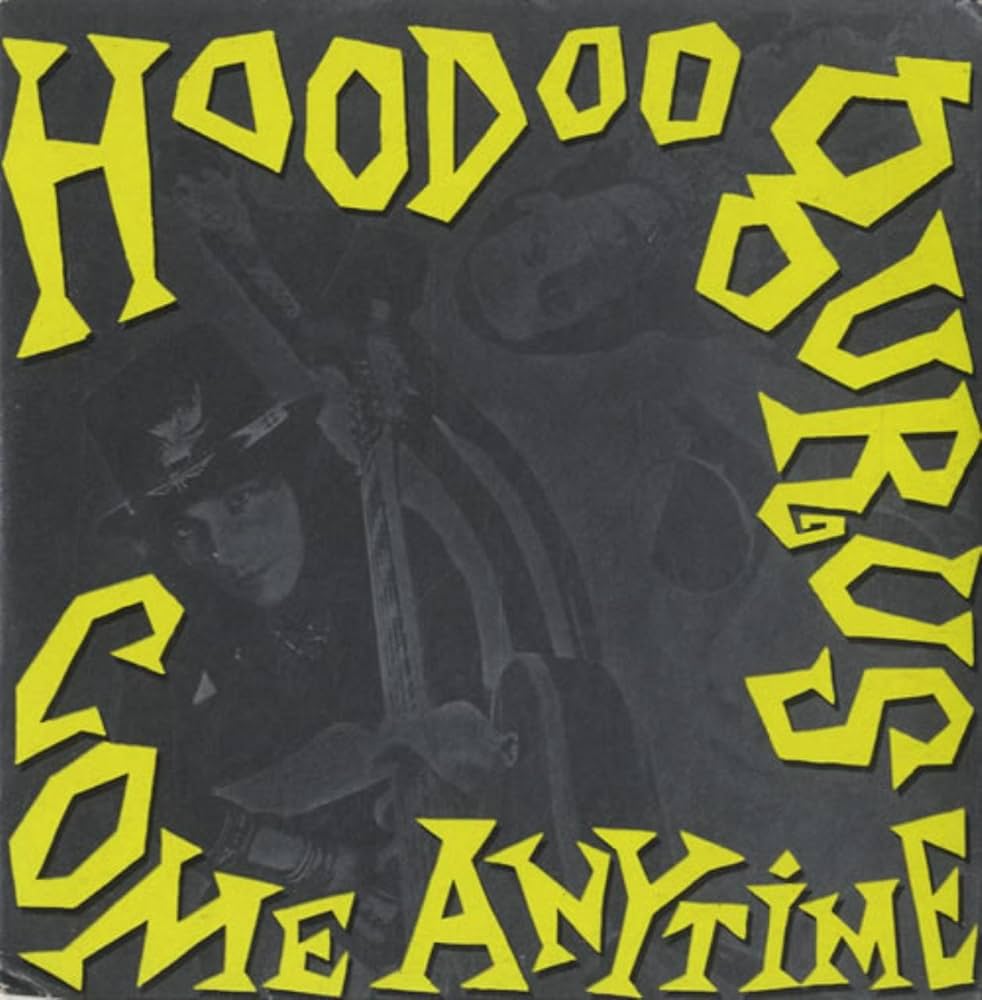
August 26, 1989
- STAYED AT #1:3 Weeks
In The Alternative Number Ones, I'm reviewing every #1 single in the history of the Billboard Modern Rock Tracks/Alternative Songs, starting with the moment that the chart launched in 1988. This column is a companion piece to The Number Ones, and it's for subscribers only. Thank you to everyone who's helping to keep Stereogum afloat.
Look: I'm confused, too. If you're under 40 and you're from anywhere other than Australia, there's a very good chance that the headline above looks like it's written in a foreign language. That band name can't possibly be real, right? There can't be a popular band that chose, of its own free will, to call itself Hoodoo Gurus. But there was. There still is, in fact. Hoodoo Gurus continue to exist.
They're Australian. I knew that much, I think. Maybe I thought they were Irish? But no. Australian. From Sydney. Somewhere, in the deepest recesses of my mind, I recalled the existence of this band. I did not, however, know that they had a #1 hit on the Billboard Modern Rock chart, or that they were ever considered any kind of college-radio darling. I'm 44, and the only thing that the name "Hoodoo Gurus" gave me was a vague, distant ringing bell.
If I ever heard "Come Anytime," Hoodoo Gurus' one Modern Rock chart-topper, I did not remember it. I could've heard it, but "Come Anytime" is not the kind of song that one remembers. It's not a terrible song or anything. It's just a vague an indistinct one. But Hoodoo Gurus earned themselves a small place in alt-rock chart history, so this column must contend with them. Those are the rules.
In the mainline Number Ones column, I've covered plenty of songs with which I was previously utterly unfamiliar. That was part of the job. A random bubblegum-garage band that had a one-off hit in 1967? An instrumental soft-jazz guy who scored an unlikely crossover success in 1963? A lite-pop act who slid into #1 in the mid-'70s, just before disco took over the charts? Those were all blind spots for me. But I grew up with alt-rock radio, and though the format entered my life just after Hoodoo Gurus' heyday, you'd think that they would leave some residue. Hoodoo Gurus did not, however, have the hall-of-fame punk resume that some of this column's other acts boasted. You could enjoy a robust alt-rock youth in the '90s without ever knowing that the Hoodoo Gurus existed. This band is new territory for me.
Since this is new territory, I can't quite say why the Hoodoo Gurus caught on with an American college-rock audience when they did. I can tell you that Hoodoo Gurus toured the US a lot, established a beachhead at college radio, and made friends with the Bangles. I can tell you that they had a very of-the-moment sound -- a breezy and lightly psychedelic take on power pop that had some of the low-end swirl of R.E.M. But we had the Smithereens at home. Why did we import another Smithereens?
Maybe the mere fact of Hoodoo Gurus' Australian identity had something to do with it. In the '80s, America briefly and inexplicably fell in love with Australian culture. Maybe the establishment of direct Qantas flights to Australia had something to do with it. The flash-in-the-pan pop success of Men At Work probably helped, too. But none of those things can fully explain the level of cultural infatuation that we went through. Do you know how much fucking money Crocodile Dundee made? Crocodile Dundee earned $175 million at the American box office. It was the #2 movie of 1986, right behind Top Gun. Crocodile Dundee outgrossed Platoon and Aliens and Ferris Bueller's Day Off. Crocodile Dundee is unwatchable now. Cultural history is a mysterious, fascinating beast.
Maybe American alt-rock fans and radio programmers simply had some kind of inferiority complex in the pre-grunge years. If you've been following this column, you've probably noticed that dour British post-punkers absolutely dominated the Modern Rock charts in the pre-grunge years. Irish acts did pretty well, too -- not just U2 and Sinéad O'Connor, but also stuff like the Hothouse Flowers. (When I thought that Hoodoo Gurus might've been Irish, I was probably thinking of the Hothouse Flowers.) Australian bands had a real presence on alt-rock radio, as well; maybe people thought they were exotic. Most of those Australian bands -- Midnight Oil, INXS, the Church -- had some identifiable thing. Hoodoo Gurus, as far as I can tell, were just some guys. Some guys who called themselves Hoodoo Gurus.
So. Hoodoo Gurus. The band got together in Sydney sometime around 1980, and they originally called themselves Le Hoodoo Gurus, which is even worse. Lead Hoodoo Guru Dave Faulkner had been a member of early Aussie punk bands the Victims and the Manikins. Various other Gurus did time in other punk bands like the Scientists and XL Capris. (I've never heard of any of these bands, but I'm sure they were all extremely important in the Australian punk world. "Television Addict," the Victims single that I'm listening to for the first time as I write this, is pretty good.) Originally, Le Hoodoo Gurus' big gimmick was that they had three guitarists and no bassist, but that didn't last. "Leilani," Le Hoodoo Gurus' debut single, came out in 1982, and it had some fun surf-guitar rumble working for it.
Le Hoodoo Gurus eventually became just plain Hoodoo Gurus, and they went through a bunch of lineup changes. Original guitarist Kimble Rendall, for instance, left the band and became a director for Australian rock bands' music videos. He also served as second-unit director on the Matrix sequels, and he directed Cut, a 2000 slasher film that starred Kylie Minogue and Molly Ringwald. I know it seems like I'm making all this up, but I promise, I'm just saying what Wikipedia tells me. I'm not that creative. This, for instance, is a real Wikipedia sentence: "As the Hoodoo Gurus, they gave their first ever performance on a segment of the kids' TV program Simon Townsend's Wonder World; this was followed by a performance alongside a man and his singing dog, on The Don Lane Show." Australia, baby. A land of contrasts.
Hoodoo Gurus didn't immediately become giant stars in Australia, but they did OK. The band's debut album Stoneage Romeos came out in 1984, and it eventually went gold over there. The biggest hit on that debut album was "My Girl," which is not a Temptations cover and which peaked at #35 on the Australian singles chart. They also had a single called "I Want You Back," which is not a Jackson 5 cover.Was that a tactic? Naming unrelated songs after Motown classics? The more I learn about Hoodoo Gurus, the more I realize I don't understand. "I Want You Back" one was a decent-sized college radio hit in America, and I'm pretty sure I've heard it on the radio a few times. Good song!
After they dropped their 1985 sophomore LP Mars Needs Guitars!, Hoodoo Gurus toured the US with the Bangles and the Fleshtones. Mars Needs Guitars! was a huge success in Australia, and it launched a couple of top-20 hits, including the big ol' rocker "Bittersweet." 1987's Blow Your Cool featured "What's My Scene?," which went all the way to #3 in Australia. It's the Hoodoo Gurus' biggest song by far, and its streaming numbers absolutely dunk on the rest of the band's catalog.
These Hoodoo Gurus songs might've been defining generational anthems for Australians, but they mostly just sound like replacement-level '80s college-rock to me. They're fine, but they're wallpaper. They've got energy, but they're not exciting. Hoodoo Gurus were apparently in love with American trash culture, but they didn't go wild with it like the B-52's; they just gave their albums titles like Mars Needs Guitars! and dedicated them to characters from Get Smart. I'm reading contemporaneous reviews that talk about Hoodoo Gurus as wild psychedelic rockabilly cowpunks, but I'm not getting that at all. Maybe they had someone writing ambitious press releases, or maybe you simply had to be there.
"Come Anytime" served the lead single from Hoodoo Gurus' self-produced 1989 album -- Jesus fucking Christ, this title -- Magna Cum Louder. "Come Anytime" is not one of the band's most popular singles these days, but I suppose it was the right song at the right time. The double-entendre title is intentional. Dave Faulkner sings that he's a man of leisure who awaits your pleasure: "What is it you want from me?/ You won't shock me easily/ Maybe it's your heart's desire/ Maybe it's your wildest dream." So yeah, he wants to fuck.
I like some things about "Come Anytime." The central acoustic-guitar riff is basic, but it's propulsive, and it mixes well with the very-'80s college-rock production. The backing harmonies have some sparkle. The organ-whirrs are fun. If "Come Anytime" were to come on the radio while I was doing something else, I wouldn't lunge for the dial. The problem is that I probably wouldn't notice that the song was playing. If I did notice, the thing that I would notice would probably be Dave Faulkner's not-very-pleasant baritone-honk voice.
It's hard to be a rock star. You can't just be good at writing songs. You have to have all sorts of intangible factors, many of which are entirely outside of your control. I look at the "Come Anytime" video, with its weird tie-dye backdrop and its complete lack of a second location, and I can't help noticing that Dave Faulkner does not look like a rock star. He looks like Phil Collins, if Phil Collins was wearing frizzy extensions and if those extensions made him profoundly embarrassed. (I say "extensions" instead of "wig" because nobody's trying to hide Faulkner's receding hairline.) Phil Collins never looked like a rock star, either, but he had the swagger to carry it off. I'm not getting swagger from Dave Faulkner. So it's honestly impressive that this guy managed to play the rock-star role, despite a clear lack of rock-star attributes, for a while -- at least in Australia.
In the US, Hoodoo Gurus never made the Hot 100, and they never got past #101 on the album chart. Even in Australia, "Come Anytime" wasn't a huge hit; it peaked at #27. When you consider the state of the Modern Rock charts in 1989, it's pretty amazing that this band was able to box out the Cure and the B-52's for a few weeks. The band only managed one more Modern Rock hit: "Miss Freelove '69," the desperately innuendo-laden lead single from 1991's Kinky. On that song, Hoodoo Gurus sounds like they're going for a Soup Dragons kind of thing. They do not succeed. That song went #3 Modern Rock. (It's a 3.) I don't remember ever hearing that one, either.
Hoodoo Gurus kept going deep into the '90s, and they remained successful in Australia until their 1997 breakup. Dave Faulkner formed a couple of other bands, Antenna and Persian Rugs, who didn't really do anything of note. Hoodoo Gurus didn't stay broken up for long. They got back together in 2003, headlined some big Australian rock festivals, and got back to cranking out albums. Just last year, they dropped Chariot Of The Gods, their first new one in 12 years. A few months ago, they toured the US for the first time in a while.
I'm sure there are huge Hoodoo Gurus heads out there, and if you're one of them, you probably find this entire column to be terribly condescending. As a critic, though, it's my duty to record my own reaction. And my reaction to Hoodoo Gurus' brief success on the American alt-rock charts is: Huh. Hoodoo Gurus.
GRADE: 5/10
BONUS BEATS: One of my first thoughts about "Come Anytime" was that it sounds like the theme of a forgotten sitcom. I wasn't far off. Starting in 2006, "Come Anytime" served as the theme music for Thank God You're Here, an Australian improv-comedy show. Come Anytime lasted until 2009, and it was recently revived. An American version of Thank God You're Here ran on NBC in 2006, and "Come Anytime" was the theme for that one, too. David Alan Grier was the host, and guests included Bryan Cranston, Mo'Nique, Jennifer Coolidge, Joel McHale, Chelsea Handler, Tom Green, and Tom Arnold. I have no memory of this show existing, but maybe that's because it only lasted for seven episodes. I can't find any video of "Come Anytime" playing during the American version, but here it is on the Australian show: