
October 21, 1989
- STAYED AT #1:3 Weeks
In The Alternative Number Ones, I'm reviewing every #1 single in the history of the Billboard Modern Rock Tracks/Alternative Songs, starting with the moment that the chart launched in 1988. This column is a companion piece to The Number Ones, and it's for subscribers only. Thank you to everyone who's helping to keep Stereogum afloat.
The alternative rock cover song has existed for about as long as alternative rock itself. In that time, the intentions behind the alternative rock cover song have often been mysterious. Sometimes, the bands were trying to expose music they liked to new audiences, like when the Clash would cover reggae hits like Junior Murvin's "Police And Thieves." Sometimes, the covers were ironic goofs, intended to clown the songs and anyone who might've enjoyed them; that's what the Circle Jerks were doing when they cheerfully desecrated a medley of AM-radio nuggets on 1983's "Golden Shower Of Hits (Jerks On 45)." More often, though, you couldn't really tell what was going on.
In the '80s, the bands of the American rock underground had some real reverence for the psychedelic rock of the late '60s, but they regarded that music with a sense of distance that was often mysterious in its own way. Consider: The first single from Nirvana, a band that'll figure heavily into this column, was a cover of "Love Buzz," a song that Dutch rockers the Shocking Blue released in 1969. Was that cover supposed to be Nirvana's comment on "Love Buzz," or did they just remake the song because it rocks? Does it matter?
But what if "Love Buzz" had turned out to be Nirvana's biggest hit? What if it was a crucial part of the band's legacy? When then? Because that's basically what happened with Camper Van Beethoven.
If you don't belong to a certain generation, then there's a pretty good chance that you've never even heard of Camper Van Beethoven. Before sitting down to write this column, I only really had a passing familiarity, and I'm probably just outside the generational window of that band's reach. In their moment, though, Camper Van Beethoven were an important band. They were slapdash psychedelic punk absurdists who played around with different styles and often seemed to be taking the piss. In their freewheeling, sardonic restlessness, Camper Van Beethoven served as a crucial bridge between the artier wing of the early-'80s punk underground and the college rock that followed -- the tissue that connects the Minutemen to Pavement.
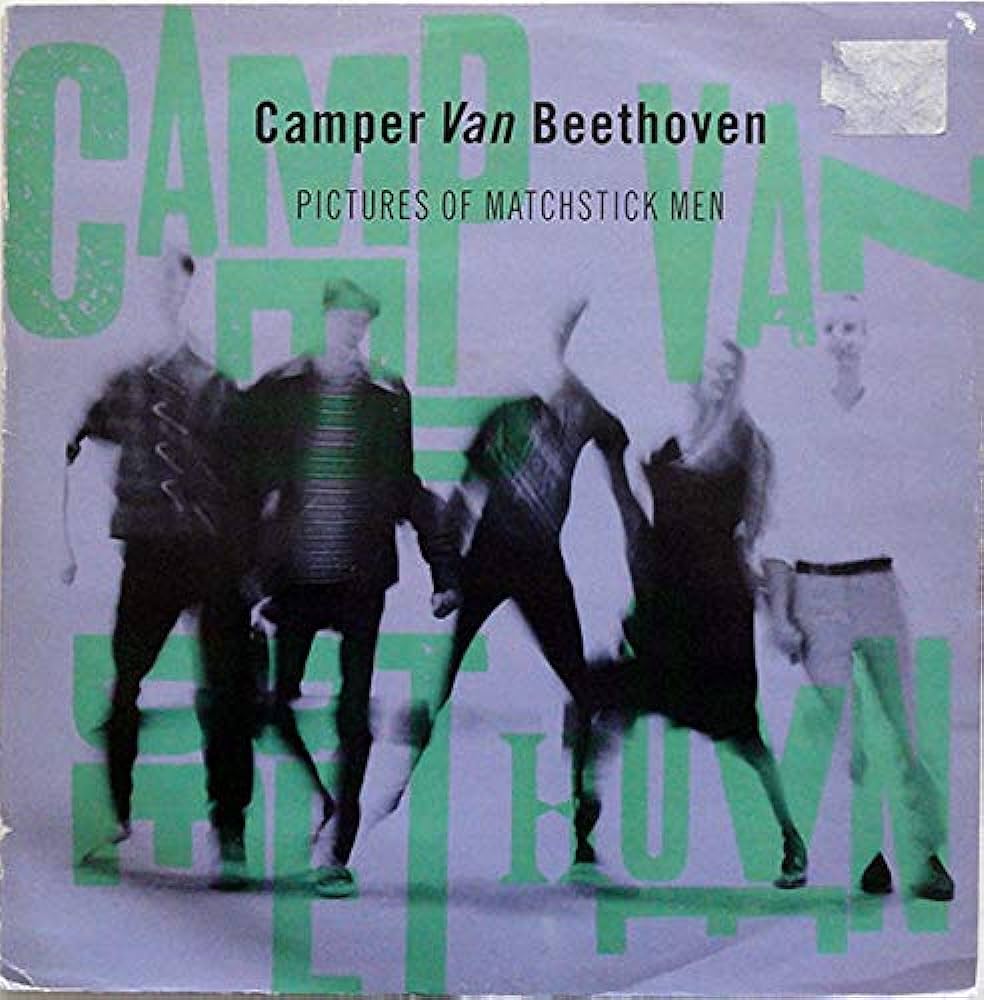
In a way, Camper Van Beethoven played a similar role to what their former tourmates R.E.M. did in the '80s. But R.E.M. were hugely popular even before they signed with a major label, and Camper Van Beethoven weren't built like that. CVB signed with a major label, scored one big modern rock radio hit, and then broke up. That would be a sad ending even if the big modern rock radio hit wasn't an ironic/not-ironic cover of a late-'60s psych-rock jam, reportedly included on their album to mollify their label. But before we get any further into CVB's story, we should talk about "Pictures Of Matchstick Men."
Francis Rossi and Alan Lancaster were teenagers when they started the London band known as the Spectres, and they were still teenagers when they made their first big hit. The Spectres gigged around town for a few years and released a couple of unsuccessful singles before changing their name to the Status Quo. In 1968, as the band members were getting into psychedelia, Rossi wrote a goofy, surreal riff-beast called "Pictures Of Matchstick Men." (Rossi later claimed that he'd written the song "on the bog," where he was hiding out from his wife and mother-in-law.) The lyrics are pure daffy absurdity -- "When I look up to the sky, I see your eyes, a funny kind of yellow/ Rush home to bed, I soak my head and see your face underneath my pillow" -- but the music is nasty proto-Sabbath heavy stomp. The combination worked. Great song.
"Pictures Of Matchstick Men" became a top-10 UK hit and peaked at #12 on the Hot 100. The Status Quo, who soon shortened their name to just Status Quo, went on to have an absolutely huge decades-long run on the UK charts. Status Quo were still cranking out massive UK hits into the '90s, and their singles were regularly charting as recently as 2010. Alan Lancaster died in 2021, but Franco Rossi, now 74, still leads the band. In the US, "Pictures Of Matchstick Men" remains Status Quo's only significant hit. It's just one of those things.
The Camper Van Beethoven career story looks nothing like the Status Quo career story. David Lowery -- not the one who directed The Green Knight and the Pete's Dragon remake, the other David Lowery -- grew up in the Inland Empire town of Redlands, California, about 70 miles east of LA. Lowery and his friends were into '70s hard rock before first-wave punk entered the mix. In the early '80s, Lowery and some friends played in weirdo punk bands with names like Sitting Duck and the Estonian Gauchos. Lowery went off to study at UC Santa Cruz, but when he was home for summer in 1983, he and some friends started a new band called Camper Van Beethoven And The Border Patrol. Pretty quickly, they shortened that unwieldy-ass name. Just by itself, Camper Van Beethoven was already a clever-enough moniker -- maybe even too clever.
Lowery and two of his bandmates returned to college in the fall, and the rest of the group went with them. The Camper Van Beethoven sound was a playfully surreal, vaguely countrified take on punk that sometimes messed around with ska or Middle Eastern music, even though the band members didn't know anything about that stuff. Jonathan Segel, another UC Santa Cruz student, joined the band, and he played multiple instruments, including violin, which leant another element to the sound. The early Camper Van Beethoven tracks mostly sounded like inside jokes, and one such song, their 1985 track "Take The Skinheads Bowling," became a kind of college-radio novelty hit. (Dr. Demento was an early supporter.)
From the very beginning, Camper Van Beethoven had an irreverent relationship with the songs that they covered. On their 1985 debut album Telephone Free Landslide Victory, they remade Black Flag's hardcore anthem "Wasted" as a self-consciously wacky country song, and they gave the same treatment to Sonic Youth's "I Love Her All The Time" on their second LP. As time went on, though, CVB became a little bit more respectful of the songs that they covered; their 1986 take on Pink Floyd's "Interstellar Overdrive" is a pretty straightforward psych-rock bugout. At the same time, they kept giving their own songs titles like "ZZ Top Goes To Egypt." CVB opened for R.E.M. on tour in 1986, and they later described the reaction as a deafening combination of cheers and boos.
Camper Van Beethoven were sarcastic cutups who made knowingly weird music. In 1986, the non-David Lowery members of the band launched the even-weirder side project Monks Of Doom. CVB's lineup kept changing. They had a devoted cult following, but their prospects for rock stardom were not great. Still, they signed with Virgin in time to release their fourth LP, 1988's Our Beloved Revolutionary Sweetheart. For the first time, they worked with an outside producer.
Dennis Herring was a former session musician who'd played on records from Barbra Streisand and the Pointer Sisters. Herring got into production in the mid-'80s, and he scored a surprise hit with his first job, Timbuk 3's 1986 single "The Future's So Bright, I Gotta Wear Shades." Herring was a Camper Van Beethoven fan, and he came aboard with Our Beloved Revolutionary Sweetheart, taking care not to mess with the group's creative process. Camper Van Beethoven scored a college-radio hit with their single "Eye Of Fatima (Part 1)" -- good song -- but it didn't cross over.
When Camper Van Beethoven recorded their second Virgin album, the band members weren't really getting along anymore. David Lowery wrote most of 1989's Key Lime Pie himself. Before they recorded the album, Lowery went to Dennis Herring and told him that he wanted the new LP to be a "dark folk" album but that he wasn't sure if Virgin would accept it. Herring knew that an album like that wouldn't sell, but he liked the songs. Lowery offered to write more of a straight-up rock record instead, but Herring advised him to stick with what he had. The "Pictures Of Matchstick Men" cover, which appeared as the penultimate track on Key Lime Pie, was the insurance policy -- the catchy rocker that could help Virgin sell an LP of battered, disillusioned songs about the fucked-up realities of Reagan-era America.
Camper Van Beethoven weren't the first alt-rock band to cover "Pictures Of Matchstick Men"; DC garage-punks the Slickee Boys released a version of the song in 1983. But CVB had been covering the track live for years before they released their take on it. They figured that the song's ringing opening riff would sound cool on violin, and they were right. In 1990, David Lowery told The Washington Post, "We're a little more raucous live than we are on record; we like to do bad covers -- songs we barely know, songs by ZZ Top, the Chocolate Watchband, and the like. Rock bands are too serious on stage; they don't give their audiences credit for being a little lighthearted. It doesn't ruin the mood if you screw around for a little bit and then go back to being serious."
By the time that they recorded Key Lime Pie, most of the wackiness was gone from Camper Van Beethoven's music. It's more of a straightforward, country-influenced rock album with embittered lyrics -- closer to the music that Lowery would make in the future. Some of that change probably came down to the departure of violinist Jonathan Segal, who left while they were rehearsing the songs for the record. CVB replaced him with Morgan Fichter, whose band Harm Farm had opened for Monks Of Doom. Fichtner only played on a few Key Lime Pie tracks, but one of them was the "Pictures Of Matchstick Men" cover. The song's video opens on her, and she looks cool as hell.
Even as Camper Van Beethoven moved in a more conventional direction on Key Lime Pie, their version of "Pictures Of Matchstick Men" still jumps out in the context of the album. It's bigger and more anthemic than anything else around it. I still can't tell whether the band's version is supposed to work as some kind of joke, and I have the same questions about a bunch of their non-cover tracks. I can, however, tell you that their version works. The band really clamps down on the groove. The violin blares like a siren, and the rest of the band sounds rich and swampy. Bassist Victor Krummenacher really fills out the melody, and David Lowery sings those ridiculous lyrics like he means them. Lowery probably wouldn't want to hear this, but his cracked, sincere rasp reminds me a little bit of Bryan Adams. I mean that as a compliment.
With "Pictures Of Matchstick Men," Camper Van Beethoven had a real underground hit on their hands. They did not take advantage. The cover wasn't enough to turn Key Lime Pie into a big seller, and the members of the band were getting sick of each other anyway. Camper Van Beethoven broke up in 1990. The other guys kept going with Monks Of Doom, while David Lowery started a new band called Cracker. Cracker turned out to be way more successful than Camper Van Beethoven; we'll eventually see them in this column. Late-period Camper Van Beethoven guitarist David Immerglück eventually joined Counting Crows, another band that'll eventually show up in the column. Immerglück wasn't an official Counting Crow when that band scored their one Modern Rock chart-topper, but he did get a Golden Globe nomination for co-writing the Shrek 2 track "Accidentally In Love."
In 1999, Camper Van Beethoven reunited for a one-off live show. The reunion stuck. CVB kept playing shows, and they started recording together again. Perversely enough, their first reunion record was a full-album cover of Fleetwood Mac's Tusk. Camper Van Beethoven released three more albums, and their most recent records are -- I swear to fucking god -- a pair of songs that they contributed to the soundtrack of 2015's Sharknado 3: Oh Hell No! (My favorite Sharknado 3 fun fact: Donald Trump was in negotiations to play the president in that movie before he became president in real life, and then he threatened to sue the producers when the role went to Mark Cuban instead.) Camper Van Beethoven were still playing live shows as recently as 2020. Their legacy is bigger than their "Pictures Of Matchstick Men" cover, but that cover is nothing to be ashamed of.
GRADE: 7/10
BONUS BEATS: I never know what to with the Bonus Beats of a cover song. There were other "Pictures Of Matchstick Men" covers after the Camper Van Beethoven version. Type O Negative and Ozzy Osborne, for instance, contributed their reading of the song to the soundtrack of the 1997 Howard Stern biopic Private Parts, but I don't think that cover has anything to do with the Camper Van Beethoven version. Instead, I'll note that Cracker, David Lowery's other band, have played "Pictures Of Matchstick Men" live a bunch of times, which kind of makes it a cover of a cover. Here's a fan video of Cracker playing the song, to a raucous reaction, at a 2009 show in Cleveland:
THE NUMBER TWOS: "I Want That Man," the sleek and assertive Harry Dean Stanton-inspired synth-rocker that Thompson Twins members Alannah Currie and Tom Bailey wrote and produced for Blondie leader Deborah Harry, peaked at #2 behind "Pictures Of Matchstick Men." It's an 8.