
February 10, 1990
- STAYED AT #1:7 Weeks
In The Alternative Number Ones, I'm reviewing every #1 single in the history of the Billboard Modern Rock Tracks/Alternative Songs, starting with the moment that the chart launched in 1988. This column is a companion piece to The Number Ones, and it's for members only. Thank you to everyone who's helping to keep Stereogum afloat.
There's this series of videos called "Dracula Flow" that's been going around online for the past few weeks. An older white guy, made up to look like an old-timey movie vampire, shouts ignorant and increasingly absurd rap punchlines into the abyss as voices offscreen giggle: "I'm on 12 Vicodins, smokin' on Scooby-Doo dick!" There's no reason why this guy has to be a Dracula, except that it makes everything feel that much sillier. That's how I feel about Peter Murphy.
Peter Murphy is the vampire guy. He's always been the vampire guy, and he'll always be the vampire guy. When Murphy was young, he had no grand designs on a singing career, but an old friend badgered him until he joined a band, presumably because he looked so much like a vampire guy. My main image of Peter Murphy will always be the one from the opening credits of 1983's The Hunger, the first movie that Tony Scott ever directed. Murphy is the first person to appear onscreen in the film -- shimmying his way toward the camera and locking eyes with the viewer, like he's trying to hypnotize someone.
The Hunger is a vampire movie, but as far as we know, Peter Murphy doesn't play a vampire. He's not really a character at all; he's just part of the atmosphere. In that opening scene, actual vampires David Bowie and Catherine Deneuve stalk through a nightclub crowd, looking for victims. I guess the idea is that Murphy's band Bauhaus is performing in that nightclub, playing their immortal vampire-themed banger "Bela Lugosi's Dead," but the other Bauhaus guys are almost entirely unseen. We just see Murphy in a lit-up cage, lip-syncing with no microphone. He looks like he's on a music-video set, and he basically is. None of this makes logical sense, but vampire kitsch has no need for logic.
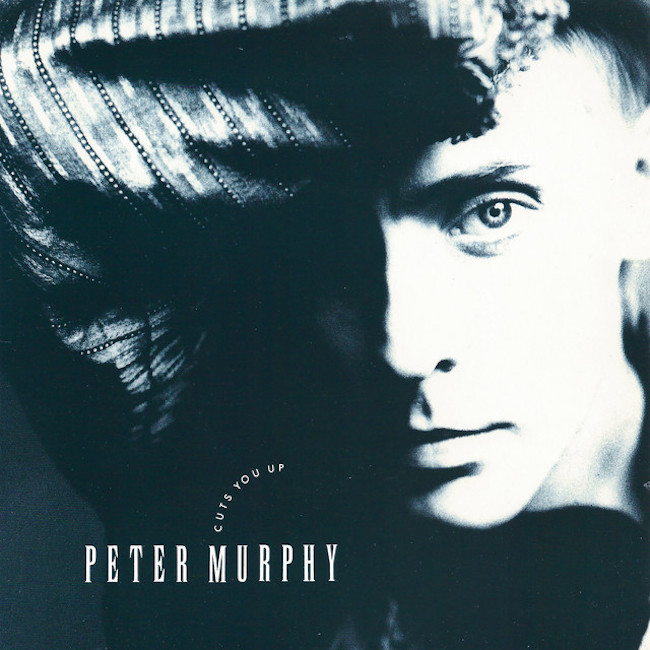
Peter Murphy doesn't strike me as someone who knows that he's making kitsch, which mostly means that his kitsch is the best kitsch. Murphy seems to take himself quite seriously, which is good; it's why his whole character works so well. Murphy looks like the vampire guy -- eyes so vivid that you can tell their color even in a black-and-white photo, cheekbones so sharp that they turn his face into a series of planes and angles. Murphy has served as inspiration for plenty of gothed-out comic book characters: the Crow, Dream from Sandman. That's a good niche. Murphy had a role, and he knew how to play it.
At the turn of the '90s, the moment when American college radio listeners were head-over-heels for anything sufficiently gothic and British, Murphy happened to make the biggest song of his life, the one track that came to loom larger than his past in Bauhaus. The song wasn't quite big enough to make Murphy into anything other than the vampire guy, but why would anyone want that? The life of a vampire-guy rock star seems extremely fun, at least until the excesses catch up to you.
Peter Murphy grew up in a working-class Irish Catholic family in the English town of Northampton. As a teenager, Murphy and his close friend Daniel Ash, like so many other kids in the UK, got heavily into glam rock. Ash had designs on rock stardom, but Murphy did not. Ash eventually went off to art school and started a few different bands, while Murphy went to work in his family's print shop. When one of Ash's bands broke up, he went straight to Murphy's house and essentially badgered Murphy into joining his band. That band became Bauhaus, and we already went into their history in the column on Love And Rockets' "So Alive."
Peter Murphy never sang before Bauhaus, and he didn't exactly sing in Bauhaus, either. Murphy doesn't have any dazzling vocal command, but he knows how to use his voice in the context of a dark and swirly rock song. Much like Bowie, his obvious greatest influence, Murphy bellows baritone proclamations through the murk, and he gets by on sheer presence. During their initial run, Bauhaus were cult-hero types who never had a huge impact on the pop charts, but they crystallized the growing goth style. Bauhaus didn't last long. They formed in 1978, quickly cranked out four albums, and broke up in 1983. Murphy already had other things going on. In 1982, he starred in a famous commercial for Maxell tapes, his hair and tie blown back by the sheer power of an early-'80s tape deck.
After Bauhaus, Peter Murphy got into dance performance and briefly considered an acting career, but he came back to music quickly. Murphy and Mick Karn, a former member of the glam-rock band Japan, got together to form a new group called Dalis Car. Their one album, 1984's The Waking Car, was a dismal commercial failure, and Murphy quickly lost interest. (He regained interest in 2012, when Dalis Car released a reunion EP.) Murphy briefly considered a proposed Bauhaus reunion in the mid-'80s, but he flaked on it, and his former bandmates went on to form Love And Rockets instead. Murphy started working with L. Howard Hughes, a former member of British new wave band the Associates, and released his 1986 solo debut Should The World Fall Apart on the British label Beggars Banquet.
Should The World Fall Apart didn't sell, and Murphy's first solo single, a cover of Pere Ubu's "Final Solution," just barely scraped the bottom of the UK singles charts. But when you've got a singer who looks like Peter Murphy, you don't give up on him so easily. Murphy and L. Howard Hughes parted ways, but Murphy found another musical partner in Paul Statham, a former member of the forgotten UK synthpop group B-Movie. Together, Murphy and Statham wrote Murphy's second solo album, 1987's Love Hysteria. They recorded it with producer Simon Rogers, who, at the time, was a member of the great and famously chaotic British post-punk band the Fall. (Later on, Rogers would join the Lightning Seeds. That band's highest-charting Modern Rock hit, 1992's "The Life Of Riley," peaked at #2. It's an 8.)
In the UK, Love Hysteria sold even worse than Should The World Fall Apart. But Beggars Banquet worked out a distribution deal with RCA, and Love Hysteria got an American release, while Should The World Fall Apart was an import-only deal over here. Murphy toured the US with the Church, a band who will soon appear in this column, and his video for the single "All Night Long" got some minor MTV burn. It was a start. When Murphy reappeared with bleached hair and a 1989 album called Deep, America was ready for him.
Peter Murphy recorded Deep with the same team he'd used on Love Hysteria: Producer Simon Rogers, co-writer Paul Statham, various sundry session-musician types. It's a weird record. Murphy must've watched with great interest as his ex-bandmates in Love And Rockets went top-five in the US with "So Alive." Some of the songs on Deep sound like Murphy is making his best approximation of turn-of-the-'90s mainstream pop. There are breakbeats. There are squealing guitars. There are moments where you get the sense that someone has put a gun to the bass player's head and told him to get as busily funky as possible. The whole time, though, it's Peter Murphy. The guy couldn't be normal if he tried. Despite his best efforts, Murphy is always going to sound less like George Michael, more like a guy holding a cape in front of his face.
The first single from Deep wasn't the Peter Murphy song that everyone knows. Instead, get a load of this title: "The Line Between The Devil's Teeth (And That Which Cannot Be Repeat)." This fucking guy. Gotta love him. "The Line Between The Devil's Teeth" has a big, attention-dominating beat and a few rubbery rock 'n' roll guitar bits that wouldn't have sounded out of place on a Huey Lewis record. It has multiple verses where Murphy sounds like he might be attempting to rap. It's a ridiculous record, a total mess, and it did not turn Murphy into a pop star. On the Modern Rock chart, during a moment when that chart was uniquely hospitable to Peter Murphy types, that song peaked at #18.
But Beggars Banquet must've released "The Line Between The Devil's Teeth" as a signal to let us know that the vampire was back. Everyone involved must've known that "Cuts You Up" was the closest thing to a guaranteed hit that Peter Murphy would ever record. Where Murphy so often sounded like he was thrashing around, searching for direction, "Cuts You Up" sounds like the work of an artist who knows exactly who he is.
"Cuts You Up" is plenty cartoonish. It's even more cartoonish if you see the video, with Peter Murphy's newly white-blond hair blowing in the studio-fan wind, the light hitting his face at angles that accentuate the geometrically pointy nature of his entire bone structure. Murphy goes running though the misty forest. He howls at the moon. He preens in the direction of mysterious light sources. The only other person who appears on camera is a bassist who plays his instrument with a violin bow. Amazingly, said bassist looks a whole lot like Wesley Snipes' Blade, even though that Blade was still years away from hitting movie screens. Maybe the Daywalker caught that video on MTV and rethought his entire stylistic presentation. Even Peter Murphy's backing-band guys were out here setting vampire trends.
The violin on "Cuts You Up" isn't a real violin, by the way. It's not a Blade-looking guy playing bass with a violin bow, either. It's a keyboard imitating the sound of a viola. Producer Simon Rogers brought in a real viola player to do that part, but it didn't sound as good as the keyboard. It makes sense. "Cuts You Up" vaguely gestures in the direction of acoustic folk, but there is no room for authenticity fetishization here. This is Peter Murphy! If it ain't ecstatically fake, it ain't shit!
Anyway: You know the way it draws you out? It takes you in and spits you out? It spits you out when you desire, to conquer it, to feel you're higher? No? Me neither. I'm not sure Peter Murphy knows, either. Years later, asked to define the "it" of "Cuts You Up" in a Songfacts interview, Murphy said, "The path of discovery, self-knowledge, wisdom... once you feel, you have it. Then the path will spit you out or off the way and ruin your assumptions of this path." Perfect! Awesome! Exactly the kind of meaninglessness that I want from Peter Murphy! "Cuts You Up" is all flowery allusion, no concrete specifics. This works great for me. Murphy bellows out those lines like they mean something, so it really doesn't matter if they do or not.
"Cuts You Up" is a pretty definitive piece of circa-1990 goth-pop. Everything is where it's supposed to be. The fake viola mopes prettily. The guitars churn and flutter. The bass player crams as many notes in as he possibly can. Peter Murphy makes his declarations like he's playing a wizard in a low-budget fantasy film. For the most part, I find "Cuts You Up" to be a glowingly pompous, endearingly ridiculous song. But that changes on the bridge, when the track suddenly explodes.
Power chords vroom in. The synth-blanket gets heavier. Murphy starts wailing wordlessly -- "whaaaaaa-oooooooh la la la lew lew" -- while his multi-tracked voice comes in with the "cuts you up!" exclamations. In that moment, "Cuts You Up" takes off soaring, reaching levels of echoing stadium-rock majesty that Peter Murphy had never touched before and would never touch again. As the song winds down to its ending, we get a repeat of that bridge, and it sounds awesome again. That part of the song makes me wonder why all of "Cuts You Up" couldn't sound like that, but I guess if you could summon miraculous moments at will, they wouldn't be miraculous moments.
On alternative rock radio, "Cuts You Up" was a monster -- one of that chart's biggest hits of all time. When I made alt-rock radio a regular part of my diet a couple of years later, I still heard "Cuts You Up" all the time. The song didn't turn into a huge pop hit like Love And Rockets' "So Alive" had, but it did cross over, reaching #55 on the Hot 100 -- Peter Murphy's only appearance on that chart ever. Deep even did pretty well on the Billboard album chart and reportedly moved a few hundred thousand units. But the album didn't have any other songs on that level, and follow-up single "Strange Kind Of Love" couldn't get any higher than #21 on the Modern Rock chart.
"Cuts You Up" turned Peter Murphy into a full-on rock star, at least in goth hotbeds like Los Angeles. (LA has always loved a fancily mopey British goth-rocker. It's honestly one of the coolest things about that town, in my opinion.) While "Cuts You Up" was still bubbling in alt-culture, Peter Murphy married a big-deal choreographer, moved to Turkey, and converted to Sufism. In 1992, Murphy returned with his big follow-up Holy Smoke. The album didn't sell very well, but its single "The Sweetest Drop" made it to #2 on the Modern Rock chart. (It's a 5.) After that album cycle wound down, Murphy never appeared on that chart again.
Peter Murphy kept cranking out albums, first through Beggars Banquet and then through a few different smaller indies. For a while, he kept working with Paul Statham, who later went on to write songs for Kylie Minogue. (I've been trying to figure out whether Paul Statham is any relation to Jason, and I just can't find confirmation. Let's hope.) A bunch of times in the '00s, Murphy performed with Nine Inch Nails, who definitely learned from his whole vampire swag and who will eventually appear in this column. In 2005, Bauhaus reunited, and Peter Murphy made his big Coachella main-stage entrance by singing all nine minutes of "Bela Lugosi's Dead" while hanging upside-down, like a bat. What can you even say? That's just fucking cool.
The Bauhaus reunion turned out to be fairly successful and durable -- at least in part, you've got to think, because everyone in the band continued to look great as they entered middle age. These things matter! Bauhaus toured with Nine Inch Nails and released a fifth album, 2008's Go Away White. But the Bauhaus reunion kept running into one big problem, and that big problem was Peter Murphy.
In 2013, Peter Murphy was arrested in LA for DUI, hit-and-run, and meth possession. In 2018, he was reportedly kicked out of his own show for throwing a bottle into the crowd and hurting someone in the audience. Last year, Bauhaus cancelled a planned North American tour so that Murphy could head into rehab. According to his bandmates, the Bauhaus reunion is over now. Let's hope Murphy gets the help he needs. After all, you don't get to live forever just because you look like a vampire.
GRADE: 7/10
BONUS BEATS: Here's Peter Murphy achieving his destiny, playing an mythic vampire called the Cold Man in the 2010 motion picture The Twilight Saga: Eclipse:
THE NUMBER TWOS: The Jesus And Mary Chain's reckless, incandescent riff-beast "Head On" peaked at #2 behind "Cuts You Up." The way I feel tonight, it's a 10.