
March 31, 1990
- STAYED AT #1:1 Week
In The Alternative Number Ones, I'm reviewing every #1 single in the history of the Billboard Modern Rock Tracks/Alternative Songs, starting with the moment that the chart launched in 1988. This column is a companion piece to The Number Ones, and it's for members only. Thank you to everyone who's helping to keep Stereogum afloat.
How would I write about this song again? When I agreed to start writing The Alternative Number Ones, it was the first question that I asked myself. Only a few songs have ever reached #1 on both Billboard's Hot 100 and its Modern Rock Songs chart. One of those songs is Sinéad O'Connor's epochal reading of "Nothing Compares 2 U," a song first written by Prince in 1984.
In its moment, "Nothing Compares 2 U" was a runaway cultural freight train -- a single so powerful that it took Sinéad O'Connor from college-radio/critical-favorite status to full-on mainstream celebrity, thus affecting O'Connor's life in some terrible and unforeseen ways. But I already wrote about "Nothing Compares 2 U" in The Number Ones. I put my foot in that motherfucker, too. I'm prouder of that column than almost any of the other thousand-plus that I've written while working on the column these past six years. And now I was going to write about it again? How?
Then, a few weeks after I started writing The Alternative Number Ones, Sinéad O'Connor died. She was 58. "Nothing Compares 2 U" meant a lot of things before July 2023, and it means even more now. This will still be a hard column to write, but it won't be hard in the ways that I anticipated.
The death of Sinéad O'Connor fucked me up. It sent me spiraling. I'd never met Sinéad O'Connor, never seen her live, didn't even really consider myself a fan when she was at her peak. But Sinéad O'Connor meant something to me. I have overwhelming admiration for people who put themselves on the line to speak out against injustice, sometimes suffering terrible consequences as a result. I have that same admiration for people who have the nerve and ability to live in a frantically, visibly vulnerable way -- people who won't, can't, let the bullshit suffocate them. On all counts, O'Connor was one of those people. She was a messy, fucked-up human being who regarded the inhumanity all around her with abject horror, and she said so. American popular culture, which had only recently embraced O'Connor, proceeded to spit her out like she was poisonous.
When Sinéad O'Connor died, I cried in therapy. I didn't cry in therapy when my dad died. That's not to say that Sinéad O'Connor meant more to me than my father; she didn't. But she did mean a whole lot to me, and when she died, I reeled. I fell down rabbit holes, and it got to the point where I resented the new music that I had to write about -- resented doing a job that I love -- because it meant that I couldn't just get lost in my own head with "Troy" or "Black Boys On Mopeds" on repeat. Live videos became a real fixation. Watching clips of O'Connor performing, I couldn't believe that this person had ever existed, that she'd managed to fall into our cultural conversation. Look at her. Listen to her. Imagine being in that room. Astonishing.
In many ways, Sinéad O'Connor represented the ideal way that the Billboard Alternative charts were supposed to work. The people at the magazine recognized that there was this whole thriving world of music out there -- one that had its own ecosystem, that could flourish without necessarily having anything to do with the mainstream pop charts. In practice, the Modern Rock Songs chart didn't really work that way, at least for its first few years. Instead, it was a playground for veterans of the British punk and new wave explosions. I love a lot of the artists that I've covered in this column, but many of them were long past their prime when they notched their Modern Rock #1 hits. They represented an alternate establishment, but it was still an establishment. This was not the case with Sinéad O'Connor.
In some ways, Sinéad O'Connor was a product of the British post-punk music scene. (She was Irish, but she was living in London when she began her career in earnest.) Before recording her world-conquering smash, O'Connor worked with some of her older peers: U2's Edge, Stiff Little Fingers' Ali McMordie, the Smiths' Andy Rourke, the Waterboys' Karl Wallinger. (U2 have already appeared in this column once, and they'll be back. As leader of World Party, Karl Wallinger will eventually appear in this column.) Siouxsie Sioux was an early influence. But O'Connor also made her one huge hit with an on-the-rise dance-pop producer, and she did it with a cover of a Prince song. She wasn't trying to play by the alt-rock rules any more than she was trying to play by the pop rules.
I can't imagine what it must've been like to hear Sinéad O'Connor's voice for the first time in 1987, when she released her debut album The Lion And The Cobra. What would your frame of reference even be? Kate Bush? Enya? O'Connor didn't sing like anyone else. She used her voice like a dagger with a velvet handle. She keened, howled, yipped, yodeled. The voice was so entrancing that you might miss the devastating incisiveness of her lyrics, even though she always enunciated those words with vengeful precision. The Lion And The Cobra is a rock album, more or less, and that's how she recorded it. "Mandika," the biggest song from that LP, is a full-on riff-beast, written after O'Connor watched Roots and recorded with Adam Ant collaborator Kevin Mooney. What a fucking song.
"Mandika" was a proper hit in the UK and Ireland. In the US, "Mandika" never crossed over to the Hot 100, but it was huge at college radio. Over here, The Lion And The Cobra went gold, and critics voted it the 33rd-best album of the year -- right behind George Michael's Faith, right ahead of LL Cool J's Bigger And Deffer. (On that year's Pazz & Jop poll, critics voted Prince's Sign "O" The Times #1. Can't argue with that.) At the 1989 Grammys, O'Connor sang "Mandika" live. She had Public Enemy's logo painted on the side of her head, to protest the Grammys' decision to give out the first rap award off-air, and she had her infant son's onesie tucked into the back of her jeans. She was 22 years old.
One week after Billboard ran its first Modern Rock Songs chart, Sinéad O'Connor made her first appearance. Her single "Jump In The River" would eventually show up on her 1990 album I Do Not Want What I Haven't Got, but it first came out on the Married To The Mob soundtrack. (Jonathan Demme always had great taste in soundtrack songs.) "Jump In The River," a crunchy rock post-punk song that got a bugged-out remix with the performance artist Karen Finley, peaked at #17. O'Connor had a much bigger song on deck, even if the song in question wasn't, strictly speaking, hers -- not yet, anyway.
It bums me out that Prince never got any love on alt-rock radio. Prince certainly made plenty of music that could qualify as "alternative rock," and at least a few of his disciples, guys like Lenny Kravitz, did well on that chart. Prince played guitar better than basically anyone who will ever appear in this column, and he shared plenty of influences with British new wavers and post-punkers. All the critics loved him, in New York and elsewhere, but those radio stations never embraced him. In his long and illustrious career, Prince only landed on the Modern Rock Songs chart once -- with motherfucking "Batdance," which peaked at #18 in 1989. Explain that to me.
Just as I already covered Sinéad O'Connor's whole backstory in the first column on "Nothing Compares 2 U," I also covered the song's genesis. Broad-strokes recap: Prince wrote the song and recorded the demo one night in 1984, possibly because he was sad that his housekeeper wasn't working for him anymore. He gave the track to a group of protegés called the Family, and their version came out in 1985 and went nowhere. O'Connor's manager Fachtna O'Ceallaigh brought the song to her. They'd been dating, and they were in the process of breaking up when she recorded her version. In a Sound On Sound interview, engineer Chris Birkett says, "That's probably why she did such a good vocal. She came into the studio, did it in one take, double-tracked it straight away, and it was perfect because she was totally into the song. It mirrored her situation." O'Connor always insisted that her version of the song had nothing to do with O'Ceallaigh -- that she would think of her late mother whenever she sang it.
Sinéad O'Connor co-produced her version of "Nothing Compares 2 U" with Nellee Hooper, a Bristol native who'd been in the omnivorous post-punk band Maximum Joy. As a producer, Hooper got his start working with the acid house DJ Bomb The Bass and then played a big role in producing a bunch of truly great late-'80s hits for the London collective Soul II Soul. Those Soul II Soul tracks are graceful, and I hear the same sense of space and motion on "Nothing Compares 2 U" -- the combination of the flighty strings and pianos with the deep head-nod groove of those drums. Japanese jazz musician Gota Yashiki worked on the track, too. But Sinéad O'Connor, who co-produced "Nothing Compares," was probably just as responsible for all that stuff as anyone. O'Connor produced the rest of the album herself, and she can claim sole credit for things like the way "I Am Stretched On Your Grave" combines Irish folk fiddles with the "Funky Drummer" breakbeat. She understood music. She knew what she was doing.
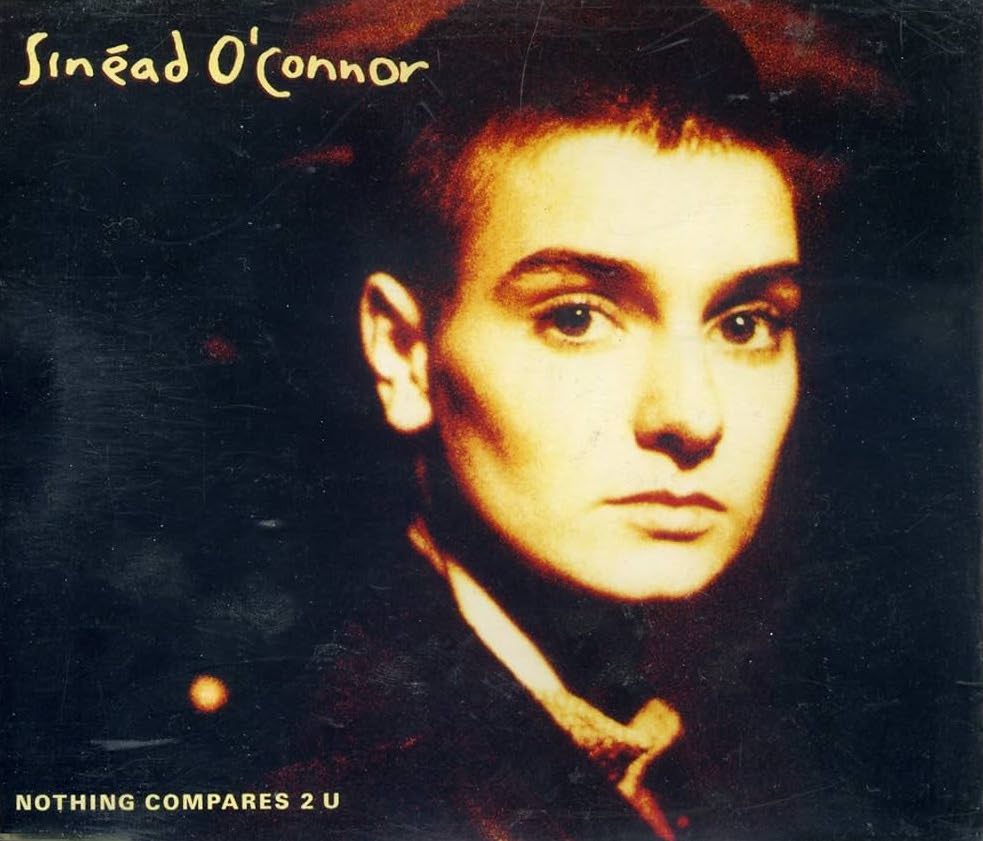
I'm not going to go into a whole new thing about Sinéad O'Connor's vocal on "Nothing Compares 2 U." You already know that it's fucking incredible. She sings the song with raw, ferocious longing, and she elevates the words and the melody that Prince wrote into something else. It's like Stanley Kubrick turning a pretty-good Stephen King book into a dread-soaked sacred text. The song's video, with its long close-up on O'Connor's face and the tears sliding down her cheek, was instantly iconic. In her 2021 memoir Rememberings, O'Connor says that she was embarrassed about crying during the video shoot. She thought her tears made those takes useless: "So it's good that we're shooting all this stuff in Paris. I feel bad I wasted everyone's time and money, though... I was crying about my mother being dead. I'm still really messed up about it, even though I'm 24. A little embarrassing. But there you go. I'm a girl."
Rememberings is such a great book -- so absorbing, so readable, so sad. When it came out, the big story that everyone talked about was O'Connor's account of meeting Prince -- being summoned to his mansion and then terribly abused. O'Connor had already told that story, but she went into greater detail in her memoir. In the context of the book, there's something absurd and maybe even funny about that whole account. I don't doubt that Prince was a threatening dickhead to O'Connor, but both of them come off as weird little freaks. They were never going to like each other. The problem is that Prince was a controlling type of weird little freak, and Sinéad O'Connor was simply not going to be controlled.
I wasn't listening to alternative radio in 1990, so I don't know how "Nothing Compares 2 U" sounded next to They Might Be Giants or the House Of Love or whatever. At the time, alt-rock radio was certainly opening up to relatively non-rock sounds. Soulful and rave-adjacent records like the Beloved's "Hello" were charting around the same time, so maybe that made it sound a little less alien. ("Hello" peaked at #6 behind "Nothing Compares 2 U." It's a 7.) But "Nothing Compares 2 U" is a true one-of-one song. It must've stood out in every context.
Less than a month after "Nothing Compares 2 U" topped the Modern Rock chart, it was #1 on the Hot 100. In her book, O'Connor writes that she was on the toilet when someone delivered the news that her single and album had both reached #1 in the US: "Whoever it was who told me got cross with me because I didn’t take the news happily. Instead, I cried like a child at the gates of hell." O'Connor knew that her tremendous, out-of-nowhere pop success would not be a good thing for her, and she was right.
At various points in her career, Sinéad O'Connor said that she was done with "Nothing Compares 2 U." The song wasn't interesting to her anymore. It had been spoiled by her experiences, with Prince and with others. But she eventually made her peace with it. In Rememberings, O'Connor wrote, "'Nothing Compares 2 U' was a song I was always -- and am always -- singing to my mother. Every time I perform it, I feel it's the only time I get to spend with my mother and that I'm talking with her again." O'Connor's final tour happened early in 2020, just before the pandemic. The last show that she ever played was at the Rio Theatre in Santa Cruz. She sang "Nothing Compares 2 U" that night, just as she sang it on most nights. As on most nights, she seemed to have an out-of-body experience singing it, even if all we have of that performance is grainy cell-phone footage.
On the pop charts, "Nothing Compares 2 U" is the only proper hit that O'Connor ever made. But on alternative radio, O'Connor lingered a little longer. We'll see her in this column again.
GRADE: 10/10
BONUS BEATS: When Prince died, a whole lot of artists covered "Nothing Compares 2 U" in tribute, and I put many of those covers in the last "Nothing Compares 2 U" column. The same thing happened when Sinéad O'Connor died a few months ago. Here, for example, is Patrick Stump playing a solo-piano version of "Nothing Compares 2 U" at a Fall Out Boy show in Atlanta:
@humancancer @Fall Out Boy performing “Nothing Compares 2 U” to honor Sinéad O’Conner after her passing in Atlanta, Ga. #falloutboy #sineadoconnor #atlanta #georgia #nothingcomparestoyou
♬ Nothing Compares 2 U - Sinéad O'Connor
(To be fair, Stump was already covering that song before Sinéad O'Connor died. Fall Out Boy landed their first #1 Alternative hit earlier this year, so they'll eventually appear in this column if I keep writing it for long enough.)
Here's Pink and Brandi Carlile singing "Nothing Compares 2 U" together at Citi Field in New York:
Here's Living Colour covering "Nothing Compares 2 U" and then going straight into Led Zeppelin's "Rock And Roll" in Boston:
(Living Colour's highest-charting Modern Rock single, 1990's "Type," peaked at #3. It's a 6.)
And here's Hot Chip, with Charles & Eddie's Eddie Chacon, doing "Nothing Compares 2 U" in LA: