
April 7, 1990
- STAYED AT #1:1 Week
In The Alternative Number Ones, I'm reviewing every #1 single in the history of the Billboard Modern Rock Tracks/Alternative Songs, starting with the moment that the chart launched in 1988. This column is a companion piece to The Number Ones, and it's for members only. Thank you to everyone who's helping to keep Stereogum afloat.
The late '80s were a time of peak monoculture, an era when a handful of huge, massively recognized stars lorded over the pop charts. But a few weird things did slip through the matrix and onto the radio. One of those weird things was a big, bald, severe-looking motherfucker bellowing a blooz-rawk anthem about Australian indigenous land rights. Did American radio listeners know what the fuck Midnight Oil leader Peter Garrett was singing about on "Beds Are Burning"? I can't speak for all of us, but no, probably not.
I was a kid when Midnight Oil broke though to the mainstream, and I didn't even get the bit about "the Western Desert lives and breathes at 45 degrees." I was like: "That's the desert? That sounds cold." Nobody had told me about the metric system yet. Nevertheless, I could tell that Peter Garrett meant what he was singing. In both voice and physical presence, Garrett vibrated with passion. And the song's video -- the band riding through the Australian desert, banging on drums in the back of the truck, looked cool as hell. MTV might've been an unlikely forum for Midnight Oil, but in that context, they stood out.
By the time that "Beds Are Burning" dropped, Midnight Oil were a long-established force in Australia. The band spent years playing the same wild, rowdy bar circuit as AC/DC, honing a sound that was big and angry and direct enough to get through to the drunk surfers at their shows. They landed on the radio in the US by belting out fierce, devoted songs about left-wing Australian causes. Maybe that made them more approachable in the US, where we could just treat those songs as if they meant nothing. But I think it's cool that Midnight Oil got as big as they did without changing their sound or their perspective for American consumption.
I find that protest songs are a lot more meaningful and effective when they target specific, granular causes rather than going for grand and vague "the world is fucked up" sloganeering. Midnight Oil clearly agree, and that's how this column gets a chance to dive deep into a stadium-sized singalong about the victims of an asbestos mining disaster.
Midnight Oil didn't start out as crusading true believers. Instead, the group's beginnings date all the way back to 1972, when they were just some young guys who called themselves Farm -- terrible band name -- banging out Zeppelin covers in Canberra. Peter Garrett, a local law student, tried out to be their singer after answering a classified ad. Garrett turned out to be a great rock frontman, less for his melodious singing voice than for his unmistakable presence. He's 6'4", which I understand is quite tall by normal-people standards, and he looks super-intense -- bald head, penetrating eyes, skinny-but-muscular Skeletor build, spasmodic-freak dancing style.
The newly-renamed Midnight Oil spent years playing for disinterested and sometimes violent surfers up and down Australia's East Coast, which must've been a real proving ground. Eventually, Peter Garrett moved to Sydney to finish up his law degree, and the rest of the band moved with him. The band found a domineering manager and started up a label of their own, and they released their self-titled debut album in 1978. Early Midnight Oil singles like "Run By Night" and "Cold Cold Change" are straight-up down-the-middle hard rock with an intensity that suggests at least a vague familiarity with punk, pub-rock, and new wave. They're definitely not punk records, though. The Hoodoo Gurus, a fellow Australian band who have already been in this column, had a more direct sonic connection to American alternative music. Midnight Oil sounded more like a hungry young mainstream rock band, though their extremely Australian identity probably made them a bit more exotic abroad.
Midnight Oil were not an immediate commercial success in Australia. Instead, they built their name by playing exhilarating shows all over the country. The band also cranked out records quickly, and their sound grew more strident and political over time. Their fourth album, 1982’s 10, 9, 8, 7, 6, 5, 4, 3, 2, 1 -- very irritating title to type -- was their breakthrough in Australia. The LP sent the single “Power And The Passion” into the top 10 and eventually went platinum seven times over. It also cracked the bottom of the American album chart, as did the band’s 1984 follow-up Red Sails In The Sunset.
In the mid-‘80s, you could almost look at Midnight Oil as an Australian answer to U2 -- albeit one that was too Australian to be too much like U2. The twitchiness of Midnight Oil's sound recalled Men At Work, and Peter Garrett’s voice sounded nothing like Bono’s, but the two bands shared gifts for big-gesture rock ’n’ roll proselytizing. Like U2, Midnight Oil were very into their favorite causes, putting on especially hard for nuclear disarmament. (Peter Garrett even ran for the Australian Senate under the banner of the Nuclear Disarmament Party in 1984. He lost badly, but he’d do better in future elections.) Midnight Oil would never get anywhere near as big as U2 in the US, but it’s telling that they had their big American breakthrough in the wake of The Joshua Tree.
In 1987, Midnight Oil released Diesel And Dust, an album at least party inspired by a tour through Aboriginal communities in the outback. That album had “Beds Are Burning,” the anthem that turned Midnight Oil into a true international force. The song went top-10 in both Australia and the UK. In America, “Beds Are Burning” was one of the biggest college-radio hits of the ’80s, and it crossed over to the mainstream, going all the way to #17 on the Hot 100. Midnight Oil also made it to #53 with “The Dead Heart,” a song written, controversially, from the perspective of oppressed indigenous people. That lyrical conceit wouldn’t fly today, but it’s a good song.
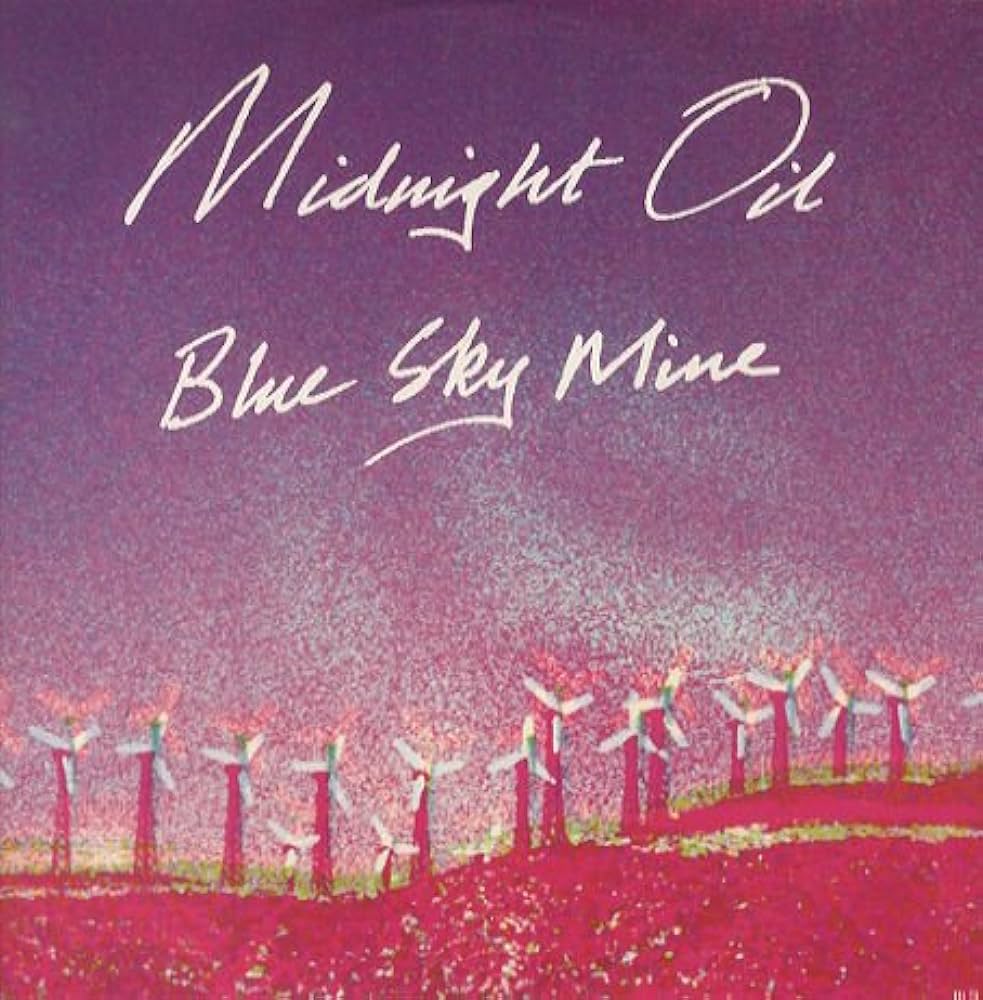
Diesel And Dust eventually went platinum in the US, and the album cycle was still raging when Billboard started running the Modern Rock Songs chart in 1988. "Dreamworld," the fourth single from Diesel And Dust, peaked at #16. That's a good song, too. Midnight Oil toured the world for a few years, and the band's members were pushing 40 by the time they came out with their follow-up LP Blue Sky Mining. The world outside Australia was just starting to catch on, but that was album number seven for Midnight Oil. They knew what they were doing, and they weren't about to change their approach.
"Blue Sky Mine," the sort-of title track from Blue Sky Mining, was inspired by a very specific corporate crime. From 1948 to 1966, Australia's Colonial Sugar Refining Company ran a blue asbestos mine in Wittenoom, a small town in Western Australia. Many of the miners were emigrants from countries like Italy. The company kept the mine open even after learning about the lethal nature of asbestos, and the miners and people of the town were continually exposed to hazardous material for a long, long time. Ultimately, cancer killed thousands of them -- something like a third of the mine's workforce. It's still considered the worst industrial disaster in Australian history. The town was completely abandoned, and victims spent decades chasing settlements from the company -- a process that was still ongoing when Midnight Oil wrote the song.
It can't be easy to write a radio-ready four-minute rock song about cancerous chemicals and uncaring corporations, but this was right in Midnight Oil's wheelhouse. The band spent a while working on "Blue Sky Mine" before they came up with a version that worked. Co-producer Warne Livesey, who'd also worked with the band on Diesel And Dust, said that they were going for a Motown thing with the track's tootling organ, and I guess I can kind of hear that. Mostly, I hear a lot of smart studio and songwriting tricks -- multi-tracked acoustic guitars, massed call-and-response backup vocals, a jangle-twang guitar solo -- there to support a song that's catchy and angry in equal measure.
On "Blue Sky Mine," Peter Garrett sings from the perspective of a sick miner who's out for justice: "My gut is wrenched out, it is crunched up and broken/ My life that is lived is no more than a token." He keeps working at a job that's killing him because it's the only way for him to keep going from paycheck to paycheck, as the company exploiting him lies to shareholders and keeps an army of PR people on retainer. (These days, the idea of lying to shareholders almost seems quaint. Shareholders love it when people get worked to death!) Garrett's narrator ultimately finds out that there's no help to be found anywhere: "If the Blue Sky Mining Company won't come to my rescue/ If the sugar refining company won't save me/ Who's gonna save me?"
I'd never heard of the Wittenoom mining disaster when "Blue Sky Mine" came out, and I really only had the vaguest idea of its story before I sat down to research this column. Still, the gist of the song feels universal. You don't have to follow the Australian news to get the message: "The company takes what the company wants/ And nothing's as precious as a hole in the ground." In its way, "Blue Sky Mine" fits the same archetype as decades of American folk and protest songs. It almost works as an update of "Sixteen Tons," with extra carcinogens sprinkled on top.
"Blue Sky Mine" is a message song that never sounds like pious hectoring. It moves. It's possible to hear Peter Garrett's honk as an Australian working-class hero equivalent to Bruce Springsteen's factory-worker mutters. You hear this guy raging at the forces arrayed against him, and you want to be on his side. A lot of that comes down to the massive fists-up chorus and to all the sharp touches -- the echoing morse-code guitars, the florid riffage, Garrett's back-and-forth with his bandmates' backing vocals. I just wish we didn't get Garrett playing harmonica, though. Maybe that's a personal thing. Whenever I hear anyone getting really busy with the blues-harp theatrics, I get a powerful sense of secondhand embarrassment, and that hits a whole lot harder when you see Garrett's full-body gesticulating in the "Blue Sky Mining" video. (The clip, shot on Australian salt flats in insanely hot summer weather, otherwise looks pretty awesome.)
Whether or not "Blue Sky Mine" brought increased international scrutiny to the Colonial Sugar Refining Company, the song definitely kept Midnight Oil's international momentum up. "Blue Sky Mine" became Midnight Oil's third and last Hot 100 hit, peaking at #47 on that chart. It went to #1 on both Modern Rock and AOR radio, which says a lot. Midnight Oil were probably a more natural fit on mainstream rock radio, where they were competing with guys like Don Henley, Damn Yankees, and Aerosmith. I'm not sure there's anything innately alternative about Midnight Oil beyond their politics, but between Peter Garrett and Sinéad O'Connor, circa-1990 modern rock radio was awfully friendly to outspoken bald singers. The Blue Sky Mining album had more Modern Rock hits, too. We'll see Midnight Oil in this column again soon.
GRADE: 8/10
BONUS BEATS: Here's actress Genevieve Lemon, who's been in a bunch of Jane Campion films, singing a relatively mellow "Blue Sky Mine" cover on Australian TV in 2007: