
February 9, 1991
- STAYED AT #1:5 Weeks
In The Alternative Number Ones, I'm reviewing every #1 single in the history of the Billboard Modern Rock Tracks/Alternative Songs, starting with the moment that the chart launched in 1988. This column is a companion piece to The Number Ones, and it's for members only. Thank you to everyone who's helping to keep Stereogum afloat.
Remember optimism? You might not. You might've been too young. You might not have even been born yet. Or maybe you were so secure in your foul opinion of the world, of humanity as a whole, that the brief tide of good feelings passed you by entirely. I barely remember, and I don't know if I bought it even then, when I was like 10 years old. But for a brief moment around the turn of the '90s, it became popular to believe that things were looking up -- that we might've even reached the vaunted "end of history," as an incredibly dumb 1992 Francis Fukuyama book put it.
In November 1989, the Berlin wall came down. In the months that followed, the Iron Curtain quickly crumbled, which led to the USSR finally dissolving in 1991. For the first time in generations, it seemed like maybe you wouldn't be instantaneously incinerated in a nuclear fireball. Nelson Mandela was freed from prison in 1990. The Gulf War ended fairly quickly and quietly, as these things go, in January 1991. Western intellectuals started to embrace the idea that the whole world would soon be united under a liberal democratic order, and plenty of regular people bought in. Also, generational shifts were happening, and baby boomers were starting to rise to positions of power around the world. For a minute there, people actually thought this might be a good thing.
It all seems just heartbreakingly naive in retrospect. Capitalism is its own kind of heartless, totalitarian force. It ground plenty of people to dust before 1990, and it's ground plenty more to dust since then. The internet didn't bring the world together, as some predicted. Instead, it atomized society, increased general loneliness, and made it so that we're all exposed to atrocities and outrages constantly, which does nothing to stop the atrocities and outrages from happening. Climate change continues to get worse. If you've got young kids right now, you can pretty much assume that they will not inherit a better world. That misguided optimism feels like it's light years away.
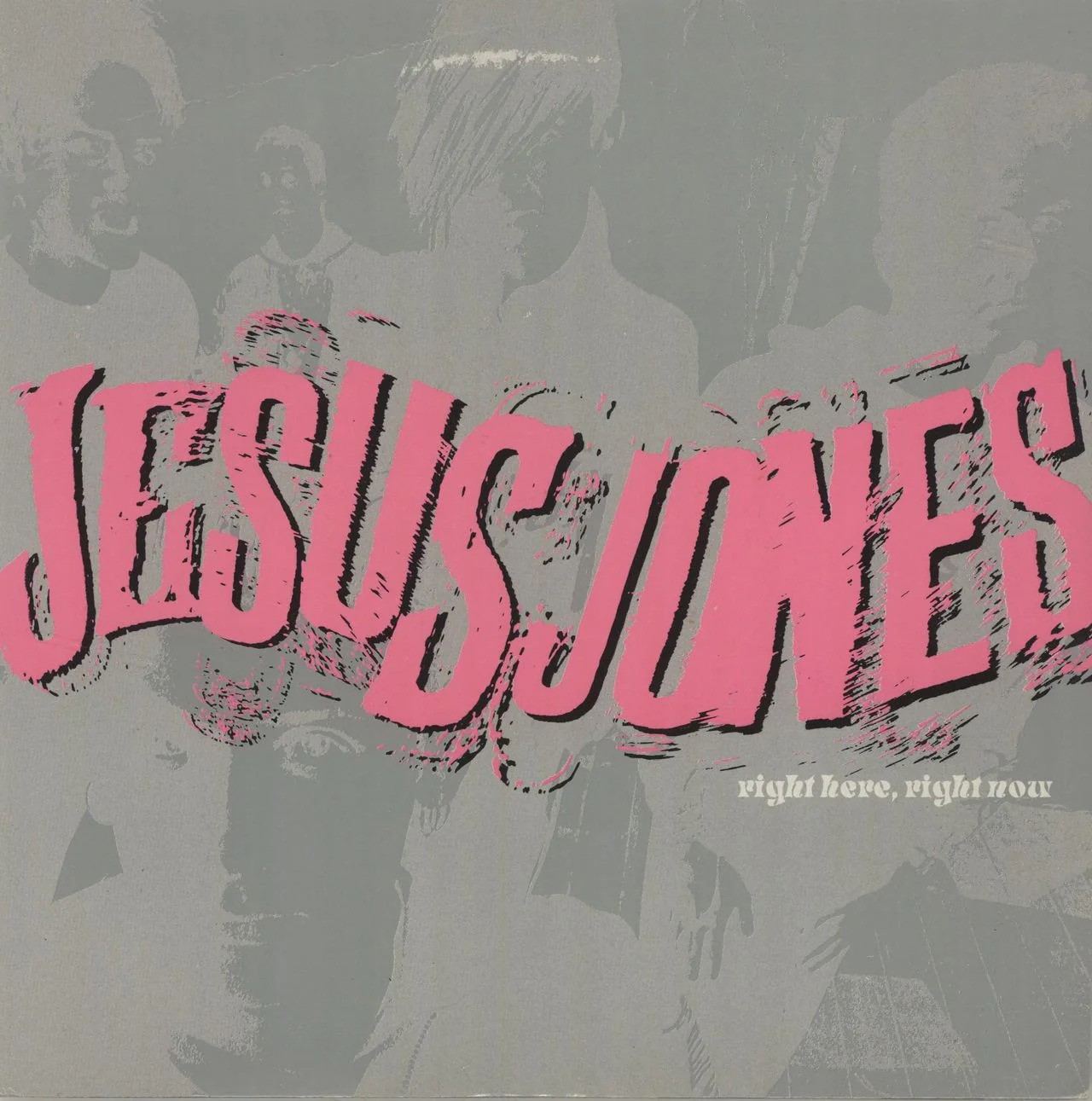
Back in 1990, the optimism was so strong that an alternative rock band -- one of the British groups on the forefront of futuristic dance-rock fusion -- recorded a warm, glowing pop anthem about how the world was getting better all the time and how this was a great time to be alive. The song was explicitly written as a response to a pessimistic American pop song from a few years earlier, and it swept across the world in 1991, becoming bigger in America than it was anywhere else. Later that year, the grunge revolution began. It's possible to imagine Jesus Jones' "Right Here, Right Now" as one side of a forking path, one that led to affirmation rather than denial. That's not where we went. The fantasy ended, and reality came crashing down, but at least Jesus Jones got a big-ass hit out of that moment.
Jesus Jones isn't one guy. It's a whole group of them. This was very confusing to American kids at the time. Jesus Jones came from Bradford-on-Avon, a small British town near Bath. The members of Jesus Jones were all skater kids who played in local indie bands in the '80s. In 1988, the story goes that three of them were on vacation together in Spain, sitting on a beach, when they decided to quit their bands and start a new one together. The name came from their realization that they were three everyday British blokes -- Joneses, if you will -- and that they were surrounded by guys named Jesus. The "Jesus" in Jesus Jones' moniker is supposed to be pronounced in the Spanish way, but nobody says it like that.
The newly formed Jesus Jones moved to London, found a guitarist and bassist, and threw themselves into the cool style of the time. In the wake of the Second Summer Of Love and the dance-rock tracks coming out of Manchester, tons of bands were doing new things, and Jesus Jones were among them. They played around with hip-hop breakbeats and rave sonics, plugging that stuff into catchy and starry-eyed rock songs. Singer Mike Edwards sounded like he was delivering his lyrics through a fucked-up megaphone, and the band behind him combined traditional instrumentation with hectic, cluttered Bomb Squad-style sample patchworks.
Early on, Jesus Jones fit right in with the industrialized dance-rock mini-scene known as grebo, which was getting a lot of hype in the UK music press at the time. The band wasn't much into the idea of being lumped in with anyone's scene, but it certainly helped them get noticed. It didn't hurt that they buried big, sweet melodies in their herky-jerk attack or that singer Mike Edwards was a handsome young guy. "Info Freako," Jesus Jones' first song, is about being overwhelmed with information, which I guess meant newspaper headlines and maybe cable TV. An "Info Freako" demo got Jesus Jones signed to Food Records, a UK label that was building a roster of bands like Blur and Diesel Park West. "Info Freako" came out as Jesus Jones' debut single in 1989, and it made it to #42 on the UK charts.
Jesus Jones released their debut album Liquidizer toward the end of 1989. It got a fair amount of critical love, and a few more of its singles just missed the UK top 40. Jesus Jones toured the UK as openers for David Bowie's band Tin Machine. Liquidizer didn't do any business in the US, but it did land Jesus Jones a distribution deal with SBK Records, a brand-new American imprint that was just starting to enjoy tremendous if short-lived success with Vanilla Ice and Wilson Phillips.
Jesus Jones cranked out their second album in a hurry. While they toured behind Liquidizer, Mike Edwards wrote the songs that would become Doubt. Label bosses leaned on Edwards to write catchier, more accessible songs, and he complied. Jesus Jones recorded Doubt in a single week, though the mixing process took a lot longer. Mike Edwards produced most of the LP himself, but for what would become their biggest single, they brought in outside producer Martyn Phillips.
Around the same time that he worked with Jesus Jones, Martyn Phillips also produced Londonbeat's "I've Been Thinking About You," a song that topped the Hot 100 in 1991. Jesus Jones sought Phillips out because of his work on the Beloved's dazzling acid house hymn "The Sun Rising," a pretty big UK hit in 1989. (The Beloved's highest-charting Modern Rock single, the 1990 Martyn Phillips production "Hello," peaked at #6. It's an 8.) "The Sun Rising" featured an uncredited sample of the opera singer Emily Van Evera, which led to a court case that the group had to settle out of court. Because of that experience, Martyn Phillips advised Jesus Jones not to use any big, obvious samples on their song. This turned out to be valuable guidance.
Mike Edwards wrote "Right Here, Right Now" after hearing the Simple Minds' extremely redundant cover of the great 1987 Prince track "Sign O' The Times." (Simple Minds have already been in the mainline Number Ones, and they'll also appear in this column very soon.) On "Sign O' The Times," Prince sang about some of the societal ills that were bedeviling America in 1987: AIDS, crack, gang violence. Mike Edwards decided that Prince's existential dread didn't match up with what he was seeing on TV news, that he wanted to write his own version about what he saw.
Talking to The Guardian in 2018, Mike Edwards said, "On the TV was coverage of the Berlin Wall coming down and all these people celebrating. I never thought that I’d see such a thing in my lifetime, and I wanted to write a sort of updated but positive 'Sign O’ The Times' to reflect what was happening." So he built a loop from the sampled bassline from Prince's original "Sign O' The Times" track, and he used that to write a song. Instead of including an actual Jesus Jones guitar solo, Edwards also stitched together a few big moments from Jimi Hendrix solos because, as he put it, "I wanted to be on a record with Hendrix."
On "Right Here, Right Now," Mike Edwards sings about "watching the world wake up from history," a phrase that's uncomfortably close to that Fukuyama title. He opens the song with this line: "A woman on the radio talks about revolution when it's already passed her by." As far as I know, Edwards has never come out and said that he was taking a shot at Tracy Chapman, but she would've been on the radio with "Talkin' 'Bout A Revolution" at the time. (Chapman's highest-charting Modern Rock single, 1989's "Crossroads," peaked at #7. It's a 9. "Talkin' 'Bout A Revolution" peaked at #24.) "Talkin' 'Bout A Revolution" is all about how poor people can only take so much abuse and how they're eventually going to rise up, and Edwards seems to say that she's wrong, the revolution is over, Communism is dead, everything is great. As a result, "Right Here, Right Now" keeps popping up on National Review lists of the best conservative rock songs.
Mike Edwards' next line: "Bob Dylan didn't have this to sing about/ You know, it feels good to be alive." Edwards is presumably talking about the early-'60s "Masters Of War" version of Bob Dylan, not the Dylan who was making Oh Mercy and messing around with the Traveling Wilburys at the time. I don't know whether Edwards meant to talk shit about Tracy Chapman and Prince and Bob Dylan, but he does come in with the line, "If anything, then there's your sign of the times." He even hits a falsetto on the word "sign." Originally, the track was titled "Nelson," as in Prince Rogers Nelson. If Jesus Jones were really attempting to take shots at Tracy Chapman, Prince, and Bob Dylan, three of the greatest songwriters in the history of American popular music, then that's honestly pretty funny. I like their moxie. If any of those three ever responded to Jesus Jones, I missed it.
If "Right Here, Right Now" really is a conservative rock song, then I might have to file it next to Dirty Harry in the pile of works that I find politically repellant but artistically compelling. But I think the song's point is more: Wow! Exciting things are happening! Can you believe it? The world can change at the blink of an eye. Mike Edwards was alive and he was waiting, waiting. He was alive, and he was waiting for this: Right here, right now. Or right then, anyway.
When Mike Edwards presented Martyn Phillips with his "Right Here, Right Now" demo, Phillips blanched at the samples. Here's how Edwards describes what happened with the Beloved's "The Sun Rising": "Apparently, the singer [Emily Van Evera] had walked into a greengrocer’s and heard herself on someone else’s record, and Martyn was badly stung for it financially. As soon as he heard our Prince and Hendrix samples he said, 'You’re not using those!,' and so we had to rebuild the track from top to bottom." The wild-west era of sampling was coming to an end, and Jesus Jones probably saved themselves a lot of money by coming up with a different bassline and guitar solo, though you can still hear something like that "Sign O' The Times" sample on Phillips' 12" mix of "Right Here, Right Now."
In its reconstructed state, "Right Here, Right Now" pulls off a funny trick. It's almost a ballad, but it still has that frisky rave-rock energy working for it. Mike Edwards sounds soft and vulnerable in his joy, and I hear just a hint of sadness in his voice, as if he's already nostalgic for an evanescent moment that's passing him by even as he sings about it. Behind him, basslines flutter, synths wriggle, and presumably-sampled horns sound triumphant notes. It's genuinely exciting when the track breaks down into a fried-but-excited halfway-to-Hendrix guitar solo, as if the ballad just can't contain all the excitement of the moment.
"Right Here, Right Now" has this beatific quality working for it, this overwhelming faith that things are turning out just fine. I find that weirdly seductive now, and I think I did then, too. (I was one of the million Americans who bought Doubt; I got the cassette through a Columbia House 12-for-a-penny deal.) The beat keeps moving, which is what keeps the track from phasing into the puffed-up boredom of the other big Cold-War-ending ballad, the Scorpions' possible CIA psy-op "Wind Of Change." The lyrical optimism blends gorgeously with the acid-house energy of the backbeat, which makes sense. After all, the future probably looks a lot brighter if your system is flooded with MDMA.
A lot of my favorite moments in pop history are the ones where people figure out something new, and this era of UK rave-rock certainly qualifies. Jesus Jones didn't move in the same circles as New Order or the Happy Mondays, but they were working off of the same influences. Along with their contemporaries, Jesus Jones were figuring out all the things that you could do with these new sonic combinations, and they ended up with a utopian combination of live-in-the-moment psych-rock daffiness and fizzy rave energy. That combination works. I was all about it. Jesus Jones happened to arrive in America at the same time as EMF, whose crossover dance-rock jam "Unbelievable" went all the way to #1 on the Hot 100 just as "Right Here, Right Now" climbed that chart. (On the Modern Rock chart, "Unbelievable" peaked at #3. It's a 9.)
"Right Here, Right Now" actually wasn't the first single from Doubt. Instead, Jesus Jones led the LP off with "Real, Real, Real," a much harder dance-rock track that I really, really liked. That song, way more than "Right Here, Right Now," is why I bought the album. "Real, Real, Real" was a top-20 hit in the UK, and it eventually reached #4 on the Hot 100, though it never got past #26 on the Modern Rock chart.
When Jesus Jones released "Right Here, Right Now" as a single in the UK, it didn't generate that same excitement, and it stalled out at #31. But SBK gave the track a huge push in the US, and the song's video made the Cold War implications plain, showing Jesus Jones performing in front of news footage that showed exactly what Edwards described on the song. On his own website, Martyn Phillips later wrote that the song was broadly anti-war but that "Gulf War veterans adopted it a 'We Showed Saddam' anthem and helped push it to #1 on the R&R chart spot and #2 in Billboard Hot 100." I haven't seen any firsthand evidence of that, but it would help explain why the song became such a huge pop hit over here. Whether or not Gulf War pilots were really doing bombing raids while bumping Jesus Jones, the song met American rah-rah feelings where they were, and it did indeed go all the way to #2 on the pop chart that summer.
When Bill Clinton ran for the presidency in 1992, he sometimes used "Right Here, Right Now" as his entrance music. Twenty-four years later, his wife Hillary did the same thing. Jesus Jones keyboardist Iain Baker tells The Guardian, "I remember calling Mike, and saying to him, 'I’m pretty sure their car stereo is knackered and our CD got stuck in there, so when they needed a campaign song, it was the only one they knew.'"
When he talked the The Guardian in 2018, Mike Edwards didn't feel the same way as he did when he wrote "Right Here, Right Now": "It has a poignancy today because I don’t feel anything like as optimistic. Once again, I feel like we could be on the brink of armageddon at any moment." We failed Jesus Jones. Good job, everyone. That poignancy made "Right Here, Right Now" age very quickly, but it gives the song a little more nostalgic juice today. Maybe that optimism was a total illusion, but it's trapped forever on "Right Here, Right Now," like dinosaur blood in fossilized mosquitos.
Jesus Jones did not keep their hold on the zeitgeist much longer. They're remembered as one-hit wonders today, and you could find tons of copies of Doubt in used-CD racks for many years. But they're not really one-hit wonders. That label ignores "Real, Real, Real," one of two big crossover hits on Doubt. It also ignores the follow-up single "International Bright Young Thing." In the UK, that was a top-10 hit, a much bigger song than "Right Here, Right Now." In the US, "International Bright Young Thing" missed the Hot 100, but it reached #6 on the Modern Rock chart. (It's a 7.)
Unlike so many bands that make a huge impact with one song, Jesus Jones stuck around. They're still a band today. The group released their follow-up album Perverse in 1993, when grunge was nearing its cultural peak. But here's something crazy: The first single from Perverse was a #1 Modern Rock hit. We'll see Jesus Jones in this column again.
GRADE: 8/10
BONUS BEATS: "Right Here, Right Now" is a moment-in-time song, which means that it's not the kind of thing that too many artists cover or sample, but it does appear in a whole lot of commercials. One band who did cover "Right Here, Right Now" is the Feelers, a group that's apparently quite big in their native New Zealand. The Feelers' 2010 remake soundtracked a pretty good commercial for the 2011 Rugby World Cup. Here it is: