
September 21, 1991
- STAYED AT #1:5 Weeks
In The Alternative Number Ones, I'm reviewing every #1 single in the history of the Billboard Modern Rock Tracks/Alternative Songs, starting with the moment that the chart launched in 1988. This column is a companion piece to The Number Ones, and it's for members only. Thank you to everyone who's helping to keep Stereogum afloat.
September 24, 1991 has gone down in history as a great day in alternative music. A whole lot of popular and influential albums all happened to hit stores on that day: Nirvana's Nevermind, the Red Hot Chili Peppers' Blood Sugar Sex Magik, A Tribe Called Quest's The Low End Theory, Primal Scream's Screamadelica, the Pixies' Trompe Le Monde. Soundgarden's major-label debut Badmotorfinger was supposed to arrive on that day, too, but its release was pushed back a few weeks. Pearl Jam's Ten had just come out at the end of August. All of those records would cast cultural shadows, and some of them would soon impact the Billboard Modern Rock chart; we'll be discussing a couple of them in this space soon. But if you happened to look at that chart on the day those albums all came out, you would've had no idea what was about to happen.
Three days before that flood of wildly important records, the English eccentric Robyn Hitchcock ascended to #1 for the first and only time. Some people are simply born to live their lives as cult heroes, and Robyn Hitchcock is one of those people. The fact that Robyn Hitchcock ever had a #1 hit on a Billboard chart -- any Billboard chart, even the lowly-in-1991 Modern Rock one -- is an accident of history. For that to happen, things had to line up exactly right. Hitchcock was 38 at the time, and he'd been making music since the late '70s. He'd never had a crack at the pop charts, either at home or in America, but his psychedelic surrealism had won over certain important Americans. Those Americans happened to include the members of R.E.M., and R.E.M.'s approval meant a great deal in 1991.
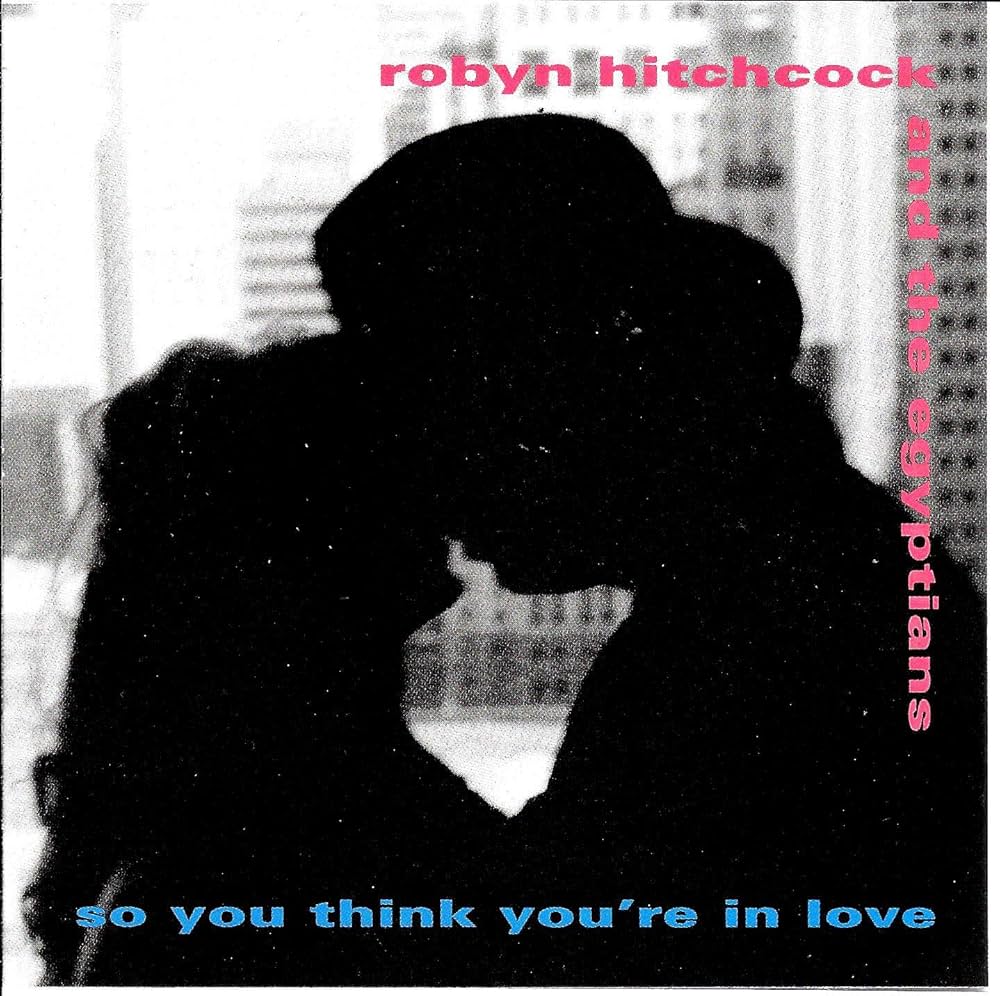
In 1991, Robyn Hitchcock and his band the Egyptians were major-label artists, three albums deep into their contract with A&M Records. They'd been critical and college-radio favorites for a while. They were tight with R.E.M., the biggest band in all of alternative rock. Peter Buck played guitar all over their album Perspex Island, and Michael Stipe sang backup on a couple of songs. For that LP, the Egyptians, who often produced themselves, brought in an outside producer with a history of crafting alternative-radio hits. Hitchcock wrote a bunch of sharp, direct, catchy quasi-pop songs that largely ditched the willful obscurity of most of his records. The sharpest, catchiest, and most direct of those songs was "So You Think You're In Love," and that song, at least in one little corner of the world, was a hit.
There's something poetic about this weird, jangly pop song occupying the top of the Modern Rock chart when all those earthshaking albums came out, then holding that spot for the next month. "So You Think You're In Love" was a product of a college-rock culture that was just about to disappear. It wasn't the last Modern Rock hit of its kind -- not exactly, anyway -- but it was an instant relic. The early-'90s alt-rock wave was a mythic event, but it's worth asking what we lost when alternative rock became big business. One of the things that we lost was a place in the world for songs like "So You Think You're In Love" to become quasi-hits. That's a loss. "So You Think You're In Love"? That's a good song.
Robyn Hitchcock has a lot of good songs to his name, though his catalogue is vast and intimidating for those of us outside his cult. Hitchcock was born in London, and his father Raymond eventually got pretty famous for writing the 1969 sex-comedy novel Percy. Once Robyn went off to a boarding school called Winchester College as a teenager, he had a bunch of formative musical experiences. There, Hitchcock became friendly with Brian Eno and had his mind blown by stuff like Bob Dylan and early Pink Floyd. Just last month, Hitchock published 1967: How I Got There And Why I Never Left, his memoir about that time in his life. After that, he went off to art school in London and started a band called the Beetles, which is pretty funny. Eventually, he moved to Cambridge, did some busking, played in a few different bands, and started the Soft Boys.
The Soft Boys began in 1976, and they were loosely associated with the whole punk rock creativity-explosion, but they were way more rooted in '60s psychedelia than most of their peers. As the band's leader, Robyn Hitchcock wrote playfully surreal lyrics and grand hooks. Even in the UK, where weirdo post-punk bands could find actual commercial success, the Soft Boys were never remotely close to being a chart presence. Not even British critics were excited about them. Instead, the Soft Boys became a word-of-mouth phenomenon. They had a huge impact on later bands, especially R.E.M. Peter Buck once claimed that the Soft Boys had a bigger influence on him than the Byrds, which is patently insane, but sure.
The Soft Boys' 1980 album Underwater Moonlight is generally considered their masterpiece, and they broke up pretty soon after its release. Guitarist Kimberly Rew went on to form the new wave band Katrina And The Waves. He wrote 1983's "Walking On Sunshine," a big worldwide hit that's also a certifiable pop classic, and 1997's "Love Shine A Light," which was the last British entry to win the Eurovision Song Contest. Robyn Hitchcock's career pretty much followed the opposite trajectory, as he got deeper and deeper into his own specific writerly quirks, which took him further and further away from anything that could be considered remotely mainstream.
In the first half of the '80s, Robyn Hitchcock knocked out three solo albums, often with former Soft Boys backing him up. I am not an expert on this man's catalogue by any means, but in the whirlwind crash course that I've been giving myself today, the one that jumps out the most is the solo-acoustic record I Often Dream Of Trains. That one came out in 1984, but it sounds like it could've come from any point in the past 60 years.
In 1985, two former Soft Boys, bassist Andy Metcalfe and drummer Morris Windsor, joined back up with Robyn Hitchcock and became the Egyptians, his semi-permanent backing band. Those guys quickly developed a kind of house style. They were jangly and upbeat and accessible, but still plenty weird. 1985's Fegmania!, the first album credited to Robyn Hitchcock And The Egyptians, features the silly, absurdist, kind of really sad "My Wife & My Dead Wife." If you're still wondering why this guy became a cult figure, that song is a pretty good place to start. American critics got behind the record, and Hitchcock made his first appearance on the Pazz & Jop Critics' Poll.
"If You Were A Priest," a gem from 1986's Element Of Light, became a minor college-radio hit in the US, and that, in addition to critical respect and R.E.M.'s vocal support, was probably what scored Robyn Hitchcock And The Egyptians a deal with A&M Records. 1988's Globe Of Frogs, the band's major-label debut, had the much bigger college-radio hit "Balloon Man." Hitchcock wrote that song for the Bangles, which seems far-fetched until you realize that "Going Down To Liverpool," an early Bangles hit, was a Katrina And The Waves cover written by Hitchcock's ex-Soft Boys bandmate Kimberly Rew. Hitchcock's A&R reps heard "Balloon Man" and demanded that he keep it for himself. It would've been a great Bangles song. Instead, it's a great Robyn Hitchcock song. I actually remember hearing that one on the radio.
The Egyptians' 1989 album Queen Elvis didn't even get a UK release, but its single "Madonna Of The Wasps" went all the way to #2 on Billboard’s newly instituted Modern Rock chart. Even in a chart climate where fellow eccentrics like XTC and Julian Cope were landing #1 hits, I can't really picture "Madonna Of The Wasps" being any kind of radio hit, but that's apparently what it was. (It's a 7.) Hitchcock, perhaps worried that he was getting too commercial, followed that record with the 1990 solo-acoustic album Eye, which came out on the indie label Twin/Tone. That album has "Queen Elvis," another Hitchcock song that really jumped out at me today. That song didn't chart, and neither did anything else from Eye.
Robyn Hitchcock got back together with the Egyptians shortly thereafter, and they recorded 1991's Perspex Island with Paul Fox, who's already been in this column for producing XTC's "Mayor Of Simpleton." I don't think I realized this when I wrote the column, but Fox apparently also produced Gene Loves Jezebel's "Jealous," so that guy was all over early alt-rock radio. Fox, who died in 2022, was an American session-musician type, but he really hit his stride by producing quirky, literate British college rockers. In a 1991 interview, Hitchcock said, "We thought he was going to smooth things out, but he didn't, which was nice."
Even if he didn't want to smooth things out too much, Hitchcock was making a concerted effort to be less chaotically weird on Perspex Island. Hitchcock was living in America, moving up and down the eastern seaboard and sometimes crashing at Peter Buck's house. Buck played guitar on pretty much all of Perspex Island, and the album came out just as R.E.M. were reaching new career heights with Out Of Time, so Hitchcock's timing was good. There are lots of catchy, propulsive songs on the record, but none are catchier or more propulsive than "So You Think You're In Love," the closest thing to a hit single that Robyn Hitchcock ever wrote.
"So You Think You're In Love" is a total headrush. Robyn Hitchcock belts out the title phrase with deranged glee, while the people behind him match his energy on the ahh-ahh backing vocals. Peter Buck's guitar chimes like a harpsichord, while an actual piano gets busy on the bridge. I really like the little details, like the great little drum fill on what otherwise would've been a brief split-second of dead air. It's a simple-enough pop song, though the structure is a little weird, and all the musicians involved clog up every second with lots and lots of notes without ever stalling the momentum. The momentum is too important.
The feeling of "So You Think You're In Love" -- all that tunefulness whirling past your ear at what feels like an unsafe speed -- is one of the things I remember most about listening to alt-rock radio in the early '90s. I wasn't looking for those hyper-jangle power-pop tracks. I was tuning in specifically to hear loud guitars and dance beats, and these songs didn't usually have either of those. But the non-loud-guitar, non-dance-beat bands that I liked the best -- the Violent Femmes, Material Issue, They Might Be Giants -- were the ones who were clearly trying to make pop songs and who were too fired-up and impatient to even gesture in the direction of singer-songwriter gravitas. That's what I hear in "So You Think You're In Love."
Hitchcock wrote "So You Think You're In Love" in the second person. He's singing to someone who's starting to fall in love with someone else and who's reckoning with the terrifying vulnerability that comes along with that miracle. He's coaching the "you" of the song, sort of. He's like: You're in love. Be honest about it. Embrace it. Don't be scared. "What is love made of? Nobody knows! What are you afraid of? Everyone knows! It's love, it's love!" I wonder if it was painful for Hitchcock to write a song that straightforward, without any lyrics about bumblebees driving taxicabs or whatever, but it works really nicely in this case.
I don't want to make "So You Think You're In Love" out to be some power-pop classic. I'm not enough of a power-pop head to bestow a title like that on it. It's a fairly slight song, and it never convinced me to dive into the Robyn Hitchcock discography, at least until the moment when I started work on this column. But it was always a breezy, enjoyable two and a half minutes, a fun car-radio singalong. That's pretty much how I hear it now, too. It's a sugar rush that fades from my mind whenever I'm not hearing it. But whenever I encounter it again, I find that I still know every word.
It's wild that a song like "So You Think You're In Love" had the juice to top the Modern Rock chart for five straight weeks, especially as all these younger bands were releasing momentous albums, but it's a good sign of where alt-rock radio was at the time. Grunge and funk-metal and dance-rock were all building up to zeitgeist moments, but they hadn't yet overtaken the power of veteran British singer-songwriter weirdos. For a couple of those weeks, Billy Bragg, another artist who fit that description, made it to #2 with his own song "Sexuality." (It's a 7.)
Soon enough, the Robyn Hitchcocks and Billy Braggs of the world would be distant memories on the Modern Rock chart. Hitchcock followed "So You Think You're In Love" with "Oceanside," the second song from Perspex Island, and that one peaked at #29. "Ultra Unbelievable Love," another single from the LP, only made it to #23. Hitchcock And The Egyptians recorded their next album, 1993's Respect, at Hitchcock's house on the Isle Of Wight, and then promptly broke up. Lead single "Driving Aloud (Radio Storm)" peaked at #19, and Hitchcock hasn't been back on the Modern Rock chart since then.
With the Egyptians done and the A&M contract finished, Robyn Hitchcock did a Soft Boys reunion tour and then got to work cranking out a steady stream of solo records, including a few that came out on Warner Bros. In 1998, the late Jonathan Demme directed Storefront Hitchcock, a movie that's nothing but Hitchcock playing live, by himself, in an abandoned Manhattan clothing store. That puts Hitchcock on a short, weird list of artists who got their own Jonathan Demme concert films. It's the Talking Heads, Neil Young, Justin Timberlake, and him. Demme was a big Hitchcock supporter, and he cast Hitchcock as a double agent in his Manchurian Candidate remake and as the wedding band leader in Rachel Getting Married.
This century, Robyn Hitchcock has embraced his destiny. He'll be a cult artist forever, and he seems fine with that. He's done the things that he's wanted to do, whether that's meant occasional Soft Boys reunions or the full album of Bob Dylan covers that he released in 2002. He's recorded and played live with tons of his admirers, including Gillian Welch, Jon Brion, Andy Partridge, and Jeff Mangum. In the 2018 movie Juliet, Naked, Ethan Hawke plays an obscure, culty singer-songwriter named Tucker Crowe, and one of his songs is "Sunday Never Comes," which Hitchcock wrote for the movie. This seems about right.
These days, Robyn Hitchcock lives in Nashville with his partner Emma Swift, an Australian-born folk musician. He seems like a lovely guy. The '90s alt-rock explosion had no room for a figure like Robyn Hitchcock, but alt-rock stardom seems like a difficult life anyway. Nobody asked me, but given the option, I'd rather be Robyn Hitchcock than most of the people who will show up in this column in the days ahead.
GRADE: 8/10
BONUS BEATS: There's a fun video of Robyn Hitchcock wearing a suit to play "So You Think You're In Love" on Late Night With David Letterman in 1991. But I'd rather go with the very strange spectacle of Hitchcock And The Egyptians playing the song acoustic on CNBC, with a smug intro from the kind of anchorman who really thrived in that era. Here's that one:
THE NUMBER TWOS: The Smithereens' fuzz-pop gem "Top Of The Pops" didn't quite make it to the top top, top of the modern rocks. Instead, it peaked at #2 behind "So You Think You're In Love." It's an 8.