
September 26, 1992
- STAYED AT #1:2 Weeks
In The Number Ones, I'm reviewing every single #1 single in the history of the Billboard Hot 100, starting with the chart's beginning, in 1958, and working my way up into the present. Book Bonus Beat: The Number Ones: Twenty Chart-Topping Hits That Reveal the History of Pop Music.
They weren't playing Phil Collins on American alternative rock radio. Mike + The Mechanics didn't get any love, either. When Genesis returned with 1991's We Can't Dance, my local modern rock station did not interrupt its steady string of U2 deep cuts so that those guys could Tin Woodsman walk their way across the airwaves. But when that very same station threw onetime Genesis leader Peter Gabriel into rotation, his music never felt incongruous. Gabriel, much like his ex-bandmate Collins, was a former prog-rock frontman who'd become a giant mainstream pop star in the '80s, cranking out expensively recorded inner-world fantasias that got heavy burn on early MTV. But Phil Collins was happy to present himself as a doofy sitcom-dad type. Gabriel was something else: a sonic explorer who only ever seemed to crash the pop charts by accident. His music rarely worked in conversation with whatever was happening in the alt-rock zeitgeist, but with his exploratory sensibility, he belonged.
Alternative rock radio didn't really exist when Peter Gabriel became a pop star. Gabriel left Genesis in 1975, a year after he masterminded their ridiculously ambitious double LP The Lamb Lies Down On Broadway. His first solo album, commonly referred to as Car since the first four damn things are all self-titled, came out in 1977. Gabriel remained a favorite among aesthetes for nearly the next decade. He occasionally sent songs into the American pop charts, especially after his strange and attention-grabbing videos went into MTV rotation. MTV also played a huge role in Gabriel's unlikely ascent to pop stardom. Gabriel's video for his 1986 smash "Sledgehammer" is a bugged-out masterpiece. Though nobody has ever fully verified this, it's probably the most-played video in MTV history.
That "Sledgehammer" clip drove the song all the way to #1 on the Hot 100. (By some strange twist of fate, "Sledgehammer" knocked "Invisible Touch," a song by Gabriel's old band Genesis, out of the #1 spot.) So, Gabriel's 1986 album, sold five million copies in the US alone. Critics loved So, too. It came in a #7 in that year's Pazz & Jop poll -- right behind the Beastie Boys' Licensed To Ill, right ahead of R.E.M.'s Life's Rich Pageant. Some of Peter Gabriel's songs got college radio play, but he was never a big favorite over there. Still, the man had gravitas and credibility. He took a long time between albums, going through heavy personal shit and putting in obsessive studio work with a long list of accomplished collaborators. He returned in 1992, bringing his sad and immersive personal soundscapes to a very different pop universe. Alternative rock radio welcomed him with open arms.
It's worth wondering: How, exactly, did Peter Gabriel qualify as alternative rock? The sound of Us, Gabriel's 1992 album, had very little to do with Morrissey or Pearl Jam or Jesus Jones. Gabriel was in his early forties, and his prog-rock past wasn't the sort of thing that would endear him to the kids at Lollapalooza. He'd gotten behind righteous social causes and explored African music, but you could say the same things about Paul Simon, never an alt-rock radio fixture. (Simon only ever made the Modern Rock chart once, when "The Obvious Child" peaked at #24 in 1990.) Gabriel's friend and contemporary Sting did get Modern Rock play, enough that he made it into this column for 1991's "All This Time." But Sting at least had a direct connection to punk and new wave, while Gabriel only ever nodded in those directions.
Still, Peter Gabriel's "Digging In The Dirt" made perfect sense next to L7 and Sugar. It was a no-brainer at the time, and it only feels like something worth explaining in retrospect. Here's my best stab at it: Peter Gabriel helped establish the idea of rock music as total sonic environment. His old buddy Phil Collins figured out his trademark gated drum sound while working on one of Gabriel's records; Gabriel's music encouraged and demanded that kind of experimentation. You could get lost in his sound. When Gabriel found pop stardom, he remained in full-on art-rock mode, working with eminences like Kate Bush, Laurie Anderson, and the Simple Minds' Jim Kerr. His 1992 return was a minor cultural event, and its layered cinematic despair wasn't that far removed from what, say, the Cure were doing. Also, "Digging In The Dirt" is a great song. That didn't hurt.
My early memories of alternative radio are a little fuzzy, but I definitely heard a lot of Peter Gabriel's catalog. WHFS, my local station, wasn't playing "Sledgehammer" in the early '90s, but I was pretty familiar with stuff like "Solsbury Hill," "Shock The Monkey," and "Red Rain." If I knew anything about Gabriel, though, I probably knew him as the "In Your Eyes" guy. There's reason for that. In 1989, John Cusack held up a boom box and played that song outside Ione Skye's window. "In Your Eyes" was a minor hit when Gabriel released as his "Sledgehammer" follow-up in 1986, but it attained immortality when Cameron Crowe used it in Say Anything, the first movie that he ever directed.
It's the most memorable scene from a very memorable film. John Cusack, a hopeless motormouth for the entire length of the movie, finally shuts the fuck up and lets Peter Gabriel do his talking, and it works. That scene has been parodied to death, but it still has a primal cinematic power. Alternative radio specifically aimed itself at loner-romantic types like the one that Cusack played, and that song, paired with that image, tattooed itself onto the brains of entire generations. (Many years later, a band called Say Anything landed a few minor alternative hits. Their highest-charting single is 2006's "Alive With The Glory Of Love," which peaked at #28.) Now that I think about it, maybe that one scene is the single biggest reason that modern rock radio couldn't wait for Gabriel's next record. Maybe that one scene solidified the idea of Peter Gabriel as permanent soulful outsider, by choice. Call it the Lloyd Dobbler effect.
In any case, Peter Gabriel largely went silent after So went supernova. He and his wife divorced in 1987 after 16 years of marriage. By all accounts, Gabriel had a few years in the emotional wilderness. He fell in love with Rosanna Arquette, but that relationship didn't stay together. He had a few flings with Sinéad O'Connor, someone who's been in this column a couple of times. O'Connor eventually sang backup on two Us songs. Much later, she wrote in her memoir that Gabriel treated her as "weekend pussy."
Instead of getting to work on a new album, Gabriel followed his big hit So by making a film soundtrack. Gabriel did the score for Martin Scorsese's The Last Temptation Of Christ. That movie caused one of the dumbest moral panics in recent memory; my parents were aghast that anyone would ever make anything hateful enough to depict Jesus as someone who, like, thinks about having sex sometimes. (I still haven't seen Last Temptation, so maybe I don't get the full context. I should see it, but a childhood steeped in Catholicism has conditioned me to run away from anyone who wants to talk about Jesus for any reason.) A year after the movie came out, Gabriel released his score under the title Passion, and it's an extremely cool record of hi-fi pan-global textures and grooves -- a Peter Gabriel album without his vocals, more or less.
In 1989, Peter Gabriel established Real World, a record label devoted to sounds from around the planet. (People liked to use the term "world music" back then. We've left that one in the '90s.) That same year, Gabriel co-produced and helped out on his collaborator Youssou N'Dour's album The Lion, and he released his own greatest-hits LP Shaking The Tree in 1990. The collection eventually went double platinum, but its obligatory new song, a re-recording of Gabriel's 1977 deep cut "Here Comes The Flood," didn't make any charts.
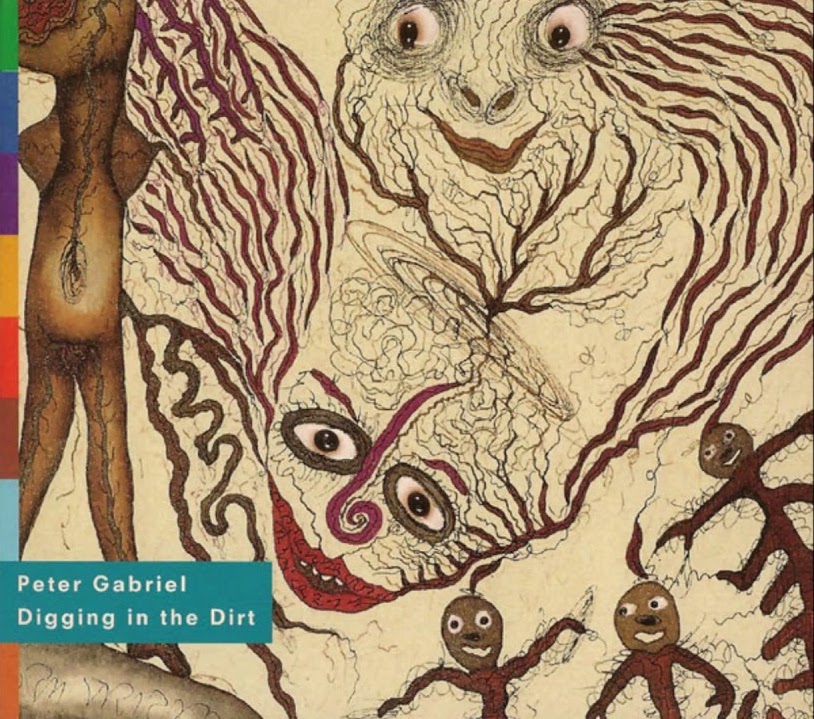
Gabriel recorded most of Us at his fancy Real World studio, and he co-produced it with his So collaborator Daniel Lanois. The album displays Gabriel's usual sonic perfectionism, and it digs deep into the stuff that Gabriel learned about himself in therapy, a practice that wasn't quite so mainstream back then. Tons of boldface names -- Brian Eno, John Paul Jones, William Orbit -- show up in the album's credits, but Gabriel's main collaborators are the ones who he kept working with over the years. There's Tony Levin, the King Crimson bassist who started working with Gabriel when he first went solo. There's guitarist David Rhodes, former leader of the British band Random Hold, who'd been a Gabriel guy since 1980. And there's Manu Katché, the Ivorian-French jazz fusion session drummer who played on lots of records from guys like Sting. All three of those musicians had a lot to do with the sound of "Digging In The Dirt," which was the first single from Us and the first Peter Gabriel song to land on the Modern Rock chart.
As Gabriel worked on his Last Temptation Of Christ score, he brought in lots of musicians from around the planet. One of them was the late Egyptian percussionist Hossam Ramzy. Later, Gabriel messed around with the tracks that Ramzy recorded for the Last Temptation track "Zaar," using loops and drum machines to add to that sound. Then Gabriel pretty much went in the booth and freestyled, and he started to get a feel for what he wanted to say with the song. Gabriel had been reading Why We Kill, an anthology book about what drives people to murder other people, and he found some resonance with his own darkest impulses. "Digging In The Dirt" is ultimately a song about the worst parts of Gabriel's own psyche, the tendencies that might've led him to alienate many of the people in his life.
I didn't understand any of that when I first heard "Digging In The Dirt." To be honest, I didn't understand any of that until I researched the song just now. I just knew that the track sounded cool and weird. It's telling that "Digging In The Dirt" started out as a beat, since the beat is really what jumps out. The song has a snaky, sinuous bassline surrounded by guitar-stabs and tumbling breakbeats, and maybe that's why some critics pegged it as Gabriel's transparent bid for radio play. (Us had a much more obvious single, and we'll get to that one in a future column.) "Digging In The Dirt" has some slight overlap with the dance-rock of its day, but it wasn't like Gabriel was trying to go Madchester. Instead, that widescreen groove was what led Gabriel to contemplate some heavy shit.
Gabriel starts out "Digging In The Dirt" whisper-singing about "something in me, dark and sticky." As the song builds, the tension in his voice gets louder. He wails, "This time, you've gone too far!" It sounds like he's in the middle of a heated argument. Then the track gets even more intense, and Gabriel begins to talk like a serial killer in a movie: "Don't talk back! Just drive the car! Shut your mouth! I know what you are! Don't say nothin'! Keep your hands on the wheel! Don't turn around! This is for real!" When the chorus arrives, Gabriel dials everything back to the whisper stage, almost mumbling that he's digging in the dirt to find and open up the places he got hurt. It's a bit like that moment when you're arguing with a significant other and you realize that you've just said something severely fucked up and hurtful -- the instant where you apologize and attempt to explain, either to yourself or someone else, why you just lost all control.
"Digging In The Dirt" might've started as stream-of-conscience self-examination, but Gabriel still gave the song his usual widescreen studio polish. Daniel Lanois and David Rhodes' guitars went through tons of different experimental compression tactics, and Gabriel got Manu Katché to play an unconventional drum kit that Gabriel built specifically for the track. Once they had a rough version of the song, Gabriel and Lanois kept remixing it, adding electronic pieces and taking other parts away. They went to Lanois' studio in New Orleans, and they got Meters legend Leo Nocentelli to come in and play more guitar; I'm guessing Nocentelli did the spidery, trebly bits. Gabriel sang some of his own multi-tracked backing vocals, and he got more people to come in and help. Gabriel's childhood friend and Genesis road manager Richard Macphail sang backup on the track, as did the former Van der Graaf Generator leader Peter Hammill and the Kenyan singer and actor Ayub Ogada.
"Digging In The Dirt" is a long song, at least by radio standards, and it has an atmosphere of its own. The different pieces of the track all seem engineered to serve the squirming, bubbling bassline and the song's angry jags. Peter Gabriel himself sounds trapped in his own head. He's raspy and downcast, and there's real venom in his voice during the pre-chorus rising action. Darkness swirls all around him, with heady organ-blurts and twangy guitar chords building and subsiding along with Gabriel's voice. Whether intentionally or not, it's got some of the same cinematic drum-loop intensity as the music that Massive Attack were making around the same time. It might go on too long, and I wish the chorus had the same entrancing effect as the rest of the track, but it's a truly effective look at a guy who doesn't feel that great about himself. It's a lot more effective if you've seen the video, too.
As with the "Sledgehammer" clip, Gabriel's "Digging In The Dirt" video goes hard on stop-motion animation. This was probably the greatest time for practical special effects in cinematic history. CGI was right around the corner, and Gabriel would soon indulge in it. But the effects that director John Downer uses for "Digging In The Dirt" have a sense of janky personality that computer imagery has almost never managed to equal. That uncanny handmade quality works beautifully for a piece of grotesque psychological surrealism.
The "Digging In The Dirt" clip opens with Gabriel lying on the ground as time-lapse snails crawl over his face and grass grows all over his body. Soon, he's underground with the slugs and worms, while another Peter Gabriel angrily digs up his body. Sometimes, Gabriel's face transforms into disgusting Lovecraftian claymation beasts. We cut away to the B-plot, in which Gabriel is out driving on a sunny day with a pretty lady. She throws a drink in his face, and we watch it in ecstatic slow motion. Absurd, heightened camera angles show us Gabriel flying into a rage, trying to kill a wasp that's stung him. He becomes a twisted, exaggerated caricature of himself -- not through effects, just through facial expressions -- and the video implies violence, either actual or potential, against this woman. He smacks the rearview mirror, crushes an apple, and puts his fist through the windshield.
Some of the stuff in the "Digging In The Dirt" video is a little hacky, like the blooming flowers and mushrooms that spell out "help" and then "heal" in the ground. Mostly, though, it's the kind of bizarre dream-world trip that can only really work in a music-video context. Gabriel understood the power of the form, and he was willing to lie motionless while the effects artists made it look like his body was engulfed in maggots. Or maybe he really had his body engulfed in maggots; I don't know. I must've only seen the "Digging In The Dirt" video once or twice as a kid, but it left an impression.
The "Digging In The Dirt" video was memorable enough to slightly overshadow the song itself. Gabriel won the Best Short Form Music Video Grammy for that clip, beating out the truly goofy field of Garth Brooks' "The Thunder Rolls," Dire Straits' "Calling Elvis," Bob Dylan's "Series Of Dreams," and Billy Joel's version of "When You Wish Upon A Star." America's critics didn't like the Us album or the "Digging In The Dirt" single enough to vote either one onto that year's Pazz & Jop poll, but the poll did have a music video category back then, and "Digging In The Dirt" made it onto that list -- at #4, behind Nirvana's "In Bloom," Arrested Development's "Tennessee," and Sir Mix-A-Lot's "Baby Got Back." If that complete incoherence doesn't delight you, then I can't help you.
Rock radio was into "Digging In The Dirt." The song went to #1 on the Modern Rock and Mainstream Rock charts, but it didn't really cross over to pop. On the Hot 100, "Digging In The Dirt" never got any higher than #52. The song hasn't stuck around too much. I can't remember the last time I encountered it in the wild, and its Spotify numbers aren't that impressive. Still, "Digging In The Dirt" is clearly important to Gabriel. He performed it at his Rock And Roll Hall Of Fame induction in 2014, and he included an orchestral version on his 2011 album New Blood, using woodwinds to replicate the bassline. When Gabriel toured last year, "Digging In The Dirt" was part of the setlist.
Gabriel followed "Digging In The Dirt" with a single that was more of a mainstream proposition, and we'll see him in this column again pretty soon.
GRADE: 9/10
BONUS BEATS: Earlier this year, Peter Gabriel sang backup on a Sheryl Crow cover of "Digging In The Dirt." Here it is:
(Sheryl Crow's highest-charting Modern Rock hit, 1994's "All I Wanna Do," peaked at #4. It's an 8.)