September 18, 1993
- STAYED AT #1:3 Weeks
In The Alternative Number Ones, I'm reviewing every #1 single in the history of the Billboard Modern Rock Tracks/Alternative Songs, starting with the moment that the chart launched in 1988. This column is a companion piece to The Number Ones, and it's for members only. Thank you to everyone who's helping to keep Stereogum afloat.
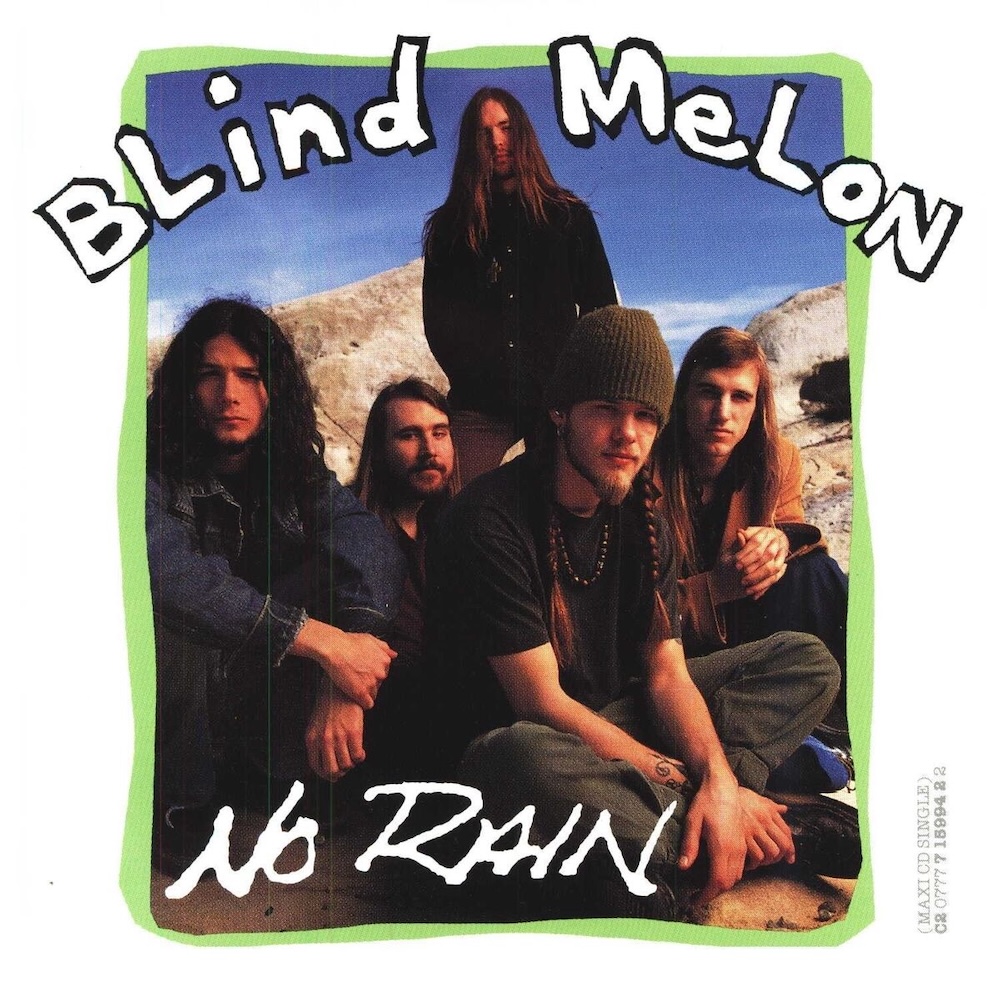
We had memes before we had a proper internet, and the Bee Girl was definitely a meme. The Bee Girl, maybe more than Blind Melon themselves, was the reason that Blind Melon's "No Rain" took off in 1993. Blind Melon's self-titled debut came out in September 1992, and it was pretty well ignored for about a year. But when the Bee Girl popped up in the "No Rain" video, tap-dancing and holding back tears and showing the indomitable power of the human spirit, she became an omnipresent MTV fixture, and she dragged Blind Melon into the spotlight behind her. Blind Melon didn't perform at the 1993 VMAs, but the Bee Girl did. The Bee Girl was a star.
A different version of the Bee Girl appeared on the cover of the Blind Melon album. That's an old photo of Blind Melon drummer Glen Graham's sister Georgia, from when she acted in a school play back in the '70s. When Blind Melon were getting ready to release their debut, someone found that old picture and joked that it would make a good album cover, and then the joke became a reality. For the "No Rain" video, Samuel Bayer, the same director who made Nirvana's "Smells Like Teen Spirit" clip, built a fantastical little fable around that photo, and he found an extremely cute little kid to bring the image to life. Bayer's only motion picture is the 2010 Nightmare On Elm Street reboot, and that thing sucks butts. But just between his "Teen Spirit" and "No Rain" clips, Bayer made a serious impact on the brains of an entire generation of kids. I was one of them.
The Bee Girl was Heather DeLoach, a 10-year-old kid from Orange County. She was the last to audition for the Bee Girl part, and it's hard to imagine anyone else, up to and including Glen Graham's sister, playing the role. When the "No Rain" video starts, we don't even hear the song. Instead, it's the Bee Girl doing an adorable little tap-dance routine for some unseen audience that laughs at her cruelly. The Bee Girl runs out of the room and onto the sidewalks of what appears to be downtown Los Angeles, where she alternates between moping in front of construction sites and happily vibing for fellow randos. Somehow, she finds her way to an absurdly color-graded meadow, with crazily green grass and a crazily blue sky, where she discovers a horde of fellow bee-costumed dancers and also Blind Melon. In the big happy ending, the Bee Girl finds home in an impossible dreamworld, a place far away from a mean and uncaring reality.
If you were hungry enough for symbolism, you could see the "No Rain" video as an allegory for the early-'90s alt-rock boom itself -- a moment when societal misfits came together and built their own alternate world when the real one proved to be too inhospitable. Or you could just watch it as a cute little bit of stoner-bait that was in constant MTV rotation all day and night. Either way, Blind Melon went from major-label obscurities to quadruple-platinum rock stars, at least for a moment. "No Rain" remains one of those songs that's inextricable from its video, and its sun-dazed guitar-twinkle and utopian skitter-scat vocals will always evoke images of the Bee Girl finding her slice of paradise. But the alt-rock dreamworld wasn't all that it was cracked up to be, and Blind Melon singer Shannon Hoon quickly became one of the many young casualties of the early-'90s boom times. In its way, the "No Rain" video's imagined happy ending led to truly bleak real-world consequences. The Bee Girl made it out OK, though.
Shannon Hoon came from Lafayette, Indiana, the same nowhere Midwestern town that birthed a kid named Bill Bailey five years earlier. Bailey couldn't wait to get out of there, so he jumped on a bus to Los Angeles and rechristened himself as W. Axl Rose. Shannon Hoon was a gifted high-school athlete with a taste for starry-eyed '60s bands like the Beatles and the Grateful Dead. After high school, Hoon started singing for a local hair-metal band with the objectively hilarious name Styff Kytten. In his capacity as Styff Kytten lead singer, Hoon wrote a ballad called "Change." The band didn't last, but the song did. In his early twenties, Hoon moved to Los Angeles and met a few other musicians who came to that town from faraway places.
In LA, Shannon Hoon met bassist Brad Smith and guitarist Rogers Stevens. (That's not a typo; that's his name. Rogers. As in multiple Rogers. Like if my first name was Toms.) Smith and Stevens both came from West Point, Mississippi, and they eventual convinced their drummer buddy Glen Graham to move out to LA to join them. Christopher Thorn, another guitarist, came from Pennsylvania. I suppose Los Angeles is always full of small-town kids who move to the big city to make it big, but that must've been especially true during the glam metal era, when a band like Poison could jump into a van from central Pennsylvania and reinvent themselves as kings of the Sunset Strip.
Shannon Hoon met Rogers Stevens and Brad Smith at a party. Hoon got up and sang an acoustic version of his old hair metal band's song "Change" at that party, and Stevens and Smith were impressed enough that they wanted to start a band with him. They named themselves Blind Melon, possibly after a Cheech & Chong character but also after a nickname that Smith's father had for hippies. This raises an important little wrinkle in the Blind Melon story. Blind Melon ultimately came up in the alt-rock era, but they didn't have roots in new wave or hardcore or any of the other punk-adjacent worlds that typically made up the alternative nation. Instead, they were devotees and descendants of free-flowing improvisers like the Grateful Dead and the Allman Brothers. They were a jam band, more or less, even if the term "jam band" wasn't really part of the lexicon yet.
There were so many hippies in the early '90s. When I started high school in the year after "No Rain," they'd always be out on the parking lot at lunch, hanging out with the punk and the goth kids and everyone else who self-consciously set themselves apart from what the other kids were into. I knew a lot of hippie kids, and they were so nice. They'd hide between cars during lunch and smoke weed out of crushed Coke cans, and they were always down to share. They got me into devil sticks, and I got pretty good with those devil sticks for a while. One of them had a vintage orange VW bus, so they weren't afraid to live the cliché.
At the time, the Grateful Dead were still a fully-intact touring band, and those young neo-hippie types would go to a few shows during the summer and bring back stories about nitrous tanks and drum circles. Some of them were really into the Beastie Boys or techno as well, but they all loved the Dead. Some of them were also into the Dead-type bands, the Phishes and Widespread Panics of the world, who were already drawing pretty-big crowds on the touring circuit. Alt-rock radio usually didn't play those bands, but it sometimes got ahold of a song or two that came out of that world -- a couple of Spin Doctors tracks, a few Blues Traveler songs, that one Rusted Root joint. Those bands all traveled along parallel paths to a band like R.E.M., and you'd see occasional moments of crossover, but they didn't necessarily attempt to appeal to the same audiences.
For the most part, the jammy bands were based in little college towns, and they spent most of their lives on the road. They weren't moving to LA and trying to land major-label deals. Blind Melon were an exception. Shannon Hoon's older sister had been high-school buddies with Axl Rose, so she made an introduction. Rose took a liking to Hoon, and he invited Hoon to sing backup on a few songs from Guns N' Roses' Use Your Illusion albums. Hoon is even in the video for "Don't Cry," lip-syncing on the rooftop while helicopter spotlights shine everywhere and Axl does his snake-dance. I think a metal-magazine news blurb on that video was the first place that I encountered the name Blind Melon. (Guns N' Roses' only alt-rock radio chart hit, 2008's "Chinese Democracy," peaked at #24.)
Blind Melon signed with Capitol around the same time that Shannon Hoon showed up on those Use Your Illusion tracks, and they recorded an EP that they never released because they thought it sounded too slick. Eventually, the whole band moved to a rented house in Durham, North Carolina. They figured that they could live more cheaply out there, and they kept practicing together until they completely gelled as a unit. They recorded a few bits of their debut album in that house, but they made most of the record in Seattle with producer Rick Parashar. A year earlier, Parashar used his London Bridge studio to produce Ten, the debut album from the young and promising Seattle band Pearl Jam. When Blind Melon were making their self-titled debut, Ten hadn't really taken off yet. Around the same time, Parashar was also producing Alice In Chains' sophomore LP Dirt. Purely by accident, Blind Melon found themselves at the same parties as the Seattle guys who were just beginning to take over the world. (Pearl Jam and Alice In Chains will appear in this column. The 50-year-old Parashar died of a pulmonary embolism in 2014.)
The only thing that makes Blind Melon an alternative rock album is the fact that the term "alternative rock" has no real definition. For the most part, Blind Melon is a hippie-dippy noodle-rock pastiche, an attempt to recapture the shimmy-strut feel of early-'70s Rolling Stones. Its sound is closer to the Black Crowes than to Pearl Jam, but it's not like those two things are worlds apart. Blind Melon kept things old-school on purpose. They mostly recorded live, and they often had their two guitars playing in separate speaker channels for maximum headphones-listen trippiness. They wore little tiny sunglasses and flowy fabrics. They went really, really hard on funky wah-wah guitar sounds.
The critics of the early-'90s alt-rock world did not take to Blind Melon. In Trouser Press, Ira Robbins described the band's songwriting as "lazy, amelodic, and shapeless" and Shannon Hoon as "a raspy singer who can’t carry a tune." I can get why a guy like Robbins might've been aggravated by the MTV-assisted sudden popularity of a backward-looking '60s throwback like Blind Melon, but I think that first album is pretty fun when I'm in the right headspace. It's got a pleasant sense of amble, and the instrumental give-and-take gestures at lots of well-worn tropes without quite committing to any of them. But the record only really snaps into focus when "No Rain" comes on. Maybe that's because "No Rain" is so instantly familiar to anyone who was in eighth grade in 1993, or maybe it's because the song is just really good. I can't be objective about my own nostalgia. "No Rain" went platinum at sleepover birthday parties in Ellicott City, Maryland, where my family had just moved. I didn't like the song enough to buy the Blind Melon album, but I didn't need to buy it because the song was always on. To me, it'll always sound like a certain time in life, and I will always love it for that.
In a Pitchfork blurb, Jeremy Gordon, whose debut novel just dropped, once described "No Rain" as a song "that doesn’t sound depressed even though it literally describes depression." I never really thought of "No Rain" that way before reading that, but it's true. The mellow choogle of "No Rain" communicates glorious indolence -- a life so carefree that you can sit around watching puddles gather rain. But if you look even a tiny bit deeper, you pick up on something heavier in those lines about longing for connection and sleeping all day. All five members of Blind Melon are credited as writers on all the band's songs, but "No Rain" mostly came from bassist Brad Smith, who confirms that "No Rain" is specifically a song about depression. In a Songfacts interview, Smith says that he wrote "No Rain" before Blind Melon started. At the time, he was working construction, and he'd busk for change on Venice Beach after finishing his shift. He had a girlfriend who had serious depression, and he thought that he wrote "No Rain" about her. Over time, though he discovered that it was really about him -- the difficulty he had getting up every morning, the persistent feeling that he was wasting his life in LA and that he should go back to Mississippi.
Smith says that he played "No Rain" by himself for a year before it became a Blind Melon song, and he also acknowledges that Shannon Hoon's singing elevated it. Maybe that's key to the power of "No Rain." Maybe the person singing it shouldn't be the one who was depressed enough to write it. Whatever the case, Blind Melon don't play "No Rain" like it's a song about depression. Instead, it's a jaunty amble. Rogers Stevens' lead guitar floats with an unhurried grace, and the rest of the band grooves softly, starting off with fingersnaps and never becoming much more obtrusive than that. It floats along with a loopy grin on its face.
Shannon Hoon sings "No Rain" in a pleasantly soft whine, his vibrato sometimes picking up an unearthly rattle that reminds me of the Auto-Tune robot sound. Honestly, he sounds a bit like Axl Rose, or like the version of Axl Rose that never feels the need to act tough. I hear a bit of Perry Farrell in his voice, too. But Rose or Farrell would've brought rage. There's no rage in "No Rain," no catharsis. Even when it builds up to its climactic guitar solo, Blind Melon keep it on a low simmer. They sound like they're slowly spinning around in a sunny field, and that's mostly what they do in the video.
The video was the missing thing that Blind Melon needed. At first, "No Rain" didn't stand out to anyone. Blind Melon toured with acts like Neil Young and Lenny Kravitz, and they released a bunch of singles. Nothing clicked, and the album didn't sell. One song, "Tones Of Home," got into minor rotation at modern rock stations; it peaked at #20. I remember seeing SPIN ads for the Blind Melon album with the bee-girl cover and thinking that it looked stupid.
But then the "No Rain" video came out, and MTV fell in love. Bee Girl actress Heather DeLoach probably did more press than the band. She reprised her Bee Girl role, taking a couple of pratfalls in "Weird Al" Yankovic's "Bedrock Anthem" video, and she got cast in movies like A Little Princess, Camp Nowhere, and The Beautician And The Beast. She didn't keep going with her acting career, but she turned out just fine. People still runs little check-in stories with DeLaoch whenever she hits some big life milestone. The magazine published her wedding photos when she got married in 2017. She described herself as "a very happy bee." That's great, right? Those of us who grew up with the "No Rain" video have always rooted for the Bee Girl.
Once modern rock radio stopped being homebase for British '80s veterans, it pretty much followed MTV's example, so "No Rain" became a staple. "No Rain" also crossed over to the mainstream and became a mini phenomenon. The single reached #20 on the Hot 100, and the album got as high as #3 and ultimately moved four million copies in the US. Blind Melon did not adjust well. The band got sick of "No Rain," and they refused to play the song when they opened for the Rolling Stones on tour. Shannon Hoon's drug problems quickly got bad. He got arrested a few times -- once for fighting cops and security at the American Music Awards, once for getting naked and pissing from the stage and onto a fan. Imagine going to see Blind Melon and the singer pees on you mid-set. For a while, Hoon was in and out of rehab. When Blind Melon played at Woodstock '94, Hoon was reportedly tripping on acid, wearing his girlfriend's dress.
In 1995, Blind Melon released their darker, more sonically ambitious sophomore album Soup. It's one of those classic cases of a '90s band with one big hit completely losing its audience with a more difficult follow-up that then becomes a cult favorite among a certain subset of fans -- the Pinkerton paradox. Lead single "Galaxie" made it to #8 on the Modern Rock chart, but it did nothing on a mainstream level. (It's a 7.)
Shannon Hoon tried to clean up, especially after his daughter Nico was born in July 1995. Blind Melon attempted to tour, with an addiction counselor on the road for Hoon's benefit, but that arrangement didn't last. Hoon went to sleep on the tour bus before a New Orleans show in October 1995, and he never woke up. He died of a cocaine overdose at the age of 28. I genuinely have no idea whether Blind Melon would've kept going and found more success if Hoon had survived. These days, they turn up on a lot of one-hit wonder lists. and while they technically belong there, it doesn't quite feel like the right designation. Blind Melon did fall off commercially, but it's not like they never could've recovered. They didn't get the chance. They're frozen in time forever, and most of us still think of them as the "No Rain" band.
The surviving Blind Melon members tried to keep the band going. In 1996, they released an odds-and-ends collection called Nico, after Hoon's daughter, and they donated proceeds to an addiction nonprofit. They looked for another singer, but nobody fit, so they broke up. A couple of Blind Melon members formed Unified Theory, a band who released one major-label album in 2000. In 2006, Blind Melon got back together, now with a new singer named Travis Warren. They released another album and toured for a while, as a part-time endeavor. At one point, they played in Indiana, and Nico, an infant when her father died, came up onstage and sang "Change" with them. I am a sentimental person, and that fucks me up.
The '90s were barely over when '90s nostalgia started up. I can remember going to a '90s-themed New Year's Eve party when 2002 turned into 2003; we were early on that shit. At that party, "No Rain" absolutely killed. It's funny. Blind Melon's music wasn't especially tied to the trends of its moment, and they never made perfect sense next to the grunge bands that were in alt-rock rotation at the same time, recording at the same studios with the same producers. But in that one little magic moment, Blind Melon made a song that will always cause some of us to flash back to the moment when it was inescapable. In that moment, "No Rain" started to feel oppressive -- to listeners, to the band, maybe even to the Bee Girl. But "No Rain" has taken on all sorts of bittersweet shades over the years, partly because we know what happened to the guy who sang it. Now, I can't imagine not being happy to hear "No Rain." Who could stay mad at that song? Who doesn't love the Bee Girl?
GRADE: 9/10
BONUS BEATS: I really like the gothy synthpop cover of "No Rain" that Drab Majesty released in 2020. Here it is:
BONUS BONUS BEATS: When Vampire Weekend went out on tour last year, they had a fun gimmick lined up for the encores: They would only play requests from the crowd, and they would not play Vampire Weekend songs. Someone would ask for a cover song, and they'd try to figure out whether or not they all knew it, with Ezra Koenig singing the lyrics from memory and usually fucking them up. It was fun. "No Rain" is pretty much the perfect song for that kind of exercise, and here they are playing a minute or so of that song in Austin:
No Rain in Austin
byu/ghostlythoughts inVampireweekend
The jam band Goose, Vampire Weekend quasi-contemporaries and onstage collaborators, had a very different approach to "No Rain" when they covered the song in Philadelphia last year. They brought Blind Melon guitarist Rogers Stevens to the stage, and they stretched "No Rain" out to seven minutes. Here's that:
(Vampire Weekend's highest-charting Modern Rock single is "Unbelievers," which peaked at #7 in 2014. It's a 9.)