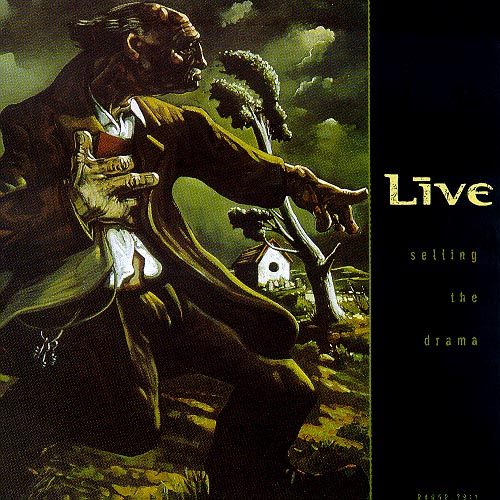
May 21, 1994
- STAYED AT #1:3 Weeks
In The Alternative Number Ones, I'm reviewing every #1 single in the history of the Billboard Modern Rock Tracks/Alternative Songs, starting with the moment that the chart launched in 1988. This column is a companion piece to The Number Ones, and it's for members only. Thank you to everyone who's helping to keep Stereogum afloat.
For most of my childhood, my family lived in a small and leafy north Baltimore neighborhood called Radnor-Winston, right next to the two colleges where my parents taught. It's a quiet, secluded spot even though it's right off one of the city's main north-south arteries. That big street is called Greenmount Avenue in most of the city, but it turns into York Road when you're about to hit my old neighborhood. To little-kid me, York Road was where everything was -- our church, the Popeye's, the McDonald's, the video store, the movie theater, every other business establishment that had any importance to my life. At some point, I asked my parents why it was called York Road, and they said it was because you could drive on York Road all the way up to York, Pennsylvania. This seemed impossibly exciting to me -- a road so big that you could take it to another city, in another state. I asked if we could maybe drive up York Road to York one day. Then we did it, and I instantly learned why we weren't always going to York.
York, Pennsylvania is not a terribly exciting place. It's one of many small, run-down industrial-ish towns that you'll encounter all up and down the East Coast -- the places that you drive through on your way to other places and think to yourself, "Whoof, good thing I don't live here." It's too small for anything to actually be happening there, but it's too big to be quaint. It's just big enough to be sketchy. When my family station wagon arrived in York and my parents told me that we were there, I had no reaction. York just looked like the road up to York, which got really boring as soon as we got north of Towson.
I would say that York is mostly known for three things these days. One: It briefly served as the capital city of the United States during the Revolutionary War. Two: It's the location of the USA Weightlifting Hall Of Fame, and there's a little statue of a guy lifting a barbell that makes for a decent landmark if you're driving north through the city on 81. Three: York is the hometown of the band Live, who were so besotted with the place that they wrote about it on "Shit Towne," a song from their gazillion-selling Throwing Copper album. Many of the "Shit Towne" lyrics are pretty obtuse, as Live lyrics tend to be; nobody knows what Ed Kowalczyk means when he sings about "this hardline symmetry of people and pets." But when you use a title like "Shit Towne," the only thing that anyone really needs to ask is why they spelled "Towne" like that. The rest is immediately understood.
Live blew up in an alternative-rock moment when rock critics and label execs were out hunting for the mythical next Seattle. Nobody was going to mistake York, Pennsylvania for the next Seattle. When the most famous band ever to come from a city dismisses that city with a song called "Shit Towne," singing about living down the street from crackheads and not even making it sound cool, it's a pretty clear sign that the region doesn't have much going for it. Live might've been desperate to break out of York, but you can't help but take on certain aspects of the place that raised you. Maybe that's why Live succeeded as a workaday, vaguely depressing alt-rock band with an instantly forgettable name. Or maybe they succeeded in spite of those aspects. Maybe they put in the work and shook off all the things about York that might've ever dragged them down. Maybe that's what we hear on "Selling The Drama," Live's first #1 hit on the Modern Rock charts.
I'll be honest here: I don't spend a lot of time thinking about Live. Live ascended to the top of the alt-rock heap when alt-rock was arguably at its cultural peak. They were all over the radio for years. They were among the first bands that I ever saw, um, live. They still exist in some form today. But Live never entered the Important Music canon, the way that so many of their peers did, even though they always strove for whatever importance they could muster. If anything, Live exist in my head as a link in a depressing chain. You could justifiably argue that Live were the first true post-grunge band, the first to find massive success by using the soul-rending intensity and guitar-fuzz overdrive of the Seattle bands to make vague and mushy big-gesture arena-rock. So it's a pleasant surprise to revisit "Selling The Drama" and to discover that this shit goes hard. It's a fucking banger! I'd completely forgotten!
I should probably clarify things here and note that Live are not really a post-grunge band, temporally speaking at least. Live existed before "grunge" was a genre or a buzzword, and Nirvana were just gaining steam when Live released their first major-label album. I saw Live at Peter Gabriel's WOMAD Festival in summer 1994, shortly after "Selling The Drama" fell from the #1 Modern Rock spot. This was my second show ever, and I still pretty much understood Live's whole deal right away: These guys wanted to be R.E.M. If you were a band like that at the dawn of the '90s, R.E.M. were your guiding lights. None of the members of Live went to college, but they all looked collegiate -- young, wiry, gawky, sincere.
Live actually covered an R.E.M. song at their very first show, at a Temple Beth Israel dance in York sometime in the '80s. They were all kids then. The four members of Live went to middle school together. Three of them -- guitarist Chad Taylor, bassist Patrick Dahlheimer, drummer Chad Gracey -- had an instrumental trio called First Aid, and they figured that they needed to find a singer after they failed to win a local talent competition. Ed Kowalczyk joined them at a practice and sang Bryan Adams' "Summer Of '69" with them. When Live appeared in the cover of SPIN in 1995, Kowalczyk claimed that the cover was "meant as a joke." If so, it might've been the last joke he ever made. Kowalczyk does not strike me as a very funny person -- not intentionally, anyway.
Baby Live went through a bunch of different names before settling on Public Affection. At that Temple Beth Israel dance, they went up onstage and took over the instruments when the band booked to play that night took a break. That night, Public Affection covered the new wave hits of the day -- the Psychedelic Furs, the Cure, the Simple Minds -- and the kids in the crowd loved them. Patrick Dalheimer experienced a life-changing moment during that performance. He later told SPIN, "There was this girl we knew from school, Dana, that flashed us -- full-on, boobs and the whole works! My dad was there, and I was afraid he would run and tell me to get off the stage 'cause I was all happy and trying to tell the rest of the band in mid-song. Matter of fact, I'm still happy. And I instantly decided that that was going to be my career." It's nice to know that someone from Live wasn't all that serious.
While all the members of Public Affection were in high school and working part-time jobs, the band started playing around the area, hitting the few venues available to them. Eventually, they got to writing their own songs and found a manager. They didn't have enough money to record or release their music, but they came up with a way. Guitarist Chad Taylor explained it to SPIN: "Somewhere along the line, I decided that if you had to have money you had to talk to people who knew how to get money and how to use it. My dad was a general contractor, and I talked to his boss, who was the only millionaire I knew. He said, 'Well, how I financed all our nursing homes is that I sold junk bonds.'" So Public Affection raised a few thousand dollars by selling junk bonds at $100 apiece. I have no idea how something like that would work, but it apparently did work. Public Affection recorded and self-released their debut album The Death Of A Dictionary in 1989, right after all the band members graduated from high school. And hey, look at this, the whole thing is on YouTube. Even from the very beginning, Ed Kowalczyk was making broodingly serious faces in every picture.
I'm not going to front like I've spent a lot of sitting around and analyzing The Death Of A Dictionary, but it sounds like exactly what it was: A bunch of talented shit-towne kids making R.E.M. type beats in 1989. It's got some charm, though it's a long way from great. The band pressed up a few thousand copies of the record, and they sold them at shows and at the one York record store that would take them. Once the album was out, the band's manager booked them at clubs up and down the East Coast and got them to play a bunch of showcases at the storied New York club CBGB. Giant Records eventually gave them a demo deal. The band recorded a professional demo on Giant's dime, and Giant didn't sign them but allowed them to keep using that demo to shop themselves around. The former Talking Heads manager Gary Kurfirst signed the band to Radioactive Records, the MCA imprint that he'd just started.
Once they signed to Radioactive, Public Affection decided that they needed a new band name. They put a bunch of options into a hat, and they pulled out Live, which has to be one of the most fiercely generic band names in history. (Another option was "Alive," which would've arguably been even worse.) Nobody was thinking about search engine optimization at the turn of the '90s, but it's still hard to believe anyone thought that name was any good. Ed Kowalczyk thought the name was "too ambiguous," but Chad Taylor had a dream where he saw someone wearing a Live hat, and he thought it looked good. Patrick Dalheimer told SPIN, "I thought it was cool because it was such a blank name." That doesn't seem cool to me, but it worked for them.
The newly rechristened Live went into the studio with former Talking Heads member Jerry Harrison, who was just in this column for producing the Crash Test Dummies' "Mmm Mmm Mmm Mmm." (Harrison has also been in this column as a Talking Head. His only Modern Rock hit as a solo artist is 1990's "Flying Under Radar," which peaked at #13.) With Harrison producing, Live recorded the 1991 EP Four Songs, and they followed it with Mental Jewelry, their first album under the Live name. For some reason, it came out on New Year's Eve 1991. I guess critics' year-end lists were not a big concern for Radioactive.
Ed Kowalczyk told anyone who would listen that his Mental Jewelry lyrics were inspired by the Indian philosopher Jiddu Krishnamurti, whose work he'd discovered in a new age bookstore. These days, rock band frontman are worried about looking too pretentious. Back then, they were apparently worried about not looking pretentious enough. Jerry Harrison helped the band beef their sound up into a churning swirl, and they added some of U2's messianic grandeur to their obvious R.E.M. influence. "Operation Spirit (The Tyranny Of Tradition)," the lead single from Metal Jewelry, got picked for the MTV Buzz Bin and went into alt-rock rotation, reaching #9 on the Modern Rock chart. (It's a 7.) I remember hearing that song and liking it back then. It sounded thick and intense and passionate. I never bought Mental Jewelry, but I thought the imitation-stained-glass cover art looked serious, and I decided that this band was cool.
Mental Jewelry came out just as grunge was starting to pop off. I don't think the Live guys were chasing that zeitgeist, but I'm sure they had plenty of influences in common. Songs like "Operation Spirit" made perfect sense next to Pearl Jam on the radio. Follow-up single "Pain Lies By The Riverside" basically sounded like R.E.M. with slap-bass, and it peaked at #24. The album sold a few hundred thousand copies when it was first out, thanks in part to Live's heavy touring schedule. It kept moving units after the band's much bigger follow-up came out, going gold in 1995 and platinum in 1999. The members of Live all moved out of their parents' houses, and they started thinking about album number three.
For their 1994 album Throwing Copper, Live went back to work with Jerry Harrison, and they made their sound even bigger and more ambitious. That one probably did have at least some influence from the grunge stuff that had truly become huge. In writing the songs, Ed Kowalczyk thought about where the band came from and the friends they made and lost as kids. That's what he said at the time, anyway. Plenty of the songs on Throwing Copper are about York, "Shit Towne" obviously included. But I don't hear a lot of that on lead single "Selling The Drama." I must've heard "Selling The Drama" 500 times when it was big, and I never even thought about what the song might be about. Now that I have considered it, I still don't really know, and I'm not sure anyone else does, either. The song's Genius annotations are full of theories about how it's about different strains of spirituality, be it Catholic or Hindu. (Kowalczyk was raised Catholic, and he got into Hinduism later.) That's probably true, but I wouldn't expect any religious epiphanies from this one.
Looking at the "Selling The Drama" lyrics now, I'm mostly surprised to learn that Kowalczyk really was singing, "Now we won't be raped." That's how it sounded, but I figured I must be hearing it wrong -- that he was really singing that we won't be rain. I also heard "scarred like that" as "starblind that," which doesn't mean anything. Maybe I was young enough to think that lyrics aren't supposed to make any sense. I should go back to thinking like that. It's a great way to hear music, and it means you don't have to waste any time trying to figure out what Ed Kowalczyk is talking about when he sings that he won't be raped. Kowalczyk himself told SPIN that lyrics were never really his main focus: "The lyrics come last. A lot of times, it's just syllables and nonsense. No words, just sounds and melody." It's fun to think that Kowalczyk wrote "Selling The Drama" like he was a Swedish pop producer who speaks English as a second language -- letting the melody and the meter dictate the words, operating through instinct rather than meaning.
"Selling The Drama" seems like it wants to mean something, with Ed Kowalczyk reaching for all these majestic images: "And to Christ, a cross/ And to me, a chair/ I will sit and earn the ransom from up here." But the song reaches its peak when Kowalczyk stops singing lyrics altogether, when he brays out hee-yaahs and falsetto yodel-whoops. The words might not mean anything to me, but the gestures sure do. "Selling The Drama" does the standard quiet-to-loud thing with great assurance. It starts out with strummy acoustic guitars and murmuring bass -- Patrick Dahlheimer got busy with those basslines -- before the riffs come galloping in and Kowalczyk gets to yowling at the top of his lungs. The ramp-up to the chorus kicks so much ass: "Ah've wheeled! Ah've wawked! Ah've read! Ah've tawked! Ah know! Ah knyeeew! Ah've beeaan heeyah befoooowwaaa!" It just keeps building and building, every new crescendo crashing down on the one that came before. When it reaches full-steam, it just ends. There's no calm-down moment. It's just gotten as big as it can get, and there's nowhere else to go.
Listening now, "Selling The Drama" does a lot of the same things as the cheesy post-grunge power-ballads that took over alt-rock radio in the late '90s. It's all grand, meaningless swoops delivered with ultra-serious fervor and nothing that even remotely resembles cleverness, and it all works on me. Maybe "Selling The Drama" is just one of the great examples of the post-grunge form. Maybe Live, just as much as Pearl Jam or anyone else, invented the mold that bands like Creed later rushed in to fill. Or maybe I just heard "Selling The Drama" when I was young enough that I didn't think I was too cool for any of that stuff. As this column gets into that era of the Modern Rock chart, I'll have to seriously consider whether I've spent most of my life unfairly dismissing all those post-grunge bands. In any case, even if I wanted to roll my eyes at "Selling The Drama," I couldn't do it. It works too well on me.
The "Selling The Drama" video shoot was the last thing that Ed Kowalczyk did before shaving off most of his hair except for the braided ponytail that he kept in back. The video itself is nothing special -- mostly just a moodily lit Live skulking around in the woods -- but it's crucially the last Live video that did not make Kowalczyk look like a dipshit. He just looks like a serious young man who sometimes wears glasses. He looks like some guy, not like a rock star. Perhaps he looked more like a rock star with the shaved-head/ponytail combination. When "Selling The Drama" came out, it fit seamlessly into alt-rock radio rotation, and it hung around for a long time. I remember thinking that the song was probably on the radio too much, but I never got sick of it the way I did with some of Live's later hits. Even if Live didn't seem like stars yet, "Selling The Drama" was a legit radio beast. It crossed over to the Mainstream Rock chart, where it reached #4. It also became Live's first single on the Hot 100. It peaked at #43 over there, and it's technically Live's biggest pop hit, though that's probably just because Radioactive didn't press up commercial singles of some of Live's other Selling The Drama songs.
Live worked Throwing Copper hard, and "Selling The Drama" was still in heavy rotation when I saw the band on that Peter Gabriel tour. So was their follow-up single "I Alone," which I remember hearing way more than "Selling The Drama" but which only reached #6. (It's a 7.) "I Alone" is even bigger and louder than "Selling The Drama," but I think it's a little clumsier, too. Both "Selling The Drama" and "I Alone" stayed on the Modern Rock chart for a long time -- 19 weeks for the former, 26 for the latter. But Live were just getting started. Throwing Copper went gold in 1994, and it didn't become a true commercial blockbuster until about a year after its release, when its third single went supernova. We'll see Live in this column again soon.
GRADE: 8/10
BONUS BEATS: Here's a very sweaty Live playing "Selling The Drama" and causing all the people covered in mud to start a conga line at Woodstock '94:
THE NUMBER TWOS: The Pretenders' sleazily swaggering barfly-life entendre-fest rocker "Night In My Veins" peaked at #2 behind "Selling The Drama." It's an 8.