
- Third Man
- 2005
The prop guys have finished adding giant, chunky lifts to the black dress shoes that I bought for my grandfather's funeral. A crowd gathers around me as I try them on, and people literally gasp when I stand up. With these lifts on my shoes, I am something like eight feet tall. A crowd of upturned faces hovers around my waist level. I feel like Dorothy in Munchkinland, except I am terrified. I'm supposed to walk in these things? The assistant director tells me to get used to them, to walk around, so that's what I do. I clomp all over that set, and I feel like an absolute freak, which is the entire idea. I'm here because I'm a freak. A freak is what the White Stripes need.
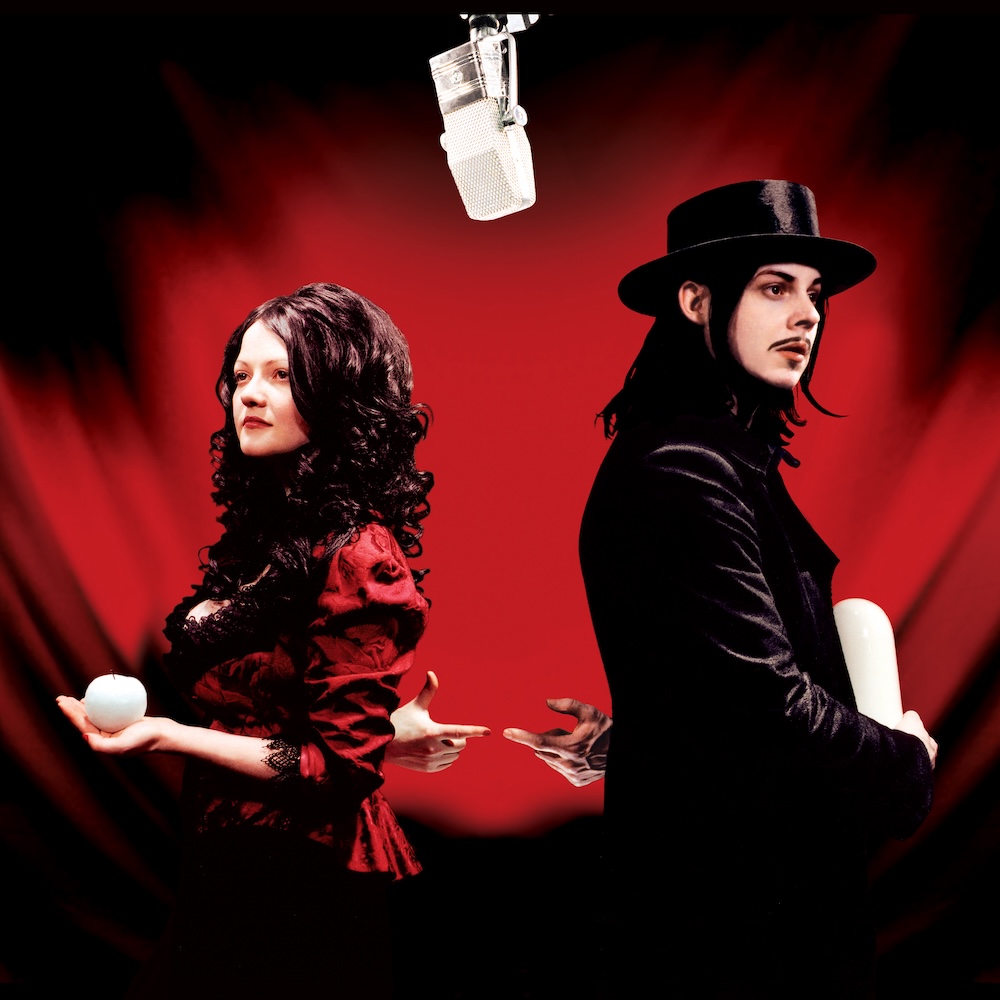
A few months before this moment, the White Stripes released Get Behind Me Satan, the follow-up to their gigantic breakout album Elephant. (Right now, in 2025, Get Behind Me Satan will turn 20 on Saturday.) The duo had tons of hype on their side before Elephant, and then they made good on that hype. "Seven Nation Army" was an instant riff-rock standard, a radio hit that became a football-stadium chant. "The Hardest Button To Button" was a jittery freakout with a mesmerizing video. "Ball And Biscuit" was the extended guitar-hero onslaught that convinced any remaining classic-rock skeptics that these young kids had the glow. The White Stripes had already done their time in the underground, honing their singular aesthetic and their oblique and unearthly approach to the blues-rock canon. By the time the world discovered them, they were ready to deliver a classic. That was Elephant. So how do you follow up the breakthrough? How do you go from lightning-in-a-bottle phenom to sustainable enterprise? Those questions have broken up tons of bands. Get Behind Me Satan was the White Stripes' attempt to answer them.
Fame wasn't an easy transition for the White Stripes. Meg White was intensely private, though she was nice enough to bum me, a stranger, multiple cigarettes on the video set. Jack White was an excited but combustible presence. After rocketing to success, he kept getting into altercations with his former friends on the Detroit garage rock scene. Sometimes, those disagreements took legal form, as with Jim Diamond, who helped record the duo's first two albums and who wanted a piece of the pie. Sometimes, they got physical, as when White famously beat the shit out of Von Bondies leader Jason Stollsteimer in a barfight. Rock stardom clashed with the White Stripes' focused and near-monastic sensibility and approach. They would never make another "Seven Nation Army." Instead, they went smallball, playing around with timpanis and marimbas and many, many pianos. In the process, they came up with a set of sly, catchy tracks that were not made with world domination in mind.
But even if you're not trying to take over the planet, you still need to sell records. The White Stripes sold records in part through the powerful gimmick of an imaginative visual language that stood out on MTV -- the charmingly simple Lego animation of "Fell In Love With A Girl," the marching lines of drum sets of "The Hardest Button To Button." On both of those videos, the White Stripes' director was Michel Gondry, the whimsical music video master whose imagination paired so beautifully with the band's simplicity.
"Blue Orchid" and "My Doorbell," the first two singles from Get Behind Me Satan, were great songs that got decent play on alt-rock radio, but they didn't have the same kind of instantly iconic visual representation. "Blue Orchid," the album's opener, sounded nothing like "Seven Nation Army," but it made sense as the lead single because it was one of the few Get Behind Me Satan tracks that really put Jack White's strangulated electric guitar to use. The video cast Jack and Meg White as gothy wastrels, and director Floria Sigismondi took the drastic step of introducing blue into the band's color palette. Karen Elson, the model who Jack White would marry later in the year, is in the video, wriggling around in a bathtub. It's not that exciting.
If one track from Get Behind Me Satan was going to be a hit, it probably should've been "My Doorbell," the pounding piano-banger that might be the album's catchiest song. But like a lot of tracks from that album, its catchiness isn't the most obvious kind. It's got a strange old-school Broadway energy. You want someone to twirl a cane when they sing it. For the video, the White Stripes brought in the Malloys, director of some of the best Blink-182 videos. They made it look like an old-timey black-and-white short, with the White Stripes playing for a crowd of cute little kids at LA's Magic Castle. Once again, MTV mostly stayed away.
Michel Gondry, meanwhile, had become a feature film auteur. His Eternal Sunshine Of The Spotless Mind came out the previous year, and it convinced people that he's a genius -- a viewpoint that was already common among music video obsessives like me. Today, Gondry is back in the mix with the White Stripes. Maybe he'll be the one to figure out how to sell this wacky, conspicuously non-rocking album from the group that was supposedly going to save rock 'n' roll. I'm here, too -- not because I have some great idea to offer the band or the director, but because I'm tall.
I just arrived in New York a few months prior, after Get Behind Me Satan was already out. My girlfriend and I moved into the Park Slope apartment already occupied by my old college friend Andrew, who now edits an indie rock magazine called Devil In The Woods. We didn't used to need roommates in Baltimore, but we need one here because New York is expensive. One day, Andrew offers me some extra money for a freelance gig: Go to the lobby of the Soho Grand and conduct a panel discussion among some all-time great music video directors. Palm Pictures has a DVD series called Directors Label, which collects music videos from brand-name directors, and they've just put out sets for Mark Romanek, Anton Corbijn, and Stéphane Sednaoui. (Future Oscar winner Jonathan Glazer has one, too, but he's not in New York.) Those three guys all meet me at the Soho Grand, and so does Michel Gondry, whose Directors Label DVD came out two years earlier. I am so psyched to talk to these guys, and I have a great time with the panel discussion. A few days later, I get a phone call from an unfamiliar number. The lady on the other end says she works with Michel Gondry, and he wants to put me in a video. I cannot believe my luck. I cannot believe this is real.
Soon after that phone call, Michel Gondry finds me in the crowd at Across The Narrows, a music festival at the minor league ballpark in Coney Island. He's like, "You are going to be in my veedeo?" I'm like, "Yeah, man!" I get to tell my girlfriend, "Hey boo, this is Michel Gondry." Then Beck dedicates "Everybody's Got To Learn Sometime," his song from the Eternal Sunshine soundtrack, to Gondry while Gondry is right next to me. My head is spinning. Is this what New York is like? Things like this just happen? When I arrive on the set in a Greenpoint warehouse, Gondry tells me that his idea for the video solidified while he was talking to me and the other directors. He thought I looked like a stretched-out version of Conan O'Brien, and he thought he could make a video out of that. Given that Conan O'Brien is already tall -- it's one of his most obvious and striking physical features -- that should give you some idea how tall I am. Gondry wants me to be even taller, and that's why I have these lifts on my shoes.
Soon, I learn Gondry's concept for the video. The set is built in a circle, set up for one continuous shot. When the White Stripes released Elephant, they were musical guests on Late Night With Conan O'Brien for one week straight. This video will reenact that moment, but Gondry will make it weird and psychedelic. On one side of the room, there's a scrunched-up version of the Late Night stage. Gondry has cast a little person to play one version of Conan, and I hang out with him for a while while we're waiting to shoot. He's a part-time comic, and his biggest acting role to date has been as a breakdancer in a Cingular ad. He's incredibly nice, and I will keep seeing him pop up on HBO shows in the years after this video shoot -- on The Sopranos, on Game Of Thrones, on Boardwalk Empire. Next to the scrunched-up stage, Gondry's people have built an elongated, stretched-out version of Conan's desk and couch. That's where I'll be.
My little brother is here, too. He's a special ed teacher's assistant in Baltimore, and he's taken the Chinatown bus up for the day because the White Stripes are his favorite band. When I tell him that I'm going to be in this video, he's like, "Ask them if they need any other tall people!" They do need other tall people, it turns out. They need people taller than him. My brother is about 6'5" -- very tall by normal-people standards but significantly shorter than me. When he meets my brother, Michel Gondry says, "Emmm, you should be taller." My brother doesn't know how to be taller, so someone finds an apple crate for him to stand on. He's supposed to play the hulking bodyguard that the White Stripes had during that week on Conan. The bodyguard was Black. My brother is not Black. In retrospect, it's pretty fucked up. In the moment, it doesn't matter because he's going to have a giant piece of cardboard covering his face.
I have a giant piece of cardboard covering my face, too. My piece of cardboard looks like Conan O'Brien's face. It does not have eyeholes. In my few seconds onscreen, I am supposed to shake hands with Jack White, accept the sculpture of Conan's face that they've given me as a gift, and walk across the stage. I am supposed to do this, with these big lifts on my feet, while looking at the camera. I can't do it. I can barely walk in these fucking things while looking straight ahead. We run through a bunch of rehearsal takes, and I am the fuckup who can't do it right. There's a whole team of film professionals here, people who stayed up all night building the set, and I let them down whenever I glance down at the bigass blocks on my bigass feet. I'm letting Michel Gondry and the White Stripes down, too. I just can't do it.
The real Conan O'Brien shows up while all this preparation is underway. He's dressed like a rockabilly guy, which is weird to see. He's so nice and so funny. When he sees me stomping around in my giant shoe lifts, he's like, "That is actually how I walk." He loves the White Stripes, and the White Stripes love him. Jack excitedly tells Conan about how he and Meg just recorded their guest-voice role for The Simpsons, where they'll do an animated version of the video for "The Hardest Button To Button." Conan is the person who wrote the greatest Simpsons episode of all time, and he tells them how excited he is for them. A few years from now, the White Stripes will give their final performance on the final episode of Late Night With Conan O'Brien. Now, I'm letting down Conan, too.
Gondry tries a couple of takes with Conan playing himself and me as the security guard, which feels wrong in all sorts of ways. We do the one long, unbroken shot over and over, and then Gondry finally decides that we got it. Everyone cheers. Finally, inevitably, I step wrong in my shoe lifts and twist my ankle, but only after the shoot is done. Karen Elson, Jack White's future ex-wife, runs over to check if I'm OK. She's so nice. Everyone here is so nice. I get my picture taken with the White Stripes and Michel Gondry and Conan O'Brien, and I don't have any of those photos anymore. When the video finally comes out, Gondry uses one of the takes of me as Conan, but he superimposes an unmoving Conan face over my cardboard mask.
The video is for "The Denial Twist," which is far from the catchiest remaining song on Get Behind Me Satan. It's another piano-rocker like "My Doorbell," another cane-twirler, and Jack White actually does twirl a cane in the video. I hear the song so many times during the video shoot, and I never really come around to thinking it's more than pretty good. Like the other two singles, it gets some alt-rock radio play but doesn't leave a huge impression. This makes sense. I see the video maybe once or twice on Fuse, never on MTV.
It's not that great of a video. I'm a little bummed that I'm in the worst of the Michel Gondry White Stripes videos, but I'm still in a Michel Gondry White Stripes video. The walking-on-air feeling lasts a day or two, until I write about the experience on my Village Voice blog, which is my actual job and which nobody has told me not to do. Reps for the band call me up and yell at me. Later on, Jack White will use me as an example of everything that's wrong with the internet when he's talking to NME. From Jack White's perspective, I pierced the mystery and gave things away when they weren't ready to be given away -- as if this video has some plot twist that I just spoiled.
I've told this story so many times. Maybe you've read me writing some version of this story. You'd tell it, too, if it happened to you. A little while before the video shoot, someone from the production company called me up and says that it was a low-budget video and they couldn't pay me anything. I was a little miffed, but what was I going to do? Not be in a White Stripes video? I do it for the story, and I do it because I love the White Stripes and Michel Gondry and Conan O'Brien. When I get to the set, it's clear that the budget isn't that low and that everyone else is paid to be here. My brother and I are the only volunteers. I'm not even mad about it! I get to be part of this thing! When I write about it and the reps yell at me, one of them says, "Where did you get the idea that you weren't getting paid?" A few weeks later, I get a check in the mail for a couple thousand dollars, at a time when I really need it.
If Get Behind Me Satan sounds like a homemade art object, that's because it literally is. The White Stripes recorded the LP at Jack White's house in Detroit's Indian Village neighborhood, using all kinds of outmoded analog tape equipment. It's got almost no guitar-hero action. Instead, it's Jack White futzing around with his ideas about folk and soul and classic pop songwriting. There's a lot of stuff about falling in love with ghosts, people who aren't really there. Rita Hayworth makes multiple lyrical appearances, serving as an avatar for the glamor that regular people can't approach or understand. "Take, Take, Take" is a classic fame-freakout song, a parable sung from the point of view of an obsessed fan who simply cannot be satisfied with his interactions with Hayworth. He can't be satisfied with a hello, an autograph, a picture. He always want something more. The public always wants something more.
It's a sneaky-great album, Get Behind Me Satan. The hooks worm their way in. Nothing immediately announces itself as an instant-class song, but "The Nurse" and "Forever For Her (Is Over For Me)" and "As Ugly As I Seem" remain some of the duo's most compulsively listenable tracks, at least for me. It's not a blockbuster. It's the thing that you make after the blockbuster, to show that you're in it for the long haul. It's a big-room's successful attempt to reconnect with their little-room selves. But the White Stripes were not in it for the long haul, and they will only make one more album before going away forever.
Get Behind Me Satan is a knowingly minor work, and it was largely received that way in 2005. Critics loved it, though not quite as much as they loved Elephant. On the Pazz & Jop poll, America's critics named Get Behind Me Satan the #6 album of 2005 -- right behind Fiona Apple's Extraordinary Machine, right ahead of ANOHNI And The Johnons' I Am A Bird Now. (I was planning to see ANOHNI at Carnegie Hall the same night that we shot the "Denial Twist" video, but I didn't realize that a music video shoot takes like 14 hours.) That was a great showing for the White Stripes, but it was still a few spots behind either of their last two albums.
Get Behind Me Satan ultimately didn't sell as well as the previous two White Stripes albums or the one that came after. It still went gold. This year, the White Stripes are heading into the Rock And Roll Hall Of Fame, and I get the feeling that they wouldn't be so well-remembered if they didn't make those last two albums after the initial explosion. Today, the weird, off-center late White Stripes albums sound just as great as the ones that put them on top of the world.
Get Behind Me Satan is a beautiful little work of low-budget weirdo outsider art. The two people who made it still felt like outsiders, even if that's not how the world regarded them. The White Stripes recorded Get Behind Me Satan in less than a week, and they reportedly spent less than $10,000 in the process. That means I got paid a significant percentage of the album's budget to clomp across their video set. In the moment, I was happy to get that check, even if I was like, "Damn, me and the White Stripes got beef now." Today, I kind of wish that the band never sent me that check, that they spent it on making a few more songs instead.