

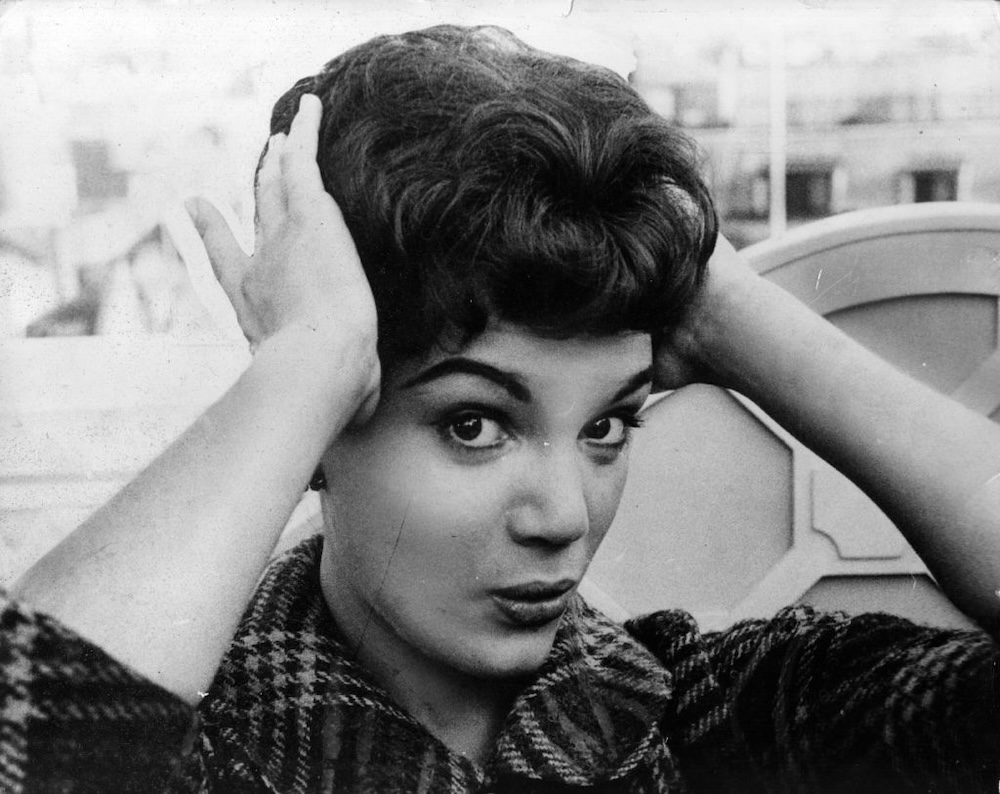
Connie Francis, the tremendously successful pop balladeer who had a huge run of hits in the late '50s and early '60s and who has been back in the TikTok zeitgeist recently, has died. As The New York Times reports, Francis' publicist shared the news of her passing in a Facebook post last night. No cause of death has been reported, though Francis has suffered from health issues recently. She was 87.
Connie Francis was born Concetta Rosa Maria Franconero in Newark in 1937. When she was a child, Francis' Italian-American family moved between Brooklyn and New Jersey. As a kid, she was a gifted singer and accordion player, and a talent agent told her to change her name to Connie Francis and to drop the accordion, though she performed under her real name on the variety show Startime Kids in the '50s. While she was in high school in Belleville, New Jersey, Francis sang on pop-song demos that were offered to other singers.
Francis released her debut single "Freddy" on MGM Records in 1955, the same year that she graduated from high school. That song didn't go anywhere, and neither did Francis' other early records. During her early career, Francis recorded the vocals for actors to lip-sync in the movies Rock, Rock, Rock and Jamboree. "The Majesty Of Love," a 1957 duet with Rainwater, became the first Francis song to crack the Billboard singles chart, where it peaked at #93. Later that year, Francis' version of the 1923 song "Who's Sorry Now?" became her first major hit, going all the way to #4 in the US and #1 in the UK.
Connie Francis started her career at the very beginning of the rock 'n' roll era, and her music sometimes nodded in that direction, at least nominally. But Francis was really an older kind of pop singer, one whose warm, innocent, non-threatening voice worked on all sorts of Tin Pan Alley songs -- jazz-adjacent big-band numbers, countrypolitan reveries, heartbroken ballads. On records, she radiated girl-next-door friendliness, and she was an absolute workhorse in the studio. Famously, she would record versions of her songs in tons of different languages, which MGM would then market around the world.
In 1958, Francis recorded "Stupid Cupid," a song written by Neil Sedaka and Howard Greenfield, and it reached #14 in the US and returned her to #1 in the UK. Later that year, Francis' version of the pop standard "My Happiness" reached #2 in the US. More hits followed, including "Lipstick On Your Collar," "Second Hand Love," and "Where The Boys Are," which became the theme for a 1960 movie vehicle for Francis. Three of her singles -- "Everybody's Somebody's Fool," "My Heart Has A Mind Of Its Own," and "Don't Break The Heart That Loves You" -- reached #1 on the Billboard Hot 100 between 1960 and 1962. For a while, Francis dated fellow pop star Bobby Darin, and the two of them sang a 1960 duet on The Ed Sullivan Show, where Francis made multiple appearances. The story goes that Darin wanted to elope with Francis but Francis' father chased him away with a gun. Later on, Francis was married and divorced four times.
Connie Francis' version of Tin Pan Alley pop became progressively less successful over the course of the '60s, and she became a symbol for naive cultural traditionalism. But she continued to tour and record, performing for Queen Elizabeth in Scotland and for American troops in Vietnam. In the years after her popularity slowed down, Francis endured some events so absurd and traumatic that they almost defy belief. In 1974, Francis was abducted, raped, and robbed at a Howard Johnson's hotel. Her rapist was never caught, but she won millions from Howard Johnson's after suing them for failing to provide security. She went into relative seclusion afterwards, becoming addicted to pills and losing her voice for years after nasal surgery. In 1981, Francis' brother George was murdered by mob hitmen after testifying against organized crime and refusing witness protection. In the wake of that loss, Francis was diagnosed with manic depression and hospitalized.
Eventually, Francis recovered her voice, and she returned to the stage. She published several memoirs, and her music went through periodic revivals, especially in Germany, where she had always been popular. Earlier this year, "Pretty Little Baby," an obscure deep cut that Francis recorded in 1963, went viral on TikTok. In interviews, Francis said that she didn't understand what it meant to go viral and that she didn't even remember recording the song, but she called the experience "truly awesome." Check out some of Francis' work below.