
- MixUnit.com
- 2005
Pusha T and Malice still talk about the Knitting Factory show. I still talk about it, too. If you were there, then I bet you still talk about it. It was a special night -- a moment when you could see potential turn into cold, hard reality. It felt like everyone I knew was in that room that night, like we were all levitating. The Knitting Factory was not necessarily supposed to be the venue for that kind of night. I knew the room well, worked the door there for a few months in 2000. It wasn't a big room. 400-cap. Tribeca. Rich neighbors calling in noise complaints all the time. It wasn't the place for the most exciting rap show in the world, until it was.
Clipse hadn't played a live show in nearly three years when they trucked up to the Knitting Factory. That was the story, anyway. They'd made a great debut album, 2002's Lord Willin'. That record went gold and launched a couple of hits, including "Grindin'," a song that rewrote the street-rap rulebook. They rapped on Justin Timberlake's first solo single. They had the allegiance of the Neptunes, a production team on a years-long hit streak. But thanks to corporate mergers, Clipse were stuck on the label shelf, feuding with their new bosses, unable to generate any momentum. Before they knew what happened, they were has-beens. And then they weren't.
Someone at the Knitting Factory booked a Clipse show in March 2006, when they thought they were ice-cold. The Clipse guys and their comrades, Philly rappers Ab-Liva and Sandman, weren't sure about taking the booking. New York was where the brothers Malice and Pusha T were born, but the city had never embraced the Clipse. Why would they suddenly come back and do this little club show? They didn't really know the answer until they touched the stage. But as soon as they stepped out there, you could see the new reality dawn on them in real time. Clipse were cult heroes. They just didn't know it.
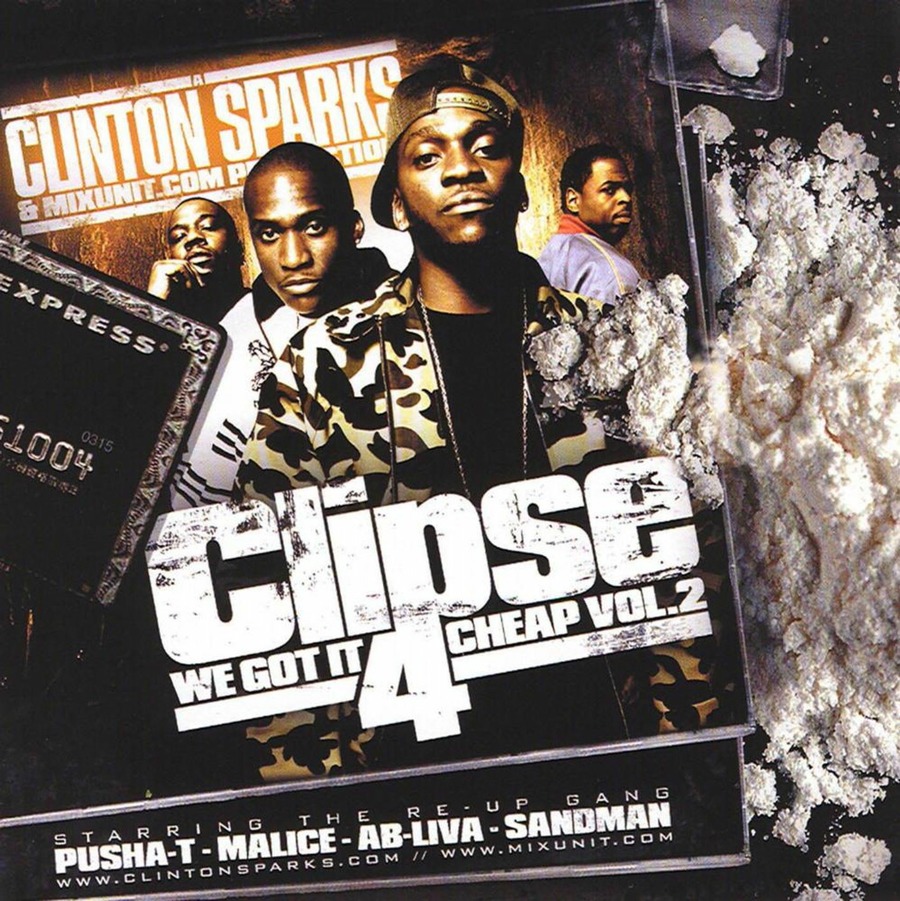
The mixtapes made them cult heroes. More specifically, one mixtape did it: We Got It 4 Cheap, Vol. 2, a glowing masterpiece of the form. Mixtapes didn't generally have traditional release dates back then, so I can't tell you exactly when Vol. 2 came out. It probably turned 20 some time in the last couple weeks. It's 20 now, anyway. We knew it was out because our mixtape guy finally got the CDs. I was new to New York when We Got It 4 Cheap, Vol. 2 came out, and I was friends with a bunch of music-blogger obsessives who anticipated Vol. 2 like it was a Paul Thomas Anderson film. We'd head up to the spot on 14th Street where a guy named Amadou sold mixtapes out of a little closet, and we'd keep asking him about the Clipse tape. He'd say it would be in tomorrow, and then we'd go the next day, and it wouldn't be there. One time, the Wu-Tang affiliate Killah Priest was there buying tapes, and Amadou introduced us. He was like, "These guys buy your mixtapes all the time!" That was a lie. but it was a nice thing for Amadou to say.
Then, finally, there it was, Vol. 2, and it was better than we could've anticipated. Clipse released We Got It 4 Cheap, Vol. 1 sometime in 2004, and it was good, but it wasn't that good. Clipse were stuck on the shelf, trying to get something moving. Their dizzying Neptunes-produced track "Pussy" popped up on the Barbershop 2 soundtrack that year, but it couldn't get any radio traction, possibly because it was called "Pussy." A song like that almost exists to become a cult favorite, a file-sharing word-of-mouth anthem.
"Pussy" anchored Vol. 1, and the Clipse fleshed the tape out by rapping over a sharp but seemingly random selection of beats old and new -- "Drop It Like It's Hot," Kanye West's "The Whole City Behind Us," LL Cool J's "I Shot Ya." Pusha, Malice, Ab-Liva, and Sandman all rapped their asses off on that tape, but it had all the hallmarks of that moment in mixtape history -- the disruptive DJ drops, the rewinds, the sound effects, the skits, the nonexistent mastering, the songs suddenly cut off halfway through. It was jarring and chaotic, and that was the point. That was how mixtapes were. Pusha T thought Vol. 1 was a failure because his mixtape guy in Virginia Beach didn't carry it. My mixtape guy in Baltimore had it, but he was surprised when I asked for it. He told me nobody was buying that one. But my friends and I liked it enough that we kept asking Amadou when Vol. 2 was coming.
Single-artist rap mixtapes were still a relatively new thing in the mid-'00s. 50 Cent and G-Unit used the format to build themselves a tremendous buzz earlier in the decade. Other early adapters figured out how to use tapes like that to cement their legends -- the Diplomats, Lil Wayne, T.I. But those mixtapes still had more in common with DJ compilation tapes than with actual albums. Clipse approached Vol. 2 differently. They worked closely with their Re-Up Gang proteges and with mix-show DJ Clinton Sparks to make it something special. When they recorded it, they lived in the guestrooms in Pharrell's mansion, a process that mirrors the way Clipse recorded their triumphant 2025 comeback album Let God Sort Em Out at Pharrell's new workplace, the Louis Vuitton headquarters in Paris.
Everyone knew that Clipse sounded amazing over Neptunes beats. Maybe that's why they avoided Neptunes beats completely on Vol. 2. They rapped over different kinds of instrumentals on Vol. 2 -- New York head-knock classics, huge pop hits, under-the-radar bangers. Pharrell -- the "sometimes Y" of the crew, as Pusha put it on one skit -- still made his presence known, sometimes coming through with a flossy verse at the end of a track. (Pusha insisted that he never wrote a verse for P: "My whole crew stand on they own two.") Together, they made something that truly mattered.
Listening to We Got It 4 Cheap, Vol. 2 for the first time in a while is a bracing experience. I know the tape well enough to rap along with all the big lines, but its sense of motion is still striking. The beat selection is fucking ridiculous. 2005 was a great time for rap production, and Clipse picked some of that moment's hardest instrumentals: the Game's "Hate It Or Love It," Common's "The Corner," Cassidy's "I'm A Hustla," Juelz Santana's "Mic Check," Amerie's "1 Thing." They found beats, like the ones for the Game's "Put You On The Game" and Tony Yayo's "So Seductive," that deserved better than the songs that they originally served. I'm not sure I'd ever even heard Mobb Deep's "Cobra" before I heard the Re-Up Gang version, but that Havoc beat is perfect face-scrunch nastiness. And when Clipse dug a little deeper into rap history, they did serious damage. I'd forgotten all about how they hijacked Ghostface Killah's "Daytona 500" beat, and I wanted to drive my car directly into a plate glass window when that track came on.
In almost every case, I'd take the Clipse's freestyles over the actual original tracks. I love the way Vol. 2 unfolds. Pusha and Malice have some of the all-time great rap voices. They're precise and incisive, and they always sound like they're disgusted that they have to explain things to you. But Vol. 2 is where their two Philly comrades really come into their own, doing more than serving as sounding boards. Tracks pick up steam as they keep going, with the brothers' cadences giving way to the hoarse, guttural wheezes of Ab-Liva and Sandman. You can hear all four rappers pushing each other, trying to make sure they never have the weakest verse on the track. Sandman was the only one who never really captured my imagination, but he's got tons of presence, and he finds all kinds of tricky ways to break up his flows, to nudge instrumentals back and forth. When the least interesting rapper on the tape is the one who offers you "a burgundy wetsuit for thinking you death-proof," you're in good hands.
But Ab-Liva, holy shit. I can't really say enough good things about Ab-Liva. Before he joined the Clipse's fold, Liva was a member of Major Figgas, a Philly collective that released one widely ignored major-label album in 2000. When he linked up with Clipse, Liva first came off like the towering security guy who sometimes gets to rap a verse. But on Vol. 2, Liva is all breathless, careening urgency. He has lines that still leave my head spinning: "Ex-dope dealer, the X being the quotient/ Dividing the product by the motion that I'm moving once it coasts off the ocean." He's the crown prince, hand whipping it to the oils of four who became accustomed to the spoils of war. He sketches his life, his music; his wrist is not far from Rembrandt to Van Gogh to Michelangelo. His past was sordid, or should he say lurid. He's Magic with the pen. He's Jordan in the booth. He's Melo with the flow. LeBron, he's the truth. Liva never became the solo star that he deserved to be. He never even released a project of his own. Instead, once Clipse broke up, he found work as Kanye West's favorite ghostwriter. It's a living.
There are moments, listening back to Vol. 2, when I convince myself that Ab-Liva was really the best rapper of the four. Then, a Malice line suddenly grabs me and twists my neck around. "Catch me if you can, I am Gingerbread/ And the mink interior is crimson red/ Y'all talk before they even mention feds/ Of how I got the block like the Dawn Of The Dead." "Never sacrifice the pride, CEO was Jive-talking/ I revert to the block from whence all this derived." Even in that moment, you can hear Malice considering his vocation in real time, wondering aloud whether rapping about cocaine is what he really wants to do with his life: "All these hues, one should be humored and amused/ But more often than not, I find myself confused/ Cruising in that drop, and still I feel/ As if I'm nothing more than a hamster in a wheel." But he raps about cocaine so well. Maybe that internal conflict is what drives him. Maybe the contradiction keeps him sharp. He's so literary with it, you can tell by how he writes -- such an author he should smoke a pipe.
Nobody was surprised when Pusha T became the breakout star years later. On Vol. 2, you can hear the focused excitement in his voice. On Clipse's version of "Hate It Or Love It," Pusha gets into personal stories, talking about the fates of some of his past associates while making sure not to say anything that could get anyone indicted. Elsewhere, he insists that he still really bags up: "How could you ever think that rap had me pumped up when that powder white come in by the dumptruck?" His flows get quoted like Socrates' philosophies. He's got more white in the hood than the KKK. Pharmaceuticals bought him charm like the jewelers' jewels. Label him landlord, he keeps kis in his hand.
We should talk about drugs, right? Pusha T talks about drugs. He talked about drugs before Vol. 2 and after Vol. 2, but Vol. 2 might represent the apex of his drug-talk: "You should see that motherfucking water boiling on the stove and those white things floating like it's Alka-Seltzer Cold." While Malice finds himself torn up over the misery that he has helped to spread, Pusha merely shrugs it off: "I put JoJo Dancer in them flames -- well, he bought it." This was a big subject of conversation among critics at the time. Plenty of other rappers -- Jeezy, T.I., Cam'ron -- were describing the drug trade in the same awestruck tones, and critics like me thought we had some idea what they were saying because we watched The Wire, a show referenced heavily across the Got It 4 Cheap tapes. Were we fetishizing? Were we making excuses for some immoral shit because it was rendered so vividly, even when we had no connection to that life? Are these stupid questions to even ask? I didn't have any answers then, and I don't have any answers now. I just know that Vol. 2 was and is viscerally exciting music.
I went nuts for Vol. 2, and so did my little coterie of music bloggers. Places like Pitchfork and the Village Voice gave us space to enthuse about what Clipse were doing. The mixtape spread through internet chatter. It was an online word-of-mouth phenomenon when that was a relatively new thing for rap music. When Clipse came to the Knitting Factory, it felt like every music critic and blogger in New York was in the room -- enough of us to pack it in way past capacity. That night, all four rappers went into their mixtape tracks, and the whole crowd rapped those tracks back at them. Pusha stood onstage, pointing out the individual audience members who knew the words the best. Clipse found out that they had this new, undiscovered audience, while the rest of us got to come face-to-face with the people who made this music that we loved. After the show, Malice was out on the sidewalk, handing out Vol. 2 CDs, but we all had it already. He looked so happy.
Clipse generated a whole lot of buzz with Vol. 2, and that momentum finally led to the release of 2006's Hell Hath No Fury, which some are calling the eighth-best rap album of all time. Hell Hath No Fury is incredible, but I might still prefer Vol. 2, a piece of work that captures a hunger and an energy that can never be replicated. Clipse's recent return was a beautiful thing, and they are still fully capable of making a great rap record in middle age. Now, a Clipse record feels like a true event. Twenty years ago, they were fighting for their artistic and commercial lives, using any tools they had at hand. Both situations resulted in great music, but the feeling is different.
Vol. 2 was the beginning of a moment, and I got to be there, to see that moment take physical form. I probably won't get to be there for another moment like that again in this lifetime. The conditions were just right. There was enough static electricity in the air for lightning to strike, and it struck. Four guys, two major-label refugees and two relative unknowns, made a piece of promotional material that can still hang with the greatest rap albums in history. That kind of thing doesn't happen, except that it did. You can still listen to it. In fact, do that, right now.
https://youtube.com/watch?v=hv0BjnWnwDs