
February 8, 1992
- STAYED AT #1:3 Weeks
In The Alternative Number Ones, I'm reviewing every #1 single in the history of the Billboard Modern Rock Tracks/Alternative Songs, starting with the moment that the chart launched in 1988. This column is a companion piece to The Number Ones, and it's for members only. Thank you to everyone who's helping to keep Stereogum afloat.
In 1989, Lou Reed had a hit on his hands. In Reed's case, "hit" was always going to be a relative term, give or take a "Walk On The Wild Side." For most of his career, Reed stayed on the periphery of the music industry. The Velvet Underground, his important but commercially unsuccessful band, inspired generation upon generation of important but commercially unsuccessful bands, as well as a few commercially successful ones. But the Velvets didn't last. In his solo career, Reed had the clout of coolness around him, and he kept making esoteric major-label albums as long as he was able, but he wasn't making anyone rich, least of all himself. Still, things lined up just right in 1989.
Through the '80s, the Velvet Underground's reputation grew, thanks to a long-overdue reissue campaign and to the younger bands, like R.E.M. and the Bangles, who proudly told the world how much they'd taken from the Velvets. Lou Reed's solo career was always spotty and indulgent, but he caught a wave when he made 1989's New York, the record where he found a revived sense of swagger and purpose, obliquely addressing certain societal ills. New York got the strongest reviews of any Lou Reed album in years, and it sold enough to go gold -- Reed's second and final gold record, after the 1974 live album Rock 'N' Roll Animal randomly achieved that distinction.
Reed's music never got a whole lot of airplay, but modern rock radio, a fairly new development, was open to whatever he was doing, especially if he made something as catchy and muscular as "Dirty Blvd." The lead single from New York went all the way to #1 on Billboard's newly instituted Modern Rock chart. The alternative-radio landscape was still just taking shape, but a Lou Reed record going to #1 on a Billboard chart -- any Billboard chart -- is not something that too many of Reed's fans might've imagined.
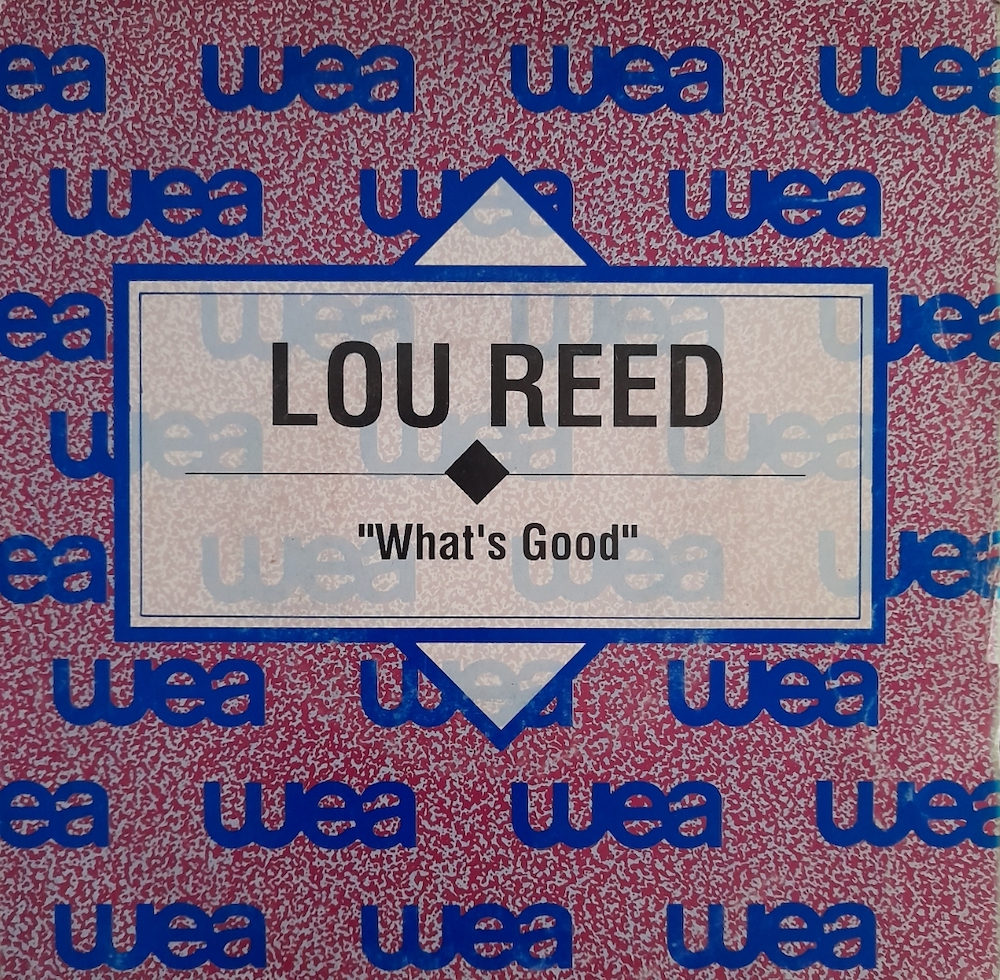
New York was a landmark moment in Reed's solo career. It capitalized on the goodwill that people had toward Reed, and it generated more of that goodwill. Three years later, Reed pulled off a repeat, going back to #1 on that Modern Rock chart even as alternative rock was in the very early days of its '90s commercial takeover. This time, Reed went all the way to the top with a random soundtrack-album throwaway that he didn't even give much of a push until he re-recorded the thing. "What's Good" is not one of Reed's better-remembered tracks, and it didn't exactly leave a massive crater in the popular imagination. Pretty good song, though.
Wim Wenders' contemplative arthouse sci-fi flick Until The End Of The World might've been a ponderous flop, but the release of its soundtrack album was an event. Contacting all his favorite artists and asking them to imagine the music that they'd make eight years into the future, Wenders assembled a dream lineup of hipster musicians. The album had songs from some of the biggest bands ever to be given the "alternative" tag -- U2, R.E.M., Depeche Mode -- and it also had a few tracks that became modern-rock radio hits. Funny thing about that: In recruiting all those stars and legends to help him envision the future, Wenders wound up capturing many of those artists in their final moments of relevance.
Talking Heads' "Sax And Violins," the first single from the Until The End Of The World soundtrack, was a Modern Rock chart-topper, and it was the last thing that the band released before they officially announced their breakup. The soundtrack also featured the final on-record moments from a couple of its other contributors. Krautrock originators Can had officially broken up back in 1979, but the band got back together to record "Last Night Sleep" for Wenders, and then they never released anything again. Crime And The City Solution, the Australian post-punk band who'd relocated to Berlin and appeared in Wenders' Wings Of Desire, broke up before the movie came out, and their soundtrack song "The Adversary" was their last recording. So much for the future.
Lou Reed, as it happened, was in a backward-looking mood when he got the assignment from Wim Wenders. Reed was just shy of his 50th birthday, and he'd lived a life of hard-drug abuse, surrounded by others living lives of hard-drug abuse. His friends kept dying. In 1990, Reed and his old Velvet Underground partner John Cale managed to bury years of animosity to record the collaborative album Songs For Drella, dedicated to the Velvets' late mentor Andy Warhol. The album didn't sell anywhere near as well as New York, but it wasn't really supposed to. One song, "Nobody But You," made the Modern Rock chart, where it peaked at #13.
In the wake of Songs For Drella, all four original Velvet Underground members reunited for a quick one-song performance at a Paris museum. A bigger Velvet Underground reunion came later. In the meantime, Reed became close with Doc Pomus, the songwriter who was partly responsible for classics like the Drifters' "Save The Last Dance For Me." Pomus was dying of lung cancer, and Reed came to visit him in the hospital every day, bringing his in-progress songs. One of those songs was "What's Good," Reed's contribution to the Until The End Of The World soundtrack.
Much like David Byrne, Reed did not seem to take Wim Wenders' prompt for the Until The End Of The World soundtrack too seriously. Wenders wanted his contributors to imagine the kinds of songs that they might record in 1999. Reed must've figured that he'd keep recording the same kinds of songs, more or less, that he'd always recorded. With notable exceptions, this was pretty accurate. "What's Good" opens with a reverb-drenched quasi-metal riff, but it quickly eases into the same kind of talk-singing post-blues vamp that was always Reed's preferred mode of expression. One of the echoing guitars even serves the same basic function that John Cale's viola did in the Velvet Underground days. This is not a complaint. If you love Lou Reed, it's a pleasure to hear him lock into this kind of groove.
On "What's Good," Reed essentially recites a series of absurdities -- "mayonnaise soda," "Sanskrit read to a pony," "a lion that barks" -- and says that these things are like life without you. There are a couple of digressions -- "What good's a computerized nose?" -- that suggest Reed was at least halfway considering what Wim Wenders wanted. Still, the song is more of a goofy lyrical exercise than anything. I don't know what form "What's Good" was in when Reed showed it to Doc Pomus, but Pomus died in March 1991, about nine months before the song came out. In its final form, "What's Good" could masquerade as a breakup song. Given its context, though, it's much more likely to be about missing someone who's died.
I really like the idea of Lou Reed attempting to eulogize Doc Pomus, a man who co-wrote tons of beautifully simple teenage-emotion songs, though the medium of lyrical silliness. Reed grew up loving doo-wop, and he wrote a few absurd dance-craze singles of his own before his Velvet Underground days. "What's Good" is minor Lou Reed. Last year, Will Hermes published a great, long Reed biography called The King Of New York, and "What's Good" barely even merits a mention in that. Still, the song comes off as a beat poet attempting to write a circa-1960 pop song, and there's something charming about that.
Reed recorded "What's Good" with some of the members of his New York backing band. He co-produced it with his guitarist Mike Rathke. (At the time, Reed was married to Sylvia Morales, whose sister was Rathke's wife.) Rathke played guitar on the song. Fred Wasserman, who'd already backed up people like Van Morrison and Elvis Costello, played bass. Instead of New York drummer and co-producer Fred Maher, Reed brought in Tom Waits sideman Michael Blair. Rathke and engineer Roger Moutenot, who's since produced a bunch of Yo La Tengo records, sang backup. The soundtrack version of "What's Good" sounds a bit like a demo, but that immediacy works for it. It's a good song. I like it.
I truly don't remember ever hearing "What's Good" on the radio. Maybe the playlists of modern rock stations still varied from region to region back before the Telecommunications Act made it possible for one company to own way too many radio stations, or maybe the station programmers were just lying to Billboard, acting like they were playing Lou Reed more often than they were. Maybe I did hear "What's Good" and just don't remember it. In any case, "What's Good" wasn't a hit anywhere other than modern rock radio. Still, the song got three weeks at #1 when a bunch of culturally consequential stuff was surging. Lou Reed's name still carried weight.
In 1992, Reed released his proper New York follow-up Magic And Loss, a death-haunted album dedicated to the memories of Doc Pomus and a woman identified only as Rita. Some people theorized that it was the Rotten Rita character from "Walk On The Wild Side," but it's more likely to be Rachel Humphreys, the transgender woman who was Reed's partner for a while in the '70s and who served as the inspiration for much of his Coney Island Baby album. Humphreys died of AIDS in 1990 while she was serving time for robbery. She was 37. Reed never talked about their relationship after they broke up, but you can imagine that her passing would've still left him haunted. Reed put lots of thoughts about death into Magic And Loss, and he opened the album with a different version of "What's Good." He made a video for that version, too, but I don't like that version of the song as much as the soundtrack one. (I'm pretty sure the soundtrack version is the one that went to #1, but since Magic And Loss came out in January 1992, I guess it could've been either one.)
Magic And Loss is a strong, absorbing album, and critics were into it. (On the 1992 Pazz & Jop poll, Magic And Loss came in at #16, behind the Jayhawks' Hollywood Town Hall but ahead of Bruce Springsteen's Lucky Town.) But the album wasn't a big seller, and Reed never made the Modern Rock chart again after "What's Good." In 1993, the Velvet Underground reunion finally happened. The band had never played outside the US in their first incarnation, so they booked a European run, which included a set at Glastonbury and a few dates opening for U2 on the Zoo TV tour. But before the reunion could start its planned American leg, which was going to include an MTV Unplugged taping, Reed and John Cale got all pissed off at each other again. Once again, the Velvet Underground broke up. They never properly recorded "Coyote," a new song that Reed and Cale wrote together, but it did come out on the Live MCMXCIII LP.
Velvet Underground member Sterling Morrison died of cancer in 1995. Later that year, the Velvets were inducted into the Rock And Roll Hall Of Fame, and the surviving members got back together for one last performance at their induction ceremony. By that time, Lou Reed was divorced from Sylvia Morales, and he was in a long-term relationship with fellow avant-garde explorer Laurie Anderson. (Anderson's only Modern Rock hit, 1989's "Babydoll," peaked at #7. It's a 5.) The two married in 2008, and they stayed together for the rest of Reed's life.
From the '90s onward, Lou Reed lived as an aging, cantankerous rock legend. His new music wasn't necessary going to dominate the conversation, but he could make whatever way-out experiments he wanted. In the meantime, his older music was continuously rediscovered and put into new contexts. In 1996, Reed's 1972 classic "Perfect Day" soundtracked a weirdly beautiful heroin-overdose scene in Trainspotting. A year later, Reed sang on an all-star benefit version of "Perfect Day" that also featured people like Bono, David Bowie, and Elton John, and it went to #1 in the UK.
Reed's late-in-life projects were mostly pretty batshit, like his 2003 Edgar Allen Poe concept album or his 2007 ambient LP inspired by all the tai chi that he was doing. (He got really into tai chi.) He made occasional guest appearances, including on tracks from the Killers and Gorillaz, a couple of groups who will eventually appear in this column. Reed's final album, 2011's Lulu, was a full-length collaboration with Metallica, one of the biggest bands in the world. (Metallica's highest-charting Modern Rock single, 2008's "The Day That Never Comes," peaked at #5. It's a 7.) People treated Lulu as an instant-punchline atrocity, but I'm glad it exists, even if I'm never tempted to go back and listen again.
I saw Reed live once, when I had to cover the Chicago Lollapalooza in 2009. I had a shit time at that festival, and Reed's late-afternoon set on one of the big stages went long. For the second half of his set, I was really annoyed. As in: "This guy needs to finish up already; I'm trying to see Band Of Horses right now." Consider this to be a valuable reminder: I'm a dumb idiot, and you shouldn't take anything that I write too seriously.
Lou Reed died in 2013. He'd been suffering from liver cancer, and he'd already had a transplant, but liver disease still killed him. His death came as a major shock, but given all the things that he did to his body over the decades, it's pretty impressive that he made it to 71. Reed became a two-time Rock And Roll Hall Of Famer when he was posthumously inducted as a solo artist in 2015. More than a decade after his death, people are still building entire careers off different sounds that Reed helped invent. We're lucky that we had him. "What's Good" is not a big part of Lou Reed's legacy, but it'll do.
GRADE: 7/10
BONUS BEATS: Broken Social Scene's Kevin Drew posted a "What's Good" cover online after Lou Reed's passing, but then he took down the YouTube video, and I don't see it anywhere else on the internet. Instead, here's Gotye, an artist who will theoretically appear in this column one day, sampling "What's Good" at the end of his 2006 track "Night Drive":
THE NUMBER TWOS: Social Distortion, the early-'80s Orange County hardcore pioneers who gradually evolved into pomaded, raw-throated heartland-rock bellowers, never reached #1 on the Modern Rock charts, but they got close with "Bad Luck," a heartfelt singalong with some beautifully stupid lyrics. That song peaked at #2 behind "What's Good." It's an 8.
THE 10S: Nirvana's snaky, sinister, conflicted Killing Joke bite "Come As You Are" peaked at #3 behind "What's Good," and I swear it's a 10.
U2's "Until The End Of The World," a psychedelic throb that sounds a bit like the band's take on Jane's Addiction, appeared on that Wim Wenders soundtrack that I keep mentioning, and it peaked at #4 behind "What's Good." Regardless of how it happened, it's pretty impressive that Lou Reed was able to box out prime Nirvana and U2, at least on this one chart. You miss too much these days if you stop to think, but I think "Until The End Of The World" is a 10.