
- Rough Trade
- 2025
It keeps happening. A beloved band reunites after a long absence and records another album. Or maybe a beloved band never breaks up, and they just release their first album in a very long time. You want to hear it, and you're excited, but you hope it doesn't tarnish their legacy. Somewhere in the back of your mind, you can't let go of the idea that every band reunion is a cynical financial decision, or that every comeback album is an unabashed wallow in the shallow marshes of nostalgia. And then the band releases something that forces you to shut the fuck up and appreciate what they've done. Maybe their latest album isn't the best thing they've ever made, but it can stand tall alongside their classics. They can hold their heads up high, and you get a new entry in a discography that you once considered to be a closed book. Everybody wins.
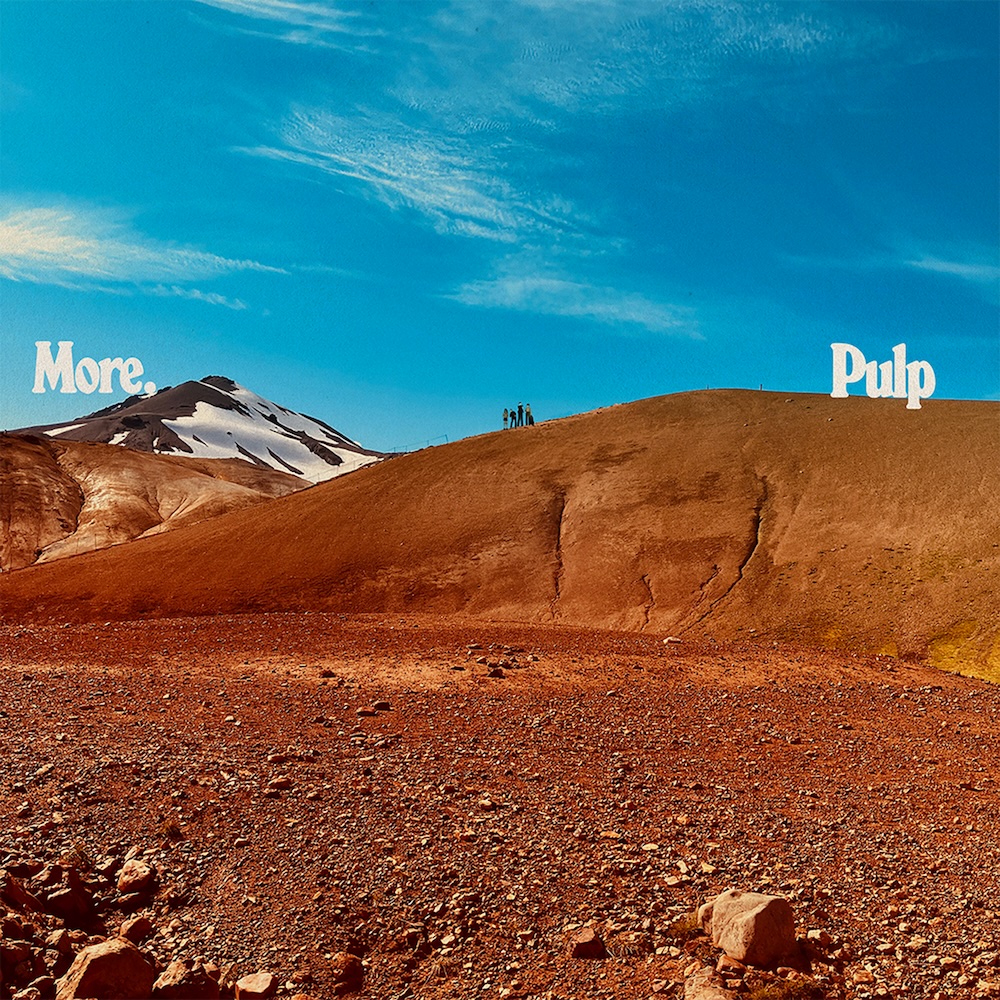
Honestly, it's amazing how often this has happened. It happened with My Bloody Valentine and Slowdive and plenty of other lesser shoegaze lights. Hum and Celtic Frost pulled it off when key members of both bands were near the ends of their lives. A Tribe Called Quest did it after a key member had already passed away. Dinosaur Jr. did it, and then they kept doing it over and over. Sleep. Carcass. American Football. Mission Of Burma. Little Brother. The Cure just did it a few months ago. In the world of Britpop, big dogs like Blur and Suede came back strong. Even with all those past precedents, the return of Pulp feels impossible. Pulp's legacy was secure, and they didn't have to make anything more, but they did. They made More.
The grand overarching story of Pulp already had plenty of plot twists before this one. It's been 47 years since a baby 15-year-old Jarvis Cocker started some version of Pulp with his school friends in the dank northern English city of Sheffield. For many years, they were a struggling, ambitious indie band who disdained peers like the Smiths but just couldn't find a wider audience. But then, after three unheard albums, they made the major label leap and released 1994's His 'N' Hers, the breakthrough where they crystallized everything they'd been trying to do. And then: "Common People," Different Class, the instantly legendary Glastonbury where they filled in for incapacitated headliners the Stone Roses, the Mercury Prize, the critical plaudits, the four top 10 hits, the Michael Jackson dust-up at the Brits, the tabloid infamy, the drugs and sex and expensive clothes. This Is Hardcore, the disgusted post-fame album about dark nights of the soul, might be even better than the masterpiece that made them famous in the first place. We Love Life, the 2001 commercial disappointment that the band just barely managed to release before dissolving, is better than most bands' best.
In the popular imagination, Pulp's magic largely came down to Jarvis Cocker, the band's gawky, erudite, freakishly charismatic frontman. That perception didn't do anything great for the group's long-term health; it's one of the reasons that guitarist and violinist Russell Senior left when Pulp were at their peak. But Pulp were bigger than just Jarvis Cocker. Cocker has made a lot of great music since Pulp ended, but he never fully recaptured the playfully devastating grandeur of his old band, and he didn't seem that interested in trying. The other Pulp members moved on to other chapters of their lives, some of which took place entirely outside the realm of music. Pulp's 2011 victory lap reunion tour was a way to close the books on the band and leave everyone feeling good about what happened. That reunion wasn't about new music, and it only yielded one single -- "After You," a James Murphy-produced recording of a track that Pulp first laid down before breaking up in the first place. That's a great song, but it didn't start a new chapter for the band. Pulp's reunion didn't lead to new music, and that was fine. They had done enough.
But now, here we are. Pulp got together again, right around the time that bassist Steve Mackey passed away. Last year, they started debuting new songs at shows, and the videos of those new songs suggested that something truly special was happening. A new album was rumored, and then those rumors were confirmed with the release of "Spike Island," a song that feels even more like a full-strength Pulp song than even "After You" ever did. The strings sigh. The guitars sashay. The keyboards shine like distant stars. The rhythm section locks into the casual disco strut that none of Pulp's peers could ever approach. Jarvis Cocker sleepily murmurs about temptation and confusion and mass exultation, and then his voice soars into the sort of gasping, wailing hands-to-the-sky chorus that could've levitated the crowd at the titular festival -- the same one that inspired him to write "Sorted For E's And Whizz" 30 years ago. Somewhere in there, Cocker reaches an epiphany: "I was born to perform! It's a calling! I exist to do this: shouting and pointing!" It's knowingly silly and self-deprecating, like so many of Cocker's other immortal lines. But it gives me goosebumps, partly because I can hear that Cocker has them, too.
"Spike Island" is a truly great Pulp song, and it justifies the existence of More all by itself. It's one of many amazing moments on More, which is dedicated to Steve Mackey's memory and which immediately joins the pantheon of classic reunion albums. I should not be surprised, but I cannot get over the fact that More exists. It's been a quarter century since the last Pulp album, and that record's producer was literally Scott Walker -- a move that put Pulp into direct conversation with their '60s and '70s idols even though Cocker dissed Walker's 1970 album 'Til The Band Comes In in his "Bad Cover Version" lyrics. Walker isn't with us anymore. This time around, Pulp have gone to work with James Ford, whose name doesn't carry the same mythic weight but who knows where the strings should come in and who understands the breathy, hiccuping majesty of Cocker's voice.
Ford has done many wonderful things in his career, but he's most commonly associated with the Arctic Monkeys, another great Sheffield band that has lived out an entire massive career in the time since Pulp released We Love Life. When the Arctic Monkeys first arrived, people would ask Alex Turner about Pulp's influence on him. But Turner was nine years old when Pulp were at their peak, and he told reporters that he was "more into climbing trees an' that." That's how long Pulp have gone between albums, and they make it sound effortless! In interviews, Pulp say that they recorded More almost on a whim and that they finished it in three weeks -- faster than any of the band's past records. They had no contract, financed everything themselves, and finished nearly one song per day in the studio. In addition to the four remaining core Pulp members, they got help from past associates -- Richard Hawley, Jason Buckle, members of Cocker's Jarv Is... band. Brian Eno and his family join the chorus of backup singers on "The Hymn Of The North," a song first written for a play. Strings abound. The production is vast, as it should be. Nobody ever did luxurious regret or kitchen-sink flirtiness quite like Pulp, and their lush languor is fully restored here.
Middle age looks good on Pulp. They were always older than their peers. Jarvis Cocker was well into his thirties by the time he got famous, and Pulp contemplated oblivion on songs like "Help The Aged" when they were still on top of the world. On More, they're as coyly romantic as ever, but now the romance is all about appreciating what they already have, not the missed opportunities of their youth. The devastating disco-flavored single "Got To Have Love" has a message as simple as its title, the crushing and liberating truth that love itself is the only thing that matters. Over a pounding, urgent beat, Cocker testifies, "Without love, you’re just making a fool of yourself! Without love, you’re just jerking off inside someone else!" On the next track, the soul-spangled "Background Noise," Cocker warns of how quickly you can lose that love: "Over years, love turns into background noise/ Like this ringing in my ears/ Like the buzzing of a fridge/ You only notice when it disappears." He sounds like he knows what he's talking about.
Sex and money and envy and desperation all come up on More, as they have on Pulp records past. As on Pulp records past, Jarvis Cocker delights in the embarrassing, grimy physical reality of sex itself. "Tina" is one of Cocker's great songs of obsession, like the older ones about women named Deborah and Sylvia. This time, the titular Tina is a generic name for a recurring fantasy, for all the women he's ever been too scared to approach. He can't even visualize his fantasies without deglamorizing them: "Screwing in a charity shop on top of black bin bags full of donations, the smell of digestive biscuits in the air." Over the forbidding swell of "Slow Jam," Cocker tosses off a pickup line for the ages: "Here comes the Holy Trinity/ Behold the crown of all creation/ Come on, let’s have a threesome, baby/ You, me, and my imagination." On "Farmers Market," Cocker imagines the moment that he met his wife -- "backlit by the sunset, or maybe the fires marking the end of the world" -- and he almost blows it, saying hello and continuing through the parking lot before he catches himself and stops: "Hold on! Are these groceries really that important? More important than getting your number? Or finding out who you actually are?" It's one of the most romantic things he's ever written.
Jarvis Cocker's gift for wordplay is undiminished, and he gets off tons of clever bars on More -- rhyming "Hackney" with "acne," suggesting a slow jam rather than slow death. But cleverness is never the end goal for Cocker. It's a way of getting at bigger ideas. He presents himself as someone who's still figuring things out. He opens "Grown Ups," a hip-shaking staccato reverie about his youth, with a memory of a past epiphany: "The moon went behind a petro-chemical plant/ I had a feeling I didn’t understand." He's talking about the urge to grow up, to join the new generation and the pub conversation. But when a friend tells him that he moved near the motorway because it's good for commuting, Cocker laughs in his face because he thinks that he's joking. The song's real epiphany isn't an epiphany at all. It's the hard-earned understanding that you don't understand a thing: "I know it’s all about the journey, not the final destination/ But what if you get travel sick before you’ve even left the station?"
There's a pleasing circularity to More. Pulp refer back to past glories, keeping the new songs in conversation with the old ones: "Don’t remember the first time, or the last time, or the way we got from here to there." Pulp ended their last album with a glorious song called "Sunset," and they end More with "A Sunset," a song that might be just as glorious. This one is about the inevitable moment that someone finds a way to charge money for the beautiful thing that we all get to witness at the end of every single day: "I bought myself a ticket to the happening of the year/ The sky lit up with colors/ The crowd let out a cheer."
Cocker's bandmates understand how to musically underline all of his points, to answer back with a softly contemplative guitar figure or to lock into a chintzy but determined dance groove. As a song like "Hymn Of The North" spirals heavenward, Cocker's bandmates and collaborators give his voice a resonance that it hasn't had since that last Pulp album. They understand who they are and what they do. On More, I hear Pulp embracing their own greatness. After all these years, they've tapped right back into all the beautiful, ineffable things about Pulp -- the sneaky insights, the charged-up banter, the lux atmosphere, the anthemic scope, the emotional weight that comes through even when they try to disguise it with cleverness. Once again, a legendary band has returned to us with another miracle. Maybe we shouldn't be surprised, but miracles should always feel like miracles.
More is out 6/6 on Rough Trade.
We rely on reader subscriptions to deliver articles like the one you're reading. Become a member and help support independent media!